An Example of Why Verbs Make a Difference

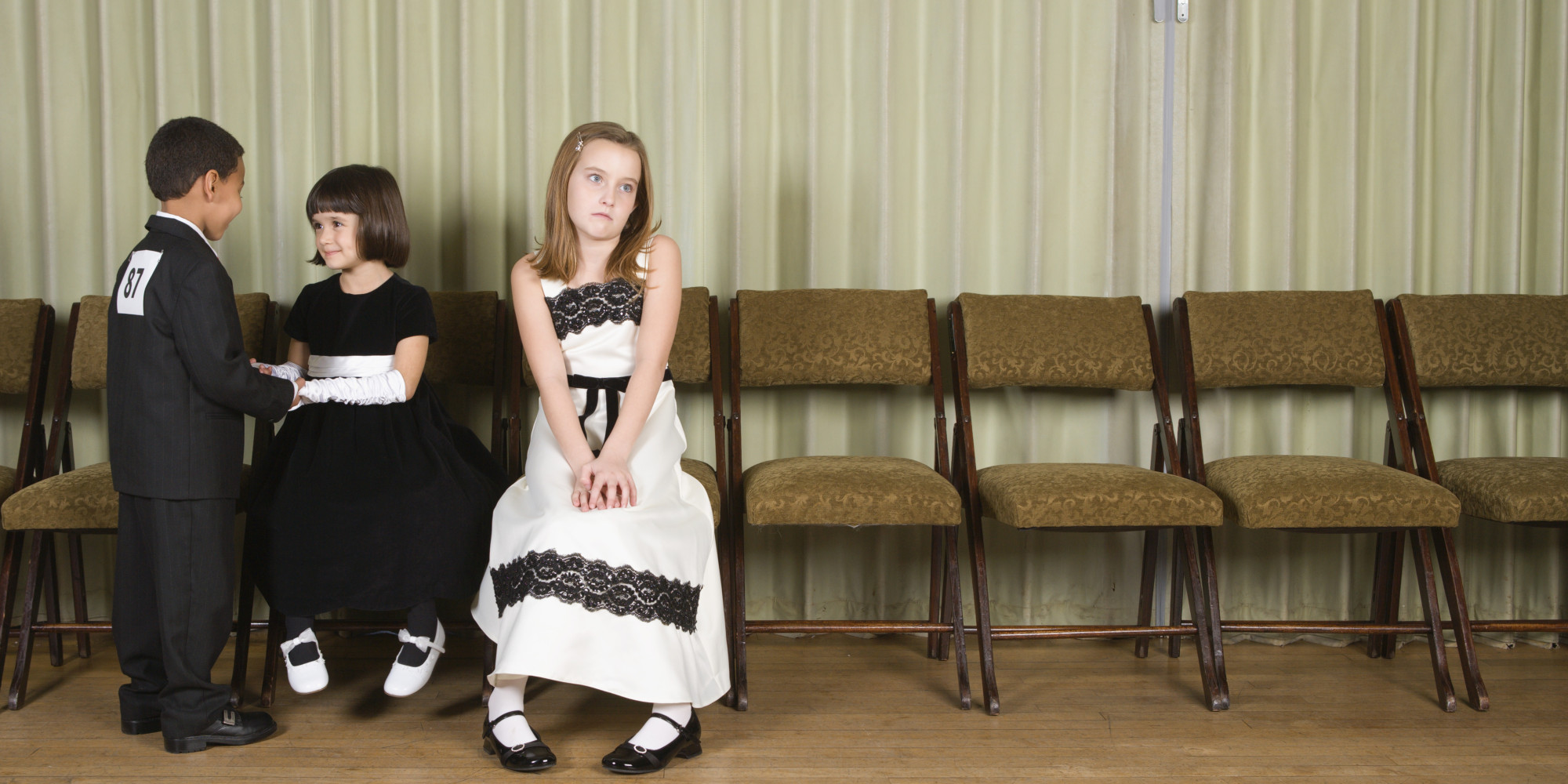
wallflowerOne of my students is rehearsing a play that requires her character to be at a dance.  I happened to see a few minutes of rehearsal, and noticed that she kept looking to the floor, which is a choice I try to encourage actors to not use to excess.  Audiences like to see your eyes.

She explained that she was looking at the floor because she was waiting for someone to ask her to dance.  In other words, she had chosen to have her character be bashful and demure, and so refusing to make eye contact with any men, to put any pressure on them to ask her to dance, or to invite them to do so with her eyes seemed to be the way to go.

Except that it doesn’t work, and not only because the audience can’t see her eyes.

It doesn’t work, because bashful and demure are adjectives.

But wait! I hear you say.  She said she is waiting for someone to ask her to dance!  “Wait” is a verb!

It is.  But it’s a pretty dull verb to watch on stage.  As actors, you need to choose active verbs, and verbs that have some strong needs driving them.  There isn’t a lot of strong need behind the verb “to wait”.

The direction the actress is heading is fine.  Let’s see if we can translate what her instinct is telling her into something that is more active that will create more interest in the scene.

I think back to my junior high dances, and what it was like to wait for some boy to work up the courage to ask me to dance.  None of the girls wanted to be categorized as wallflowers; we all wanted to be dancing all night long, but this was back when it wouldn’t have occurred to us to ask a boy to dance.  So we waited.  But “waiting” wasn’t actually what we were doing.  We were praying someone would take us away from the wall, to prove to everyone else that we were desirable.  And to prove to ourselves that we were.

There was a lot of emotional energy coursing through us, and that’s a strong thing to bring on stage.  A desperate need to be wanted.  So instead of looking at the ground shyly (an adverb), she can be looking around for someone to ask her to dance.  Maybe smiling at someone who glances her way, issuing a shy invitation.  Or darting her eyes away when she’s afraid a handsome man noticed her staring at him, sure that he couldn’t be interested in her.

Let’s take it a little further.  What if the character doesn’t want just a dance – she wants a boyfriend?  She clearly doesn’t have one, or he’d be dancing with her.  So she’s standing at the wall, desperate to be taken away from it so that no one feels sorry for her, and desperate to have a boyfriend who will be a regular Saturday night date and keep her out of these situations.  Someone she can bring to parties and family dinners.

So now she’s scanning the crowd, not just looking for someone who might be interested in her, but also looking for someone she could care for.  Now she has a reason to be a bit braver in smiling at the men who really catch her eye, and looking away when the men who she doesn’t want to dance with look her way.

Let’s take it even a little bit further.  We want to ramp up what’s at stake for her as high as possible.  Never settle for something short of the peak.  Always push it up the mountain as high as you can.

What if she isn’t just looking for a boyfriend, but she’s looking for a husband?  Not just any husband.  Her dream man.  The man she will adore until the day she dies.  The man whose children she wants to bear.

What if our young lady is on a quest for nothing less than True Love?

Love is a powerful choice.  If you can, always, ALWAYS choose it.

What if our young lady has spent too many years alone, and can’t bear it anymore?  She’s tired of waiting for the right man; she wants him to enter her life NOW.  Maybe she needs something good to happen in her life, and she thinks the right man will bring about that change.  Maybe she is desperate to have a child, but isn’t willing to settle for a child by just any man.  He has to be the right one.

Suddenly, there’s a lot at stake for the young lady at the dance.  Suddenly she’s no longer just waiting for something to happen TO her, she is taking action herself.  She has come to the dance for the express purpose of finding her Knight in Shining Armor.  Everything is on the line for her at this dance, and so whatever she does, and whatever she says, is going to be driven by this need to find True Love.

To find True Love is the objective; the strategy is to meet him at the dance; the tactics may be to pray, to flirt, to invite, to smile, to encourage, to identify potential lovers, to avoid men she knows are wrong for her.  Etc.

wallflower 2Can you see how much stronger a choice this is than the choice to look at the ground because that’s what women might do in this situation?  Looking at the ground is an external action that is grounded in nothing specific.  Bashful and demure are general terms.  Until you can get at why this particular character is bashful and demure, you can’t do anything with it, and looking at the ground is going to appear to the audience as what it is – a superficial choice.

But take the motivation of wanting to find True Love and add to it an obstacle that is keeping her from finding it – her own insecurity, her own shyness and awkwardness in social situations, her own conviction that no man can love her that deeply because she doesn’t deserve that sort of love – and now you REALLY have something to work with.  Now, you can toggle throughout the scene between desperately wanting love and fearing you’ll never find it because you aren’t good enough.  Maybe you cast your eyes to the floor now and then, maybe you don’t.  But whatever you do, the audience will feel the power of both your need and fear.

THAT’S good acting.
Actor’s Etiquette: Make Your Entrances On Time

Etiquette-Design-5The last community theater production I was in, no less than four actors completely missed their cues to come on stage during Tech Week.

By completely, I mean everything came to a halt while they were located.  In one instance, I was about to go off stage and drag them on after improvising for about two minutes when they finally showed up.  This was only five minutes into the play.  In the other two cases, there was nothing to be done but stop the play while the actors, who were deep in the dressing rooms, were found.

Thankfully, we had no such incidents during the run, although we did have one actor come on stage a page early.  This called for some quick thinking and readjustment on our parts after the actor exited, so we could pick up the dialogue we had missed due to her early entrance and then jump forward to the scene after her exit.  Those of us onstage were pulled out of the moment a bit, but the audience remained ignorant of the problem.

I’m not sure that I’ve ever been in a play when this happened before.  Oh, sometimes an actor spaces out and comes running on stage a second or two late, but never more than that.  These occurrences, however, were pretty egregious, and two of them happened with experienced actors who should have known better.

Pay attention.  Make your entrances on time.  Don’t leave your fellow actors hanging on stage.

Harnessing Your Subconscious: Using Tools to Build Layers

LayersWhen you use a tool, you are putting down a layer of your character.  Tools need not be things you carry into your performance.  They usually aren’t.  I wouldn’t, for instance, suggest using the Open Door Reading tool in front of an audience.  But that doesn’t mean it isn’t a very useful way of exploring the character at certain points in rehearsals.  (I’ll talk about when to use these tools another time.)

This is a very different way of looking at rehearsals than you may be accustomed to.  Many actors I encounter in community theater see rehearsals as a means of reaching a finished performance.  Nailing down choices as soon as possible is the order of the day.

That’s natural.  We want to give a good performance, and we’d like to believe that it’s like putting together a barbecue grill.  You take the parts out of the box and lay them out, so you can be sure you have them all.  You follow the instructions, step by step.  And voilà, you have a barbecue grill that looks like the one in the store!

Acting isn’t like that.  You aren’t painting by numbers here.  You’re creating a characterization that is unique to you.  And every time you do a new play, you start from scratch.  You may develop skills to do this better and faster over time, but even when you become a technically proficient actor, you are still starting from scratch with a new play:  a character you know nothing about in a circumstance which is entirely new to you.

Acting is always a learning process.

Tools are ways to explore the character in all its diversity.  If used properly, they don’t require you to think excessively.  As with any new activity, you have to employ your conscious brain a bit more as you learn the technique, but the better you get at the technique, the less you’ll need to think about it. So please don’t look at the tools as handcuffs that will bind your creativity.  They actually free your creativity.

You don’t have to use all the tools I give you.  I suggest you try them with a certain amount of conscientiousness, simply so that you can understand what they are addressing and decide for yourself if they have anything to offer you.  You may not use them consistently over the course of your acting life; I don’t.  And you may find ways to achieve what they give you that are more effective for you as an individual.  However, doing them as I explain them and repeating them until you’re sure you understand them is a good way to understand the issues involved.

As Davina noted in class, it’s hard to speed up a scene when you’re still focusing on playing your verbs.  It’s hard to focus on playing your verbs when you are trying to receive emotional content from your partner.  It’s hard to do any of them when you are trying to remember your lines.

That’s okay.  That’s how it works.  Remember, your conscious brain doesn’t multi-task well enough to handle this, and in any case, trying to do them all at once means you don’t do any of them particularly well – at this early stage in rehearsals.  And by early stage, I’m talking about the first half of the rehearsal period.  Maybe even the first two-thirds.

“But I know this line should be said this way!”  No, you don’t.  You think you do.  But you’re forcing something on it.  Even if it IS the right choice, you shouldn’t force it.

If you are a very instinctive actor, as I am, it is easy to “know” early on what is right for your character, but the truth is you are only in the ballpark, not on base yet.  It is also true that you will not be correct 100% of the time.  Even if you have fabulous instincts, a good 10-20% of the time there is a much better choice out there waiting for you to discover it.  But if you stick with your “but I know this is right!” ego attitude, you’ll never discover it.

You can always come back to your “right” choice.  But if you’ve explored your other options, you’ll be sure it really is “right”!

To read Layering a Character, go here.

Harnessing Your Subconscious: Layering a Character

Okay, back to the acting tools.  At long last.

The recipe for this yummy lasagne can be found at http://www.simplyrecipes.com/recipes/lasagna/

The tools I am introducing you to are simply ways to input good, focused, intentional data into the computer that is your subconscious.  Practical ways of using the open/closed modes of creativity.  Your subconscious, brilliant synthesizer that it is, discards what doesn’t work and keeps what does.  You don’t have to tell it what to keep most of the time, not that it would really understand anyway.  It just knows what works in context.

Give it plenty of data, and it will know what works in the puzzle that is your character and what doesn’t.

But remember, it does understand frequency.  It equates frequency with desire, and it considers your desires to be more important than what works.  So if you do a scene the same way every time, it will accept your choice.  It will try to compensate as much as it can for any choices that don’t work, but it has limited abilities in this regard, just as it does with your golf swing.  Make a lousy golf swing, and your subconscious can’t make it perfect.  It will just help to give you better results than you would have gotten if your subconscious hadn’t interfered on your behalf.

So how do you run a scene over and over in rehearsals without encountering the frequency problem?

Simple.  You keep coming at the scene from different angles.  You intentionally avoid doing it the same way every time during the first half of the rehearsal period.

If you can successfully “stay in the moment” – which, as I’ve said elsewhere, is much harder to do than you probably imagine – then by definition, what you’re doing will always be different.  But “staying in the moment” in the first rehearsals isn’t enough.  Later, yes.  But early on?  No.

A really interesting, creative, complex characterization is composed of “layers”.  When we talk about people being complicated, we liken them to onions.  Every time you peel away another layer, you find some different and unexpected aspect to their character underneath.

lasagne 4As an actor, you build a character in reverse, by putting down layer after layer.  You’re taking an unfinished piece of furniture and doing some complex faux finish work.  You sand it, you prime it, you sand again, you paint, you wipe, you paint again, you distress it, etc.  But you put down those layers one at a time.  You examine different aspects of your character’s relationships, needs, worries, desires, etc., individually – with your conscious brain (aided by your subconscious) – but you let your subconscious put the layers together.

When you are examining the components of a given layer, you are free to ignore the other layers.  When you are able to do this, you are giving high quality, focused attention to whatever you’re working on.  Whatever you’re ignoring this time, you’ll pay attention to some other time!

To read Using Tools to Build Layers, go here.


Actor’s Etiquette: I Haven’t Heard My Line Yet

il_570xN.227565305Many actors are a bit casual at memorizing the actual lines in the script.  This is not only disrespectful to the typically absent playwright; it also usually hurts the play.  If you’re one of these actors, there is little I can say to convince you to handle the matter otherwise, and I’m not going to try.

But when it comes to another actor’s cue, be sure to give the cue line verbatim.  Tiny little things can throw an actor off, and if you start messing with your word choice when delivering a cue, you can, at best, take an actor out of the moment, and it will take him a half page to fully integrate himself with the play again.  At worst, you will cause him to forget his lines.  He is memorizing not only his own lines, but his cues, and he isn’t memorizing what you say in rehearsal, but what is in the script.  (Probably in the vain hope that you will someday stick your nose in it and figure out that you’re saying the line wrong.)

So be courteous, and deliver the cue lines as written.  Every time.

How the Open/Closed Modes Work for Actors

John Cleese talks about open and closed modes, which I’ve noted is what I’m talking about when I say “trial and error.”  (I haven’t been able to find the source for this terminology, if it was originated by someone other than Cleese.)  The modes are very useful in terms of understanding how trial and error works, especially for an actor.

While you don’t want to start rehearsals by saying, “I should do this here!”, it is perfectly okay to say, “Let me try doing this here.”  That’s an open mode decision.  You’re open to possibilities when you say “try.”  Failure or success is not the issue.  We’re just trying something.

Classical_Brainstorming_and_Double_BrainstormingOpen mode is about figuring out what to try.  Brainstorming.  Think of ad execs, sitting in a conference room, throwing around every idea they can think of, many of them stupid, while trying to get pencils to stick in the ceiling tiles.  Saturday Night Live writers toying with skit ideas until they find the ones with the most potential for this week’s show.

That’s what the cast and director should be doing at early rehearsals.  (You can also do some brainstorming on your own time, and bring your ideas of things to try into rehearsals.)

In closed mode, you take the idea you came up with in open mode and take them for a test drive.  (If you’re an SNL writer, this is when you sit down and turn the skit idea into a script.)  You give it the old college try, fully committing to that choice when you run the scene.  Then you go back to open mode, and say, “In what way did that work?  In what way did it not succeed?  What else can I try?”

Note that you haven’t said, “Yeah, I think that works.  Next?”  Instead, you’ve said, “Okay, I know what impact that has.  What else can I try?”  Now you go back to closed mode with the “what else”.  You try as many alternatives as you can think of, and each time you’ve completed the scene, or beat, or whatever, you go back to open mode and evaluate it for pros and cons.

You may not be able to try all the ideas you’ve got for a scene in a single rehearsal.  You have to try out your ideas within the context of how your director wants to use the time.  If you are very confused about your options and want to go through them all in one night, tell your director.  He may be able to accommodate you.  If not, you just try them out as you have opportunities to run the scene.  You’ve got plenty of time.

Once you’ve tried out all the ideas you can think of, you have good information on which to base a decision.  You can choose one of the alternatives, or you can say, “Well, this is the best one I’ve got so far, but it’s not as good as I’d like.  Maybe I’ll find something better down the road.  I don’t really have to choose yet, so I’m going to just put this on the back burner for a while and see if my subconscious can do anything with it.”

Even if you do choose one of your alternatives, keep an open mind.  Something better might pop up, even if you aren’t actively looking for it.  Just be open to it in case it does come knocking.

There is another sort of “openness” you need to maintain even in closed mode, and that is the openness related to staying in the moment.  It’s an ability to recognize when something new and unexpected has arrived, and make room for it and respond to it.  That particular gate needs to always be left open.

Can’t I Make Any Decisions?

DECISIONS-DECISIONS1Of course you can, and you will.  There are three different ways decisions get made:

Sometimes conscious choices that have to be made.  This doesn’t mean that you can’t change them down the road if you realize there is a better alternative.  Blocking choices are an obvious example.  We’ve got to get you off stage somehow, so we explore the options we think are available and choose from among them.  We may revise it later, but we’ve got some place to start.

When it comes to comedic action, I do a lot of exploring in rehearsal and choose the funniest alternatives.  I once directed a play that had a young woman sneaking through the window of her own apartment in order to spy on her roommate.  We worked to find all the ways we could to make it difficult for her to do so and comic ways for her to overcome the difficulties.  The exploring happened over a number of rehearsals, and with each rehearsal, the bit got longer and deeper and funnier.  Explore, then choose.

These decisions often have to do with storytelling.

This is one of the times when the director is invaluable as a third eye:  Yes, that works.  No, that is too small for the audience to be able to read clearly.  What if we do this instead?  Or even better, what if we try . . .?  Yes, that’s good.  I like that.

It’s intentional, conscious decision-making, but it comes out of trying alternatives.  It’s for the actor to say, Yes, this is emotionally true and I can play it, or No, we need to find something better.  But we can choose something that is dramatically interesting, that tells the story as well as we think it can be told right now.

The second sort of decision is when you’re rehearsing and a moment happens and we recognize its goodness and say, “Eureka!” or “Thank God.”  Moments when we know that something has fallen into place the way it should.  Again, it doesn’t preclude the possibility that we can find a way to make it even better.  But we know we are moving in the right direction, and so we choose to stick with it, for now at least.

The third sort of decision is the one that just seems to make itself, over time.  This is your subconscious at work.  Just keep providing it with information and trust that it will do its job.  Most of your decisions will be made this way.

What if you find, three-quarters of the way through rehearsals, that there are decisions that it hasn’t made?  Now you can feel free to make them consciously, and spend the rest of your rehearsal time to really making them work.  They are decisions that have not been rushed to, that have considered everything you have learned about the character up to this point.  You aren’t forcing anything on to your role.  Rather, the role has revealed itself to you over time so that you can make the best choices possible.

To read How to Make Decisions About Your Character, go here.

Actor’s Etiquette: Being Creative in an Ensemble

etiquette_thingsyouneedtobetoldI hope that my recent posts on creativity indicate that coming up with ideas and trying them out in rehearsal is a good thing and to be encouraged.

So how do you offer ideas if you aren’t supposed to do anything that another actor can interpret as you telling him what to do?  Everyone talks about “Ensemble Acting” as if it’s a good thing to do.  If I’m part of an ensemble, shouldn’t voicing my opinions about the play as a whole be acceptable?

Yes, and no.

First, ensemble acting primarily implies a certain equity among actors strictly in terms of their importance to the piece.  In ensemble acting, there is no obvious “starring role”, and this equity carries into the way the actors work together, too.  Actors accustomed to working together may be able to respectfully generate ideas in a brainstorming sort of way that offends no one, and if the ideas are offered up without any one idea being strongly advocated by an actor who isn’t the one enacting the idea, it’s all good.  But that’s the sort of thing that comes over time, typically in resident companies.

But here’s the truth about ideas. If they do involve you, just do your part of it and the rest will come.   If you throw something new and inventive to your partner, she’ll have the chance to respond to it in whatever way she likes, which may be better than your idea.  Or maybe she’ll find your suggestion on her own, simply because you have given her something good to work with.  That is all that is required most of the time.  Experiment as much as you like, but don’t demand a certain response to your own behavior.  Your own creativity encourages other people to follow you.

Sometimes an actor may be frustrated and be open to general help with his problem.  In that case, you can perhaps gently say, “May I offer an idea?  I don’t know if it’s any good, but . . .” or “I have a thought, but I don’t know if it will work.”  If you are invited to give your thoughts, you may, but do so in such a way that it puts them under no obligation to take your suggestion.  State it simply and leave it at that.  Don’t argue on its behalf, and take its rejection gracefully.

Ensemble work also means being generous to the other people in the cast.  But that’s another topic . . .


How to Make Decisions About Your Character

chrysanthemumBefore I get into how to use trial and error effectively (and why it matters) in the first half of rehearsals, let me answer the questions that have probably flitted through your brain by now, if they haven’t taken up permanent residence:

“But I have to make choices eventually, don’t I?  Ultimately, even if I’m choosing what is ‘best’ rather than what is ‘right’, I have to determine what is ‘best’, right?  So how do I do that?  And when do I do it?  When is it safe to make choices without worrying that I am choosing the wrong ones?”

Truthfully, I’m not sure how many active decisions you need to make if you are working properly.  Try enough different things often enough, and those decisions will start to make themselves.

Let’s say you’re working on Scene 1.  You try it three or four different ways, and they each have their merits.  Should you weigh their merits, debate the pros and cons, and make a choice to use Option C?

Not yet.  No need to, yet.  You’re still in the early days of rehearsal.  There’s still a ton of things to learn about the character.

Characters don’t reveal themselves easily.  If you think they do, then you’ve probably chosen a stereotype.

No, characters reveal themselves over time, over the course of weeks, as you read and reread the play.  As you rehearse each scene again and again.  The more you review the play, either through study or performance, the more it will open itself to you, in the same way that a chrysanthemum moves from a tight bud to a fully open blossom with a hundred petals revealed to you.

As you work on each scene, trying a variety of approaches, a pattern will start to emerge.  You’ll start to see some consistencies in the character from scene to scene.  You’ll start to see how a character trait in one scene is more fully developed in a second scene.  How something that happens later in the play reveals something about your character in an early scene.  That something which was confusing to you is suddenly explained by a line you never took much notice of before.

By remaining open to possibilities for longer than you may be comfortable with (thank you, John Cleese), you will discover that the possibilities that don’t work will simply fall by the wayside.  It’s like letting the chaff blow away in the wind.  Give the wind enough time, it will reveal the wheat to you.  What you will be left with is a focused performance with both adequate consistency and surprise.

Decisions get made for you over time without you having to do much about it, if you’ve explored sufficiently.

To read Can’t I Make Any Decisions?, go here.

Equus, Part III: The First Five Minutes

equus set

The major concern that impacted how my student interpreted the opening monologue in Equus was a need to grab and hold the audience’s attention in the first five minutes of the play.   I agree with the premise in principle.

Should you, as an actor, concern yourself with this?  Honestly, I think it’s the director’s responsibility.  Your responsibility is to make your character a believable person who fairly represents the playwright’s intention.  If you do that and the script is a good one, then the matter of “is the audience going to stay awake for the play” probably won’t arise.  If it does, the director will notice and correct it.

In a quality script, the playwright has eliminated this problem.  Peter Shaffer is one of the best British playwrights of the 20th century.  Equus won a Tony, a Drama Desk, and a Drama Critic’s Award.  It’s very likely that my student was worrying needlessly, but let’s not take anything for granted, and talk about why the script works in this regard.

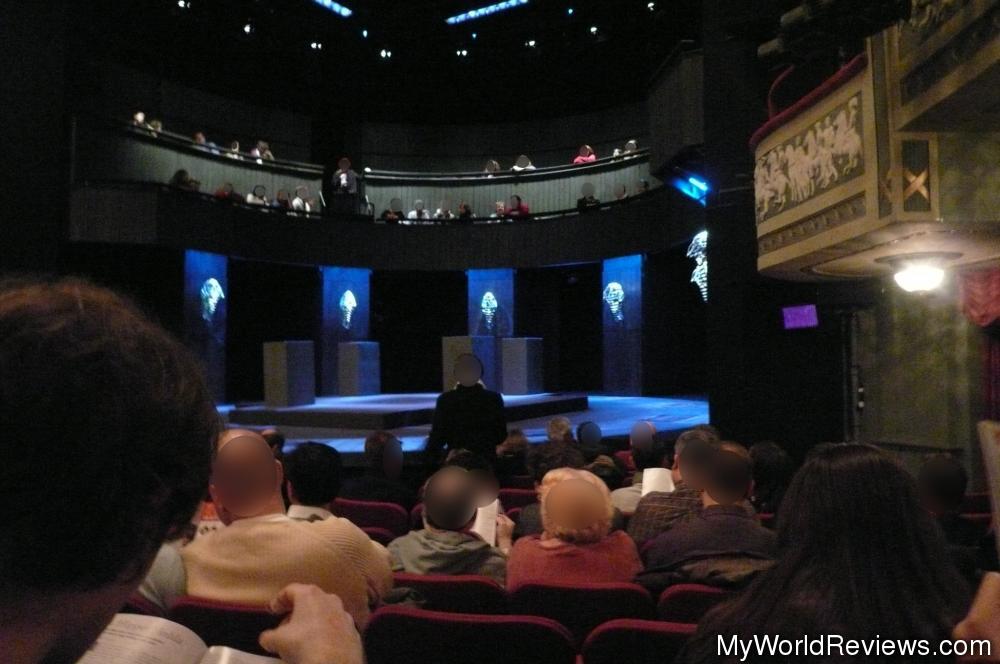
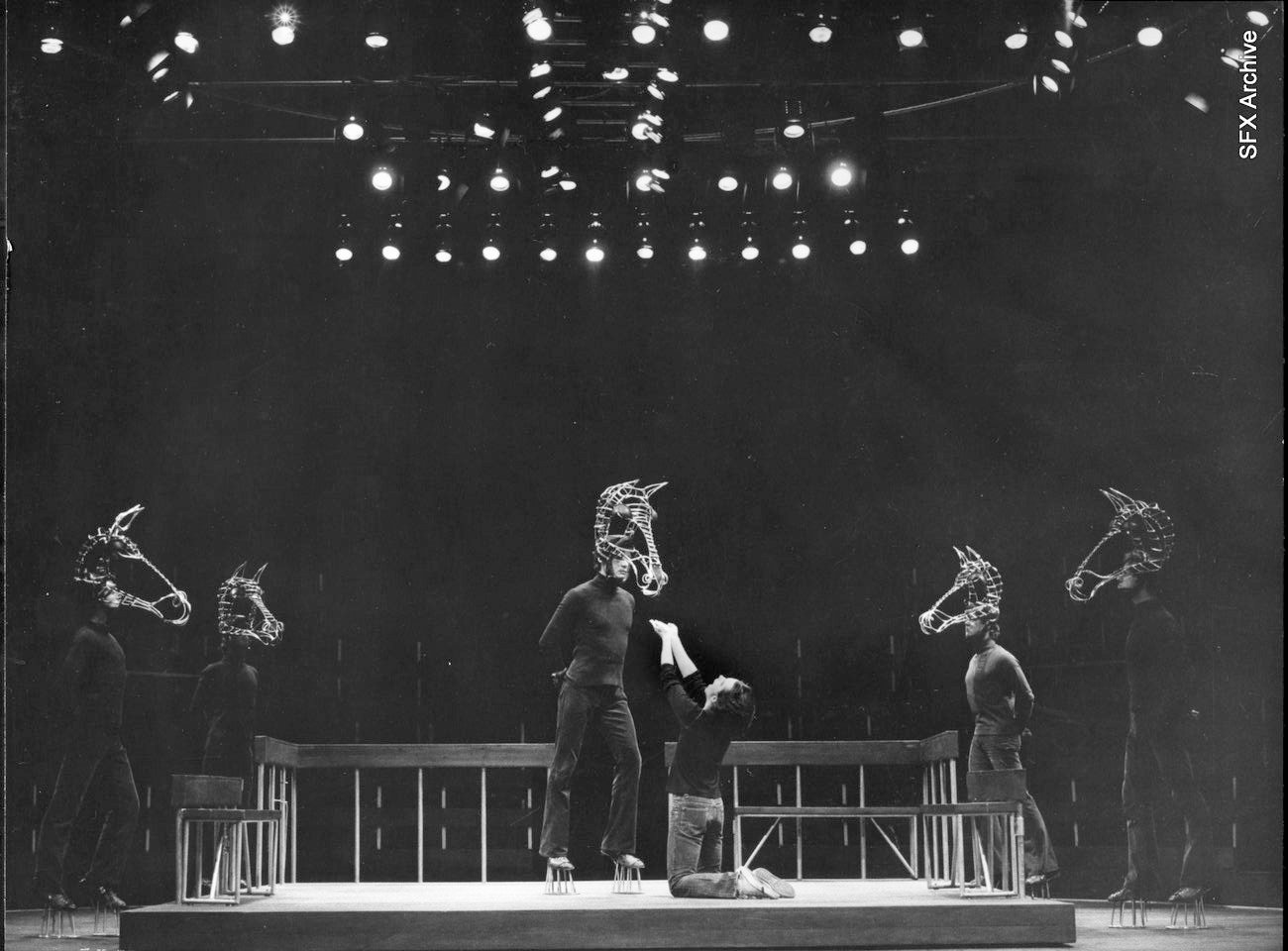
First, Shaffer prefaces the script with some Author’s Notes about the staging.  The photo above is from the recent Broadway revival, and it is loyal to the playwright’s concept in the important ways.  The original Broadway set is below, with the “boxing ring” described by Shaffer.

equus original

Shaffer asks that the entire cast sit on benches behind the boxing ring throughout the performance and enter the ring for their scenes.  When the horses enter the action, the actors playing them rise from the onstage bench and strap on one of the horse heads that hang around the perimeter.  At the start of the play, Dysart sits to one side and speaks to the audience while Alan and Nugget embrace center stage.

The 1974 photo shows you what Nugget looks like.  This highly theatrical and creative imagining of the horse captures the audience’s attention from the moment the lights come up.  All the actor playing Dysart has to do is not lose the audience’s attention in the three minutes between Nugget’s exit and the revelation that the boy embracing him blinded six horses while tending them in the stable.

Shaffer’s gives Dysart a wonderful opening monologue, one that raises more questions than it answers.  Dysart is clearly a man in pain, at a crossroads we don’t yet understand.  He uses words like “lost” and “intolerable” to describe himself, providing intrigue.  Equus plunges us into suspense on a number of levels almost immediately, and when we learn about the blinding at the five minute mark, we are firmly hooked.

This frees the actor playing Dysart to simply play the truth of this man’s life.  At least, this is where he should start.  A month into rehearsals, once he begins to get a good handle on who Dysart is, the director can evaluate whether the first five minutes is strong enough to grab the audience.  A good actor can make the necessary adjustments in a rehearsal or two.  But in the early days of the production, you want to throw yourself into what your character is feeling.

Does the actor need to go out of his way to make Dysart likable?

There is nothing in the script that makes Dysart unlikable.  You may or may not want to have dinner with him, but audiences empathize with good people in painful circumstances.  Make him a real human being with real feelings and needs, and the odds are very good that he will be likable.

What about intentionally playing the humor of the first half of the monologue to deliberately contrast with the serious tone of the second half, as my student did?

The opening of a play is not just about grabbing and holding the audience’s attention.  It establishes the world of the play as well as its tone (hopefully, your director defines both for you; in scene class, you need to figure that out yourself.)  As an actor, you must be faithful to both and not sacrifice either in the name of making yourself well-liked by the audience.  Humor should be injected when it is appropriate, not for its own sake.

The solemn and almost sexual ritual between Alan and Nugget takes place during the first half of Dysart’s monologue.  Use too much or the wrong sort of humor, and you risk mocking this moment, violating the sacredness of what happens between the boy and horse in the rest of the play.

Equus is an intriguing and moving drama, one that doesn’t end on a hopeful note.  It’s not a laugh fest.  All dramas typically have moments of humor, and I encourage you to find and play all of them in order to give your audience some stress relief, BUT you want to discover the tension of the scene first.  Only then can you determine if there is pressure that must be relieved.

We want to entertain the audience, to get and hold their attention.  But we don’t want to make choices that aren’t in keeping with the play.  That’s where you have to start.  When you focus on “likable” and “how can I grab the audience’s attention”, you’re going for product, not process.

I don’t know if humor is appropriate in that monologue or not.  It’s certainly worth investigating.  However, deciding to play up the humor to make the character likable without first examining the character to see if that choice is appropriate is an arbitrary choice.  You can’t choose unless you have options.  Use your rehearsal time to discover the options.  Then, and only then, can you make the best choices.

To read Equus, Part I: The Three Questions, go here.  To read Equus, Part II: Poetic Language, go here.