Actor’s Etiquette: Mind Your Sightlines

RequiredEtiquette-CD_1In a perfect world, the audience should be able to clearly see everyone on stage all the time.

It’s not a perfect world, but here are some guidelines.

If you’re doing a large musical with chorus people in the background, it’s okay for the leads to stand in front of them.  But the primary characters in crowd scenes should all be visible.

It’s okay to cross in front of someone when they aren’t speaking as long as you do it reasonably quickly and, heaven forbid, don’t stop in front of them.

Don’t forget the people sitting in the front row against the walls.  They need to be able to see you, too.  If you are upstage of other actors, pay attention during each performance so that you can adjust your position if necessary to give those audience members a glimpse of your face.  Similarly, if you are the downstage actor, be courteous to those upstage and adjust your own position if you are aware that you are blocking them.  Play with it in rehearsals so you will know what kind of flexibility you’ve got on performance nights without having to stare at the end seats to figure out if you need to move.

If you find that you are positioned on one side of the stage and looking toward the other side of the theater for a prolonged period of time, find reasons to turn your head in the other direction with some frequency.  The audience on your side of the theater deserves more than just your profile, too.

And lastly, remember that when you’re backstage, be careful about peeking through the curtains to watch the action on stage.  If you can see the audience, they can see you!

What Kinds of Plays Need Extra Rehearsal Time? Part II

Blocking issues aren’t the only challenges that may add extra time to rehearsals.  Here are some other things to consider:

One or two roles that carry the lion’s share of the play.  This includes two-handers, star vehicles, and wordy plays.  Some plays just seem to have a lot more words in them than others, and even if there isn’t one character with more than anyone else, there may be several who have more than the lead in an average play.  Plays like these typically require an extra week, just for memorization purposes.

Complex characters.  Plays with one or two roles that are particularly complicated and challenging characters probably take a little extra time to allow for the actors to do them justice.  Conversely, a well-balanced play with straightforward characters and actors who seem to be typecast in their roles may require a little less time to rehearse.

A_Few_Good_Men_CostumesMilitary, period pieces.  Some plays require body movement that is different from what we ordinarily use in real life.  Plays like A Few Good Men, where the majority of the characters are in the military, means that the actors need to learn military bearing in how they stand, walk, etc., and to maintain that consistently throughout the play.  Similarly, the manners at the Elizabethan court in Mary Stuart as well as the difference in attire will affect how actors need to move.

Physical ailments.  An actor who needs to limp, pretend to be paralyzed, use a wheelchair, or make any other notable physical movement changes may need additional time to practice them.  Some modifications, such as Laura’s limp in The Glass Menagerie, may not need much additional time, as the actress playing Laura can work on most aspects of the limp privately in her own time.  However, the actor playing the title role in The Elephant Man needs to contort his body sufficiently that extra rehearsal time is probably required.

Mind-altering conditions.  Scenes where an actor is drunk, high, crazy, or mentally challenged may need some extra rehearsal time.

Playing multiple characters.  Some people are very skilled at this and don’t need any additional time to rehearse.  However, actors who need assistance in creating clear identities for multiple characters, or who need to switch between them within a single scene, such as in The 39 Steps, benefit from additional time.

39steps3Plays requiring perfect timing or which rely on speed.  Not only does this include farces, but it also includes episodic plays like The 39 Steps and The Front Page, wherein much the fun and humor is dependent on fast-paced timing, both of lines and physical action.

Love scenes.  In theory, this shouldn’t take any extra time unless the scene is lengthy and requires a lot of physical movement, in which case it is much like a dance.  However, some actors have more inhibitions about the level of intimacy required by a love scene than others, just as some plays are more demanding in this regard than others.  Bell, Book and Candle is a good example of a play that requires considerable highly-charged physical intimacy.  If the actors playing the lovers are at all shy about entering into the demands of the scene, rehearsing them early and often to allow the actors to achieve  familiarity with each other and comfort with the physical contact is the only way to make them believable.

Foreign languages, accents, or gibberish.  A play like Enchanted April, if you have a non-Italian speaker playing the role of the cook/housekeeper who only speaks Italian, may need a little extra time, although much of her work will be done outside of regular rehearsal time.  Plays where all the characters adopt an accent, such as British English (Received Pronunciation) may take extra time to teach the cast the rules of the accent and correct them when they go astray.  Plays like Woman in Mind, the opening scene of which is conducted partly in gibberish, take additional time to rehearse, to get the actors comfortable with what the gibberish is supposed to mean and how it is to be delivered.

Classics.  Playwrights like Chekhov, Shakespeare, and Moliere present their own performance challenges that might warrant an extra week of rehearsal.

Children.  Depending on the age of the children and their level of experience, it may take a little extra time to get them to understand what they need to do.


Actor’s Etiquette: Caring for Your Costumes

etiquette_Introduction_fromBook_xsm_04032348_11051341If you are working in a college or professional theater, there may be staff in charge of caring for your costumes.  If so, it is your responsibility to treat your costume with care:  pull up your trousers when you sit so you don’t stress the crotch seam; don’t let your dress’ train sweep the dirt off the floor; don’t eat in costume unless you have a robe or towel covering your front and your lap.

Your other responsibility in this situation is to alert the staff in a timely fashion to any problems with your costumes:  tears in the fabric, buttons that are coming lose, seams that are straining.  The sooner they know about it, the sooner they can be fixed.

If, however, you are doing a show where there is no one assigned to take care of costumes, then guess what?  Anything to do with your costumes, including the above, is also your job.

Maybe not the repair work.  Maybe.  But the daily cleaning and caring for your costume is.

What should you be doing?

When the make-up stains on your shirt collar start to become evident to those in the first row, you need to wash it.  When your costume starts to stink, either wash it or spray it with vodka (the cheapest and best way to freshen costumes, believe it or not.  Just don’t use Absolut.)

And please – iron it.  In between shows.  If you’re doing three or four performances a week, by the time you get to the last one, your pants look like you’ve spent all day in the car.  If your character is arriving at the girl’s house for a first date, rumpled is usually not the look you’re going for.

If your costume is a slip or a satin dress that’s been stored in a box in the theater, please iron it before the first show!  I did a show once with a young woman who had a simple satin wedding dress as one of her costumes.  It was her first show at this theater, so I assumed that she thought someone would be ironing it for her, and didn’t have time to do it herself on opening night after she got to the theater.  I expected, however, that she’d either ask about who was taking care of the costumes or iron it herself before the next performance.

Wrong assumption.  After a few nights, I took to ironing it myself before she got to the theater.  (I couldn’t figure out how to gently suggest that she do it, and so left it to the director to mention, which he didn’t.  But I found the wrinkly dress a bit embarrassing on stage and so did it myself.)

And while we’re on the subject – if you use anything (costume or props) that has been collecting dust for years on some back shelf – please clean it.  The dust on a patent leather purse, the dirt on the flowers on your hat, and the dull scuffs on your shoes can all be seen from the audience.  Leave them in that condition ONLY if it is appropriate to your character, please!

What Kind of Plays Need Extra Rehearsal TIme? Part I

Once you’ve figured out how many rehearsal hours your play’s length requires, the following issues may warrant adding some time.  How much extra time depends on the actors involved and the demands of the particular play.  Here are some blocking considerations you might want to think about when planning your rehearsal time:

fezziwigFights and Dances.  Be they swordfights, fist fights, wrestling matches, or slapfests, any “fight” needs to be choreographed and rehearsed like a dance.  As for dances, sometimes even straight plays will have a single musical moment requiring coordinated action (e.g. The Fezziwigs’ Christmas Party in A Christmas Carol).  Choreography takes repetition to become seamless and natural; the complexity of the physical action and the coordination of the actors will determine how much extra time is required.

High levels of physical activity.  Physical activity that involves lots of props, like setting a table for a formal dinner for eight, usually requires coordinating the activity with dialogue.  This is like rubbing your belly while patting your head, and so takes a bit of extra time to make it run smoothly.  Reasonably complicated physical activity that doesn’t involve dialogue, such as scene changes made by the actors or complex physical business that either moves the plot forward or else is used for comic relief, usually requires extra time, too.  It requires a memorization of movements that can really only be learned during rehearsals.

Crowd scenes.  Any time you have more than four people on stage, it’s almost a dance to move them around.  Even one scene with six to eight people moving around over the course of six pages can add enough complexity to require extra attention.

Farces.  Because of the number of slamming doors typically found in farces, as well as the need to have exquisitely timed entrances or other physical movements (double-takes, etc.), farces usually take at least one week longer than other plays.  Farces often are longer than two hours in playing time, as well, which also means extra time.

Miming.  Not everyone is good at mime, and even if you have some talent for it, you probably don’t do it much.  Or at least, you probably don’t usually mime whatever motions the play you are in requires.  Some of this is work you’ll need to do at home, but sessions where the actors get feedback on their miming is usually a good idea if you want to really make them completely believable.

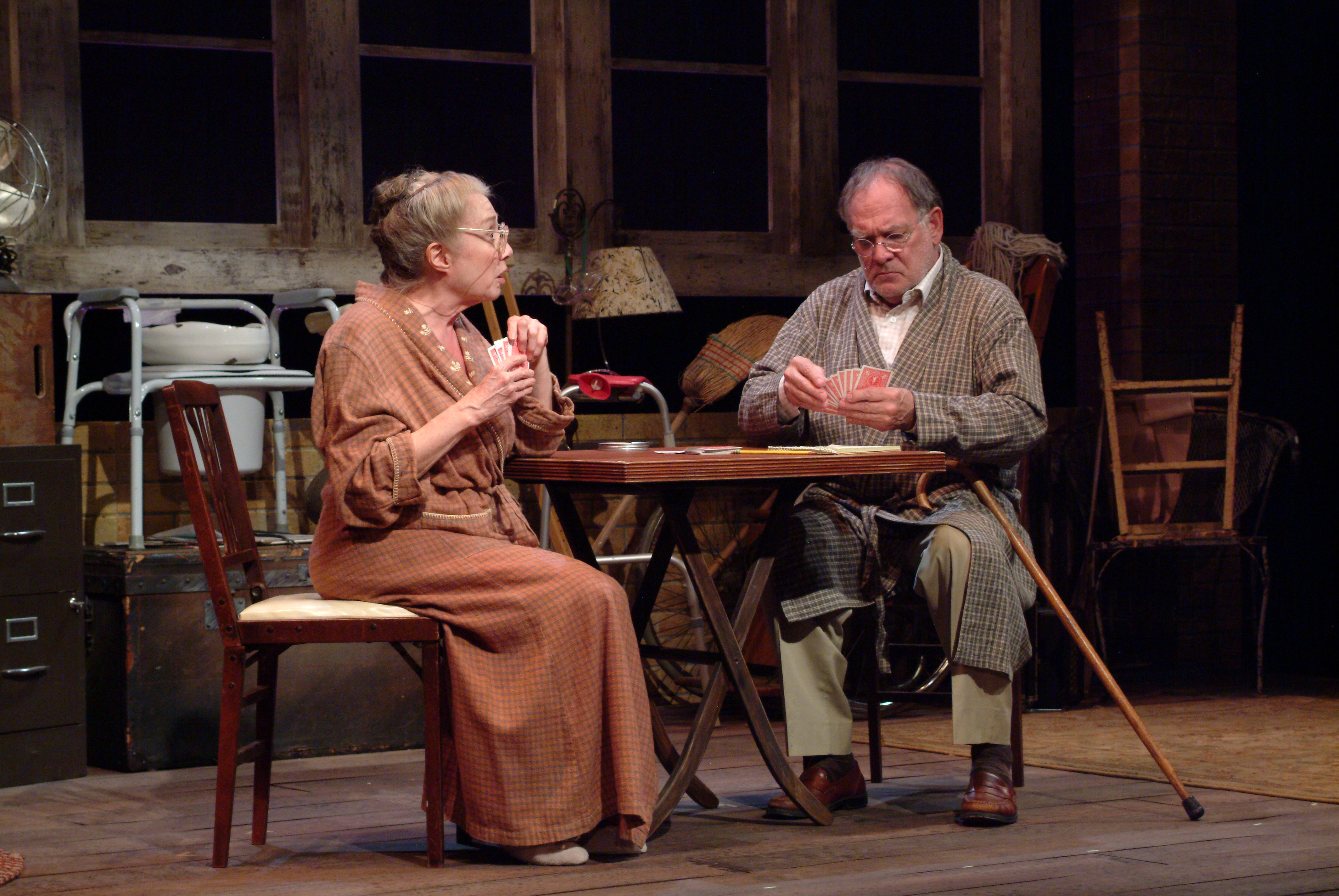
gin gameCard games.  You might not think of a card game as requiring blocking, but it does.  Plays like The Gin Game and Born Yesterday have dialogue that refers to certain things happening in the card games the characters play.  Learning when to draw and discard, when to deal, and when to shuffle your cards around in your hand, all while saying your lines, takes repeated practice to make it happen effortlessly.  The challenge is made all the more difficult because the cards you are looking at aren’t going to be the ones that are actually in the character’s hand.  That is, you may call “Gin” when you don’t actually have “Gin.”

Sleight of hand.  Magic tricks, juggling, and other similar special abilities need extra rehearsal unless the actors cast are already skilled in them.  While the actor responsible will need to practice the skill at home, integrating it into a scene where other things are happening is an extra challenge.

wait until darkThe blind.  If your character is blind, as is Susan in Wait Until Dark, you need extra rehearsal time to learn to move around the set as if you can’t see a thing.  Wait Until Dark and Black Comedy also have scenes where the stage lights are completely extinguished, but the actors have to move around the stage and do very specific actions in the dark despite not being able to see.  It takes extra practice to get so familiar with the floor plan that you can make this sort of scene flow smoothly without hurting yourself.


Actor’s Etiquette: The Little Old Deaf Lady in the Back Row

Etiquette-vector

This is a matter of courtesy to your audience, not your co-workers.

The audience would like to hear what you are saying.  A good script has had all extraneous words excised from it.  The audience needs to hear every one that remains.

Think of a stage as a room.  Whatever voice is adequate to fill that room, whether it’s the size of a standard classroom, or your living room, or a spacious great room, there is a voice that will fill it appropriately.  We don’t shout in kitchens unless something is burning or you’re about to pour vinegar into the pot, thinking it is wine.  Most kitchens aren’t that big that we need to raise our voices above normal speaking tones.

Remember that “normal” is dependent on the size of the room you’re in.  The larger the room, the louder your voice needs to be in order to be heard by anyone in that room.

Many new actors use a volume level that is appropriate to the size of the stage, but NOT to the stage plus auditorium.  The room you are occupying and have to fill is the entire space used by both actors and audience.  It doesn’t matter that the person you are speaking to is a character standing four feet away.  Your Four Foot Voice isn’t going to make it to the tenth row.

Some people have naturally loud voices, and some people have very small, quiet voices.  I’ve had students doing a scene six feet away from me, and I can barely hear them, their voices are so small and shy.  It’s fine to use that voice off stage, but on stage, your voice has to be big enough to be heard, as the saying goes, by the Little Old Deaf Lady in the Back Row.

In other words, the person sitting furthest away from you needs to be able to hear what you say as clearly as they could if you were sitting next to them.

Don’t worry about the fact that you’re speaking louder than the person in the front row needs in order to be able to hear you.  Your responsibility isn’t to him.  Your responsibility is to Grandma, who can’t walk well and so parked herself in the first empty seat she found when she walked into the theater.

Sometimes when I stand in the back of the theater and ask someone to shout, I still can’t hear them.  They are sure they are roaring, but I have to strain to understand them.  So have someone give you feedback on how audible you are from the back row.  Once you get a thumbs-up from them, you know what is required and that you can actually produce that volume, even if you aren’t accustomed to speaking at that level.  (If you can’t produce that volume or sustain it over multiple performances, that’s when you need to seek the help of a vocal coach, who can teach you how to use your vocal instrument.)

Remember that the quieter moments in a play nevertheless have to be heard by those in the last row.  Stage whispers aren’t like ordinary whispers.  Check with your director on your levels, and take his admonitions seriously.

megaphoneIf you are challenged in this area, then it’s going to be even harder for you to learn to shout when you need to in the context of a play (because you’re angry, for instance).  Best to overcome the challenge now, before you’re faced with that kind of scene in rehearsals!

One last thing:  Remember that people absorb sound in the same way that the soft materials used in soundproofing equipment do.  In other words, the larger the audience, the louder you have to be to be heard.

Do We Have Enough Rehearsal Time?

calendarI’m going to address this simply from the point of view of community theater.  The time needed for college or professional productions probably differs.  I’m also starting with choices that are largely made by the director, but I’ll finish with how it impacts you as an actor.  If you can identify upfront that the director may not have given you enough time to rehearse, you can handle how you rehearse a little differently to overcome this deficit.

In community theater, time is your best friend, but I don’t mean just the number of hours you spend in rehearsal.  Yes, that matters.  But the number of weeks from the first reading to opening night matters as well.

Why?  Because it gives your subconscious time to do its thing.  This is what John Cleese talks about when he says the third requirement for creativity is Time.  Ideally, you want seven weeks of regular rehearsals and one week of technical rehearsals.  Let’s say it takes you five weeks to get off book.  That gives you one week to REALLY get off book; that is, to reach the point where the words come out without you having to think about them.  It gives you one more week to do the fine-tuning that can only happen once you are REALLY off book.  And it gives you the eighth week to adjust to technical issues.

If the entire cast can get off book in four weeks and you’ve got a compelling reason to not use an eight week period, then for an “ordinary show” (see below), you can shorten the rehearsal period to seven weeks.  However, it’s my experience that at least some of the cast will still be on-book in that fifth week.  But the theory here is that you should put the script down no later than three weeks before opening night in order to benefit from what I will call the “subconscious effect.”

Has there ever been a community theater production you’ve been part of that seemed to be noticeably better on the second weekend of performances?  If so, you’re looking at the “subconscious effect”.  Once you get off book and are “fine-tuning” your performance, your subconscious gets very busy and does work on your role that you aren’t aware of.  Even if all you do in the week after opening is look at your script three times and have one pick-up rehearsal, your subconscious is still working and getting more comfortable with your choices.  Magical stuff happens when you give it this time to work.  So if you can give it that extra week before opening night, you’ll get better buzz to help fill the house on the second weekend!

As for the number of hours you need, my general rule of thumb is that a production with no special needs that will run for 2 hours including one 15-minute intermission requires 54 hours of rehearsal time prior to Tech Week.  To get the most out of this time, you need rehearsals that last at least 2½ hours long, three or four times a week.  (Rehearse them more often than that, and they have no time to work on their part at home as well as do their laundry.)

If the play is longer or shorter than two hours, you can adjust the total rehearsal time up or down.  But length is not the only consideration in choosing the number of hours for rehearsal.  Special considerations can increase the amount of time you need to work outside of rehearsals as well.

What do I mean by special considerations?  I’ll talk about them next time . . .

Actor’s Etiquette: Be Quiet

manners (1)When you’re not on stage, either in rehearsals or performance, be quiet.  The sound of your voice is distracting to those who are on stage, even if the audience can’t hear you.  The green room typically isn’t a place you can speak in normal tones.  I recently did a show where the action on stage was very quiet but the green room was very noisy, and not only did it throw me off, it was so audible to me that I can’t believe the front rows of the audience couldn’t hear it, too.

I’ve also heard people standing in the wings talk in a normal voice rather than a whisper.  It’s just disrespectful to those who are on stage.  If you have to do more than whisper, go far enough away from the stage that you are certain that no one can hear you.  Depending on the design of the theater, even the dressing room may not be far enough away.  Just think about where you are before you start speaking.

I understand that performances can be tedious if you have a small role, and staying silent for two hours isn’t the most fun in the world.  When the offstage sounds start to resemble a party, however, that’s too much.  There’s something in between.  Find it.

Feelings Aren’t Bad, They’re Just Scary

The first thing I do with all of my new acting students is introduce them to their feelings.  Even the people who seem quite emotional avoid their feelings, they just do it in a slightly different way than everyone else does.

Because feelings are an actor’s stock-in-trade, his primary tool, you have to be comfortable experiencing them.

anxietyExperiencing your feelings is different than feeling them.  Experiencing your feelings is about letting them be, sitting with them without trying to change them, for longer than you are probably comfortable doing so right now.  It’s about letting them exist without judging them.

Feelings aren’t bad, you know.  Even the negative ones – anger, frustration, sadness – aren’t bad.  They are trying to tell you something about your life, that’s all.  When a negative feeling wells up inside you, the best question to ask yourself is, “What expectation did I have that isn’t being met?”  (There are also a couple of follow-up questions to ask yourself, but that isn’t the purpose of this blog!)

But somewhere along the line, we got the idea that it isn’t good to feel our feelings, and so we opt out of them as much as we can.  Even the positive feelings.  We are only slightly more comfortable with letting ourselves feel positive feelings to the fullest than we are the negative ones.

I am always surprised when a student reveals to me, usually in the first class, that he doesn’t feel his feelings.  I use the male pronoun arbitrarily – I’ve had just as many women acknowledge this about themselves.  For me, missing out on your feelings is missing out on part of life, and knowing that I don’t feel my feelings would send me on a mission to understand why (but that’s just me.  You won’t travel that road until you’re ready to.)

It’s interesting that someone who knows he doesn’t feel his feelings would come to an acting class, but perhaps it’s his inner self sensing that he’s ready to try to do so.  Not all of the people like this who come to class stay, but the ones who do are very courageous, and they tell me the class has had an impact on their personal lives, as well as their acting.

But even the ones who don’t know they aren’t really in touch with their feelings realize it in short order.  And while it takes some time to really get comfortable with them, they also know in that moment that only by doing so can they produce acting worth watching.

shadow-peopleFeelings aren’t bad; they’re just scary.  Which is why you want to make friends with them slowly.  By gradually getting in touch with them, and by starting with the most benign feelings you can, you’ll realize that they’re just the boogeyman in the closet.  That nothing really terrible comes from feeling them; on the contrary, extraordinary good can come from feeling them, both on stage and off.

Here’s what I tell the people who are most afraid:  When I was little, I was the Good Little Girl.  I seriously believed that Perfection was possible long after I should have realized it wasn’t.  This wasn’t a stance forced on me by my parents in any way; on the contrary, it was entirely my choice.  Feelings like anger and disappointment and sadness were all things to be sucked up and ignored.  Surely no one would like me if they saw that I was capable of such terrible feelings!

But from the very beginning of my life, to the extent that one can imagine such a thing, I wanted to be an actress.  I think on some very instinctive level, I gravitated toward it because I understood, even at that tender age, that it was okay to feel all of my feelings on stage, including the “bad” ones.  It wasn’t me up there, after all – it was a character written by a playwright.  I could use all of my own emotions in service of creating a believable character without anyone judging me as wanting.  In fact, crying and screaming and being afraid – when appropriate in context – actually earned me praise.

Acting was very cathartic, because it gave me an outlet for feelings I wouldn’t release in real life.  As I got older, I realized that while those feelings I expressed on stage did indeed have their root inside the real me, no one watching had any idea what their deep, dark source was.  So I was completely free to indulge them as much as I liked!

I wonder, too, if the willingness to be so free with our feelings is one of the things that non-actors admire about us (aside from our ability to memorize all those lines!)  They know they could never be so brave, and admire those who can.

While the feelings that we feel on stage are, indeed, our own, they are conjured up not by our own experiences, but rather by what we imagine the character might feel in this particular set of circumstances.  This creates a little more freedom to let go; because the circumstances are entirely imaginary, they can’t harm us.  And when you are really working well, you become a way-station for them, not a holding tank.  By the end of the evening, if you’ve fully released them to the audience, you can make your way to that after-show party without the remnants of the tragic figure you played on stage following you home!

Actor’s Etiquette: Tech Rehearsals

tea-etiquette-v2We hate them, but they are a necessary evil.

They are tedious.  They start late.  Everything stops while they fix a problem.  Couldn’t they have figured this out ahead of time?

It doesn’t matter.  It is what it is.  Take a deep breath and be patient.  Everyone is frustrated.  Stay attentive to what is being said by the director or the technical crew, so you can help them.  Don’t get so involved in conversations with other actors that you lose sight of why you’re here.  Be as helpful as you can by getting into position when they need you to be somewhere, and by running something as many times as they need to to get it right.

You’ve had a lot of rehearsals to get it right.  The crew gets one, and there are all kinds of other reasons you aren’t privy to that the Tech isn’t going smoothly.  Don’t roll your eyes or lose your temper.  It will all be over soon.  And don’t worry that you can’t do any decent acting at this rehearsal.  It’s not for you, it’s for them.  You can act in the dress rehearsal.

This doesn’t mean you shouldn’t try your best.  No, you may not be able to sink into the character in this rehearsal, but the crew needs to understand the general timing and events of the show so they can match their cues to them.  Be sure you give them what they need.

The Stage Director as Film Editor

The stage director has a number of functions.

  • She chooses the tone of the play and makes sure that every aspect of the production supports that tone.
  • She identifies what she thinks the playwright is trying to say, and makes sure that all the actors’ choices are consistent with that point of view.
  • She is in charge of the mise en scene, and in that role plays traffic cop.
  • She is the Big Picture artist of the production.  Actors are little picture people.  She controls the scope and feel of the evening.  We are responsible for the moment-to-moment details.

film editorIn other words, she’s a film editor for the stage.

Having a strong sense of the big picture is an essential ingredient in a quality director.  The ability to attend to detail is an asset, but it isn’t critical.  You can be a very good director if you have people around you to handle the details.

The reverse is true for actors.  The more you can work with the minutiae of what happens in a single moment (giving oneself over to it without overthinking it, that is), the better your work is apt to be.  If you can also see the big picture, so that you can tailor your work to intentionally enhance the grand scheme and ease the director’s burden a little bit, then your performance is apt to scale some impressive heights.  But it isn’t necessary, because the director is your film editor.

Unlike a film editor, who works after all the filming has been completed, the stage director does her editing throughout the rehearsal process.  That means that you, as the actor, need to provide her with quantity of film to select from.  Take after take.  And each take should be a little different.  Each take should offer something slightly (or majorly) different to the director.  Your job is to provide choices.

Now, truthfully, you’ll do a lot of the editing yourself.  You’ll try stuff in rehearsal and realize this works and that doesn’t, and select accordingly.  But there will be times, as in The Rainmaker scene I’ve cited, where you may try two materially different approaches, and both seem to work on some level.  What to do?  Which to choose?  How do I know what’s right???????

You don’t have to.  The director will.

Isn’t this a beautiful system?  You don’t have to worry about it.  The obvious choices?  Go ahead and make them.  The ones that panic you so much that you think you have to make them early and often?  Let the director shoulder that responsibility.  That’s what she’s there for.

And this frees you up to try everything you can think of.  Because a good director will give you immediate and solid feedback about what works and what doesn’t.  Good feedback, I believe I said, speeds the learning process.  So you don’t have to worry that you won’t get it all done in time.  You will.