Playing Bad Characters: Doubt, Scene 2 (again)

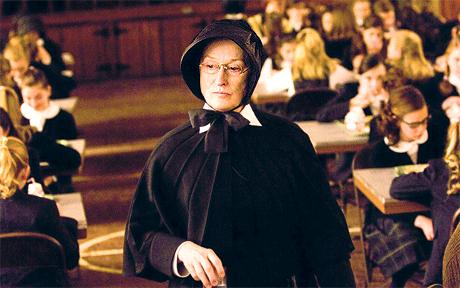
doubt sr aloysiusIn Scene 2, we have the contrast of the older, stern Sr. Aloysius and the younger, enthusiastic Sr. James.  It’s easy to like Sr. James and to frown upon Sr. Aloysius, who seems to be vetoing anything happy.  But let’s look again.

Sr. Aloysius is the principal of the school and has worked there for many years.  Sr. James is a new teacher.  We can fairly say, I think, that as a new teacher, she undoubtedly has things to learn.  Sr. Aloysius is taking the time, in this scene, to mentor her.  Her approach may seem a bit severe at times, but let’s assume that underneath the gruffness is a sincere desire to help Sr. James be a better teacher, so that the children may be better served.

If you disagree with Sr. Aloysius, what you are disagreeing with is what it means “to be a better teacher”, or “what will benefit the children”.  Those are things about which reasonable people can disagree.  But you need to understand how Sr. Aloysius defines these things and, more importantly, why.  What in her background has led her to believe these things?  Has she tried other ways and seen them fail?

What are the things that matter to Sr. Aloysius?  Let’s look at some of her lines:

“Much can be accomplished in sixty minutes.”

“Always the easy way out these days.  What does that teach?  An easy choice today can have its consequence tomorrow.”

“Penmanship is dying all across the country.”

“You favor History and risk swaying the children to value it over their other subjects.  I think this is a mistake.”

“I do not say this to aggrandize myself, but to illustrate the importance of paying attention.”

“What good’s a gift if it’s left in the box?”

“The best teachers do not perform, they cause the students to perform.”

“Good teachers are never content.”

“It is a society which requires constant educational, spiritual, and human vigilance.”

“God gave you a brain and a heart.  The heart is warm, but your wits must be cold.”

“They’re children.  They can talk to each other.  It’s more important they have a fierce moral guardian.  You stand at the door, Sister.  You are the gatekeeper.  If you are vigilant, they will not need to be.”

“I’m sorry I’m not more forthright, but I must be careful not to create something by saying it.”

Take these lines out of the dialogue and forget that Sr. Aloysius is the one saying them.  These are all lines that you can probably either agree with or else understand the thinking behind them.  You may think that an adult ought to be more than a fierce moral guardian to a child, but you can probably get on board with Sr. Aloysius’ view that adults should protect children from anything immoral.

Despite all of the things Sr. Aloysius says that we don’t care for, the play is sprinkled with lines that we can agree with, that show her to be a bit more human than we thought when we first read the play.

The interesting question about Sr. Aloysius is that she is absolutely well-meaning and in some ways absolutely right.  Yet she takes it to an edge that we find unpalatable – she is an extremist in what she believes.  Why?  How has she arrived at this point?  What in her history has brought her to such a rigid, black and white position?

Well, that’s the journey you go on in rehearsal.  Just remember that she, too, has a heart, and that her heart is warm as well.  She knows William London is on a bad path and that she can’t do much to alter it, and it pains her.  She worries that someone will hit Donald Muller because he is black, and that Linda Conte will have sex before she turns 14.  And while she asks Sr. James to help Sr. Veronica because the school can’t afford to lose a teacher, I suspect that she is also worried about Sr. Veronica’s physical well-being as well as her happiness.  Who wants to be shunted away to the old nun’s home?


Playing Bad Characters: Doubt, Scene 2

doubt_1435912cSo let’s take the idea that Sr. Aloysius is not an unredeemable person, but someone who sees her mission as protecting the young children in her care from all harm.

When we first meet her, in Scene 2, it is clear that she is a woman of strong and firm opinions on matters like teaching methods.  You may not agree with those methods, but you need to give thought to why they matter to her.  Why should a teacher showing enthusiasm for a subject be a bad thing for kids to experience?  Why should knowledge be delivered as bitter medicine?  What benefit is derived by this approach?  Because in Sr. Aloysius’ eyes, there is a benefit.  It’s not an arbitrary choice on her part, and it’s not because she’s generally mean.  She sincerely thinks this is best for the kids.

Her advice to Sr. James sounds like severe criticism, but from Sr. Aloysius’ point of view, she is simply trying to help her to be a better teacher.  Sr. Aloysius is an ISTJ in Myers-Briggs’ terminology – she is businesslike and fond of order and tradition.  Part of the attraction of the Catholic Church is that if you want rules and black and white, you can find it there (you can also find the opposite there, even in the 1960s, but if you are attracted by rules, you can certainly find them.)

So for Sr. Aloysius, there is comfort and security in regulations.  If she fears uncertainty – doubt – then her desperate clinging to her set of rules helps quell her fears.

What’s the number one diamond line for Sr. Aloysius?  The final line of the play:  “I have doubts!  I have such doubts!”

So we have a nun who means well and wants to do the best job she can as principal (which means protecting her charges to the utmost), but is scared to death of the grey area and enforces the “Rule of Law” at her school both to protect her charges and to protect herself from the terrifying unknown.

Count both the adjectives and the verbs in that last paragraph.  Notice how I haven’t mentioned words like severe, heartless, unfeeling, mean-spirited, vindictive, vengeful, harsh, etc.?  Instead, I’ve given you motivations that you can use to drive what you do.

The playwright has written lines that have all the severity and mean-spiritedness necessary.  You don’t have to work to add any of that negative emotion to the performance.  The words will take care of that.  Your job, actually, is to do the opposite – to temper the strong language of the play with an emotional life that makes sense and creates a three-dimensional human being instead of a stereotype.

But let’s go back to the script of Scene 2.  Sr. Aloysius calls art class a waste of time.  Play the emotion (“she’s disparaging the arts”) and you play into the stereotype.  But if you stop and think about how someone could justifiably consider the arts a waste of time (what would you replace them with, and what benefit would the students derive from the replacement?), you take just a little bit of negative energy out of that line.

William London, the unruly child in Sr. James’ class, appears to be Sr. Aloysius’ favorite whipping boy, and she seems to be unreasonable, at least at first.  But read page 15 again.  What if Sr. Aloysius’ assessment of William’s life is absolutely spot on?  Forget how she says it, just look at the facts.  Does she become just a little bit more understandable?

More next time . . .

Liking Bad Characters: Doubt, Part 1

Doubt 2“You want me to like this terrible person I am playing?”

Actually, that’s precisely what I want you to do.  Impossible thought it may seem.

In order to get to “like”, you first have to understand her.  I’ve talked about this some in other places, but let’s look at it specifically in terms of people who do terrible things to others.

The director of Doubt (see When Your Character is Very, Very Bad) clearly thinks Sr. Aloysius does terrible things to others.  Let’s look at why she does so.

As always, it comes down to her verb.  At first blush, especially if you don’t like her, Sr. Aloysius’ verb seems to be “to get rid of Father Flynn” or “to expose him as a deviant”.  Of these two choices, the former has more validity to me.  While she certainly wants him to confess, repent, and reform, her bigger concern seems to get him out of the church (as a priest, anyway).

It’s not enough to say “to get rid of Father Flynn” – you have to follow it up with “why?”  She could want to get rid of him because she thinks he is a discredit to the priesthood, because she can’t stand to look at him (his long fingernails turn her stomach), or because she thinks he is taking the parish in a dangerous direction.  All three of those things do come into play in her feelings, I think, and are part of what helps to build a layered interpretation of Sr. Aloysius.

None of them get to the heart of the matter, however, which is this:  She wants to protect Donald Muller and every other boy in her charge from Father Flynn’s predation.

“To protect her charges from rape” is a more positive spin on the situation than “to get rid of Father Flynn” isn’t it?  It’s also more positive than “to get rid of an immoral priest” or “to stop a rapist”.

Why?  Because protecting someone is a positive act; getting rid of, or stopping, someone has a negative tone to it.

If we go with “get rid of Father Flynn”, then if he is guilty of her charges, we’re okay with her actions, even if we don’t necessarily innocent of like her way of going about it.  But if he is innocent of her charges, then her actions are vindictive.  It’s an either/or proposition.  We either approve of her (even if we don’t necessarily like her) or we hate her.

But if we go with “to protect her charges from rape”, we will find her at least somewhat likable (and not merely approve of her) whether Father Flynn is innocent or guilty, because she is motivated by something good – the desire to advocate for and protect all children in her care.

The fact that she is willing to “move away from God” (her words) in order to achieve her goal is, for a religious, a sacrifice of some consequence.  This reveals how high the stakes are for her.  She will do anything to protect innocent children from being defiled and abused.

Does this make her more likable and understandable to you?  I hope so.

Next time, I’ll take you a little deeper into how this choice of verb affects your portrayal of Sr. Aloysius, and how the script supports this perspective.

When Your Character is Very, Very Bad

08_Doubt_Streep.jpgA local theater is doing a production of John Patrick Shanley’s Pulitzer Prize winning play, Doubt.  The audition notice described Sr. Aloysius, the older nun determined to rid her school of the priest she is convinced has molested a young boy (and played on Broadway by Cherry Jones and in the film by Meryl Streep) as an

Old School elementary principal, stern, suspicious and cynical.  She shows no weakness and discourages any and all signs of weakness.  Her nature is excessive. She is unsympathetic and rules with an iron fist, adults and students alike.  She strongly dislikes Father Flynn’s sense of compassion and his compassionate demeanor.  Think cold, heartless and 100% strong willed and mean spirited.  Her anger and guilt-inducing suspicious nature, drives her passion.

Pretty extreme description, no?  “No weakness”, “any and all signs”, “excessive”, “iron fist”, “cold” “heartless”, “100% strong willed and mean spirited”.  Not a lot of room in there for playing the opposites, which I hope you now understand, if you’ve read the rest of the blog, helps to create a nuanced, interesting, unpredictable, believable character.

As it turns out, the director attended parochial school during the 60s and 70s until graduating from high school, and the description he provided reflects his own experience with at least some of the nuns he encountered.  Which is Lesson Number One:

Be careful about bringing your own baggage to the role.  Be sure it is applicable.

I’ve heard actors say things like, “Well, I would never do that, so I don’t find it believable!”  (Yes, but your character does, so you need to wrap your head around that.)  About La Marquise de Merteuil from Les Liaisons Dangereuses:  “I just can’t like her, she’s evil.”  (If you’re going to play her, you better understand her pain and what drives her to do terrible things, and not just see “evil”.)

The play isn’t about you; it’s about your character.  Separate your personal beliefs and experiences from what is happening to your character.  Use your own experiences if they are aligned with the character, but be careful to not assume that some correlation implies complete correlation.

If you perceive your character in the way this director sees Sr. Aloysius – if you can step back and recognize that you are using some weighty, definitive, and extreme language to describe her – it’s a very big indication that you’ve got some personal issues that are clouding your judgment about the character.  You need to sort out what those are and open yourself to the possibility that your character isn’t a mirror image of whomever it was who harmed you in the past.  (Similarly, if you paint your character with rose-colored glasses, you need to look for some flaws and accept that they do exist.)

But let’s say you’ve never met a nun in your life nor had any cruel teachers, and yet your reaction to Sr. Aloysius is not unlike the director’s response.  What do you do?  How do you go about playing characters with no redeeming qualities?

Stay tuned . . .

Playing the Verbs: Personalizing What You Find

IndividualityLet’s go back to Part 5 of Script Analysis:  Other People’s Money.

In it, I found a verb for Bea:  To save the jobs of men who work at the plant and have no other viable means of employment.  This is a powerful choice, and factors into not just the scene with Garfinkle, but into everything Bea does once she becomes aware of the nature of Garfinkle’s interest in the company.

But it’s still just words, just an intellectual choice.  Choosing the verbs is one thing; playing them is another.

So how do you play them?

First, be religiously sticking to Getting What You Want and ignoring the emotional nature of the scene.  Try to save the jobs, and the emotions will take care of themselves.

Second, try to Save the Jobs as if your life depends upon it, because in a play, it always does.

Third, find a way to personalize it.  Earnestly trying to save jobs will get you half the way there, but it won’t dig into your heart, and that is where we want the work to be.

In this case, I created sob stories for three of the men at the plant.  It’s not enough to say “1200 men will lose their jobs if something isn’t done.”  Generalizations don’t touch your heart.  Specifics do.  I also had ideas of what they each looked like, sounded like, how they behaved at the plant.  Who was the jovial guy who was always getting attention, and who was the quiet man who observed everything and would give you the shirt off his back if he thought you needed it.  I imagined the annual company picnic in July and all that Bea did to plan it each year, and the pleasure she took in watching the kids play and the families enjoy each other.

I thought about how it is a small enough community and the plant large enough that Bea is apt to run into the men and their wives outside of business hours at the gas station, the supermarket, church.  How she sends get-well, happy birthday, and sympathy cards when appropriate.  How she marveled at how much little Sammy has grown since she saw him last.  How involved she is in the lives of everyone at the plant.

This is the kind of backstory that helps my performance, but I didn’t start constructing it at the start of rehearsals.  I didn’t work on it until I realized, somewhat deeper into rehearsals than I should have realized, that Bea’s verb didn’t have to do with Jorgy.  Yes, she doesn’t want him to lose his job, either, but she knows he is financially secure.  It’s the machinist and the foreman she is really worried about.

MachinistsThere was a workbench at the very back center of the stage, behind the flats, and it had a blue light on it, to allow actors to safely move from one wing to the other.  As I sat in the wing waiting for the scene that begins on page 66, I’d look over to the workbench and imagine that I could see my three guys – Frank, Joe, and Mitch – working out a problem together, laughing and enjoying each other’s company, unaware that there is a fight underway to take their jobs from them.

That minute of imagining got me in touch with the heart of what Bea is feeling and allowed me to bring an emotional level out on stage that wouldn’t have been there otherwise.  (Because I forgot to do it one night, and it showed in my performance!)  It’s all an act of imagination – I usually favor the Stella Adler/Sanford Meisner “What if” approach to the Lee Strasberg “emotional memory” approach – but imagine well and imagine specifically, and the results can be powerful.

Script Analysis: Diamond Lines, Part 2

Archeological DigDiamond lines are lines that come with baggage.  They reveal a character’s history, something that has shaped who they are.  They ask you to go on an archeological dig.

The fact that the playwright throws them into the script tells you that they are critical to understanding the character and what she does in this play.  If she was the homecoming queen and the playwright doesn’t mention it, then being the queen wasn’t a defining moment for her or, at least, its ramifications (how she felt about it, how others reacted to it) don’t impact what happens to her in this play.

However, if the playwright does let this fact drop, it means it matters.  Was it a defining moment for her?  Is it is past glory that she clings to or one she wants to shed?  Has it affected how the men in her life view her, and is that a good thing or a problem for her?  How strong is her sense of self?  Does she need public approbation to feel good about herself?

Diamond lines usually jump out at me, but I also comb through the script to look for them.  Sometimes they are subtle, and you may not realize until halfway through rehearsals that there is really more buried in that line than you gave it credit for.  This is normal, but think what an advantage you have if you recognize what the line has to offer earlier in rehearsals!  Objectively looking at lines to see what they might mean is a way of finding them early.

So once you find your diamonds, what do you do with them?

Let’s start with what you SHOULDN’T do:  “Decide” they mean X, and then play X.

For example, let’s take Bea’s line about apologizing to no one.  You could take that to mean that she doesn’t give a damn what anyone thinks about anything she does and play that, but it’s a bit simplistic.  For instance, it assumes that she behaves that way in all situations, and that’s unlikely.  She’s too likable a character for that to be true.

That approach also may assume she’s a little “in your face” about what she does:  “Take me as I am or don’t take me, I’m not changing for anyone”.  This, too, might have some validity, but it’s an extreme position, and while I believe in amping up your stakes by going as far as you can with something, that’s a very different thing than defining your characters by taking their personality traits to extremes.  People are very complicated beings, full of contradictions.

So one place to start is by taking what it seems to say about Bea – that she doesn’t apologize – and imagine circumstances under which she would.  What makes her feel bad?  How does she feel about other people (because we apologize to people we care about and not often to those who drive us nuts)?

Then, let’s put the line in context.  She is speaking very specifically about her relationship with Jorgy.  This line tells me that she knows it’s an unorthodox relationship, she knows what a stir it caused in town, and she has lived with that stir for most of her life without once responding to questions or misconceptions or insults that sprang up as a result.

That’s a very difficult thing to do.  It tells me that Bea is made of steel.  (But again – where are the weak points in her steely frame?)  It also tells me something about how she feels about Jorgy.  You only can keep silent in the face of personal attack if you know, with every fiber of your being, that you are doing the absolutely right thing.  Bea loves Jorgy so deeply that she is willing to sacrifice everything for it.

Did she make the right choice in doing this?  Not for you, as the actor, to say.  Only for you to examine the reason for the choice and the impact of that choice.  What did she sacrifice in order to be with Jorgy on such unusual terms?  How did it impact her marriage?  Her relationship with her daughter?  With friends?  Co-workers?

Mostly what I do with diamond lines is try to internalize what they really mean, and not necessarily in a way that I can communicate verbally to you.  It’s a matter of understanding how they make me feel.  If Bea’s choice would not have been mine, they I have to spend considerable time getting to a real place of understanding why she made that choice.

What would I be willing to stand for over time without budging an inch?  How much of a conscious choice was this and how much was simply who Bea is?  Were there moments when she almost responded to someone and didn’t, held back at the last minute?  What did that feel like?  If Bea had chosen to respond, what would she have said?  Would what she would have said changed over the years, as she matured?  After Jorgy’s wife died?  After her own husband died?

You need to simply sit with diamond lines and let them work their magic on you.  They always have layers to them.  How much of what drives them is genetic, and how much environmental?

Revisit diamond lines over and over again.  In the shower.  While driving.  Waiting in the checkout line.  Keep pushing deeper into them, both intellectually and emotionally.  Sift through your character’s history and heart, brushing away the dirt that covers your diamond.  Discover all of the diamond’s facets, not just what first meets the eye.

To read Script Analysis:  Diamond Lines, Part 1, go here.

Script Analysis: Diamond Lines, Part I

Diamond-2013-High-HD-WallpaperAs I look back at the last post on Other People’s Money (Part 5), I’m not sure that I made clear an important point about making decisions about your character.  (I typically write a series in a sitting, and can thus be sure that everything ties together.  Those five posts I wrote separately, as scattered time permitted, and so they may need some editing to be truly cohesive.)

You don’t have to know everything about your character.  You just have to know the Right Things.  The Important Things.

It’s kind of like going for the root cause.  Push away the symptoms – they’ll take care of themselves – and instead uncover the fundamental issues driving your character.  Along the way, you’ll find little things that matter and help flesh out your character.  But don’t get distracted by them and forget to find the diamonds.

What are the diamonds?  They are the lines – often single sentences – that your character utters or someone else says that tell you something major about your character and how to play him.

Here’s some examples from Other People’s Money:

Coles:  

  • I knew as soon as the old man told us about our expected visitor.
  • Twelve years ago he told me if I did the job it’d be my company to run when he steps down. . . .I don’t want the rug pulled out from under me so close to the finish line.
  • I kept this company alive.

Bea:  

  • You see – manners . . .  You could learn from that, Jorgy.
  • In a life filled with rumors and gossip and sideways glances, I apologized to no one.  Don’t expect it of me now.  You won’t get it.
  • Garfinkle:  Who are doing this for?  Bea:  Myself.  I don’t need the money.

Garfinkle:  

  • He’s a “yard” chauffeur.  Bring him inside and you’ll spoil him.
  • God damned right. The best game in the world.
  • I’m a modern-day Robin Hood. I take from the rich and give to the middle-class.
  • I looove money. . . . Money is unconditional acceptance.
  • Katie, why are you so hard on me?

Jorgy:

  • Jorgy:  What’d you say your first name was?  Garfinkle:  Lawrence.  Jorgy:  Larry, you made her day.
  • I call it running away.
  • Lawyers are like cab drivers stuck in traffic.  They don’t do anything, but their meter is always ticking.
  • I’m scared time has passed us by.
  • A business is more than the price of its stock. . . . It is, in every sense, the very fabric that binds our society together.
  • Bea: Jorgy, you only made one mistake in your life.  You lived two years too long.

Kate:  

  • Mother, I’m sorry if it was in poor taste.  That’s who I am.
  • He walks away with millions. You walk away with memories.
  • Anger.  About thirty-five years’ worth.
  • I love blatant sexists.  They’re my meat.  But I wouldn’t work for you if you begged me.  I like being associated with winners.
  • God save me . . . I love this!

I’m not going to tell you why these lines are “diamond” lines – first, you’ll have to read the play to see them in context, and it’s a worthwhile exercise.  I do hope that you can see why someone of them carry such weight, even out of context.

Second, you need to try to understand yourself why these lines matter.  If you do the work and can’t figure it out, email me and I’ll be glad to help you understand what is confusing you.

Next time, I’ll talk a little more about why they matter and what to do with them.

.

The Problem with Run-throughs

digressionI need to digress and talk about run-throughs.  I’m writing this from the director’s perspective, but it’s useful for an actor to know, too.  I have much more to write in the Script Analysis series on Other People’s Money, but I feel a mighty powerful need to digress, too.

Run-throughs are rehearsals in which one “runs through” an entire act (or an entire play) with minimal, if any interruptions, and notes (corrections, suggestions, etc.) are given after the act is over.  There are a few real benefits to using run-throughs in rehearsal:

  • To “check in” on where the play stands.  If you’ve been doing a lot of piecemeal work, it helps you see how it is coming together.
  • To give the actors a sense of continuity.  Some actors find it difficult to work a play in pieces without regular run-throughs to remind them of how the play feels as a whole.
  • To give the actors the chance to really explore their emotional life.  Once you’ve cleared up the rough bits in the first half or even two-thirds of the rehearsal period, whether it’s physical stuff that needed fine-tuning or emotional motivations, actors can’t really explore their characters’ emotions fully if you jump into the middle of an act at the start of rehearsal.  And eventually, you need to be running the entire play in one night, because the second act builds on the first.

Maybe there are other benefits I’m not thinking of at the moment, and if so, I’ll be happy to add them as they spring to mind.  HOWEVER,

There are directors who seem to think that run-throughs, once blocking rehearsals are completed (“you move here on that line, then you sit, and then you stay there until she enters, at which point you rise and walk to the fireplace”), is the proper way to go.  In other words, a week or so into rehearsals, it’s time to move to a run-through of the act.

I understand where this philosophy comes from (at least some of the time):

  • That’s how the directors I worked under operated, so that must be how it’s done!
  • I can see how close the play comes to my vision, and so I can know better how to fix it.
  • How else would you direct a play?

If you’re working in community theater (or high school theater), this is, sadly, a not-uncommon approach to directing.  Why “sadly”?  Because it’s not particularly effective, even if you’re (otherwise) a good director.

On the one hand, I understand that a lot of people who end up directing in these venues have had no training as directors, and often no apprenticeship with anyone who is really good and creative as a director.  I’ve known directors who have never acted, and who have no real understanding of what an actor needs (whether he knows it or not, and not everyone does) to do his best work.  For those directors, run-throughs make perfect sense, because those directors are all about final product — beginning on the first day of rehearsal.

I am going to do something HIGHLY UNUSUAL for me, for those of you who have been reading this blog for any period of time, and confine myself to a SINGLE ARGUMENT, which is (for me) so powerful than any other arguments (which I could surely find) would be superfluous.  I recently came in touch with it in a powerful way, one of those wonderful “Aha!” moments that make life worth living for me.

The human brain is dualistic.  That is, we know a chair is a chair not only because it shares characteristics with another chair, but because it doesn’t share enough characteristics with a table.  We know what is “better” only when we compare it to like things that are “less good” or “okay, but who cares” or “atrocious”.

So if an actor is struggling with a scene, or simply in the early stages of “discovery” (which have nothing to do with final product — see all kinds of other posts throughout this blog) — letting him run that scene once a night — perhaps twice, in the context of the entire act, if he’s lucky — is insufficient.  Why?

Because if a scene or a beat or a moment or whatever isn’t working, you need to isolate it and work it repeatedly, so that the dualistic mind can do its work.  Forget what I’ve said about the subconscious — that will come into play here, too, but my emphasis on the subconscious does not mean that the conscious mind has nothing to contribute.  It does (but many actors rely too much on it, even if they think they don’t).  And here’s where the conscious mind is a real asset.

I’m speaking as an actor now:

Run a scene the first time, and you’ll get the “default” position — whatever your natural instincts brought you to.  Maybe not all of it works as well as you’d like.  Run it a second time (immediately), and you’re likely to change the things that bothered you the most.  The benefit is that you just did the scene in a different way, so you can compare the two (the brilliant dualistic mind at work) and say, “Huh.  I liked that part of version 2 better, but this other part was worse.  But I’m still not happy with what I did the first time.”

Notice that I haven’t gotten very specific about what did and didn’t work.  I don’t have to.  I may just be reacting on a gut level, but I feel that one or the other version succeeded in each moment, or that neither did.

Do it a third time, and I can start fine-tuning more.  I keep what worked from each of the first two versions and try to fix the remaining broken parts.

Or maybe I go completely off the rails and try something different the third time, most of which doesn’t work, but which offers me a clue about the exchanges that are troubling me.

I can take these learnings ONLY because they are back-to-back.  Spread them out over three rehearsals?  I’m sorry, I haven’t got that good a memory.  I can’t remember the nuances of how I played this scene two nights ago.  In the intervening 48 hours, my boss has yelled at me, my kid has had a fever of 103.1, the quote from the roofer came in and I almost fainted, and my best friend told me she’s having an affair with her dentist.

Seriously — you can’t expect me to remember what I was displeased with at the last rehearsal if it was more than an hour ago.

Now, I’m talking as a director (who happens to be an actor, but that’s sort of coincidental):

At some point, I’ll talk more about how I direct and what I think directors can learn from it, but for the moment, I’ll just say this:  I work my scenes to death, until every important piece has been dissected — not necessarily fixed, but dissected,  I make my actors massively uncomfortable by not following the usual formula of repeated run-throughs.  I’ve learned to throw enough run-throughs in to keep the actors calm, while still focusing my attention on the pieces.

Still, I know that my actors, if they haven’t worked with me before, feel some uncertainty at my approach.  But 3/4 of the way into rehearsals (if it takes that long! — depends on the demands of the play, which is a story for another post), the prospects for the play look brighter for the actors.  They still aren’t out of the woods, but they begin to think that maybe I haven’t led them entirely astray.  By the end of that week, they start to become believers, because there is this magical alchemy that happens — a product, I’m convinced, of my approach to directing.  By the time we get to Wednesday of opening week, they are ready.  I mean Really Ready.  I believe in having a show that is as good on opening night as it is on closing night, because both audiences are paying the same ticket price.  I ensure that by making sure my shows are ready by the Wednesday that precedes opening night (and by the way, this also includes giving the actors a night off on Tuesday of Tech Week).

I should also say that the final product we’ve arrived at on that Wednesday?  It’s not only better than what the actors anticipated, it is better than what I anticipated (and I always have loftier goals than my actors).

Most importantly, I have a cast that is chomping at the bit to open, and is supremely confident that they are doing superb work.  Hard to over-estimate the importance of that.

I’ve done this with a variety of casts and a host of different kinds of plays.  It has worked every time.

I grant you, there may be one important distinction between what I’ve done with my casts and what another director might do.  I have a very good sense of how to help actors deliver their best performances.  Not every director will share that.  But allowing actors to explore options in a scene early on in the rehearsal period — not once you realize that repeated run-throughs are not fixing the problem — is an easy trick that doesn’t require any special expertise as a director!

Please, PLEASE give me feedback on this post if I am off-base.  As an actor and a director, I don’t think I am — and I have recent experience to justify this belief — but I am ALWAYS on the lookout for new information that might improve my perspective.  So comment if you disagree!


Script Analysis: Other People’s Money, Part 5

OPM2Now, I can make the opposite argument to the one I’ve been posing in the last four posts.  Let’s say that Jorgy and Bea’s relationship was physical from early on, and that they moved in together after Bea’s husband died.  Did they try to keep their affair quiet, or at some point did they stop caring what other people thought and carried on without apology?

They don’t strike me as people who would be that insensitive to their spouses, especially given the fact that they chose to not divorce.  So if they were sexually involved, it seems likely that they did their best to do it on the sly.

Even if they were very cautious about it, rumors were bound to start.  How Bea handled it is one of the defining things about her character.  “In a life filled with rumors and gossip and sideways glances,” she tells her daughter in the first act, “I apologized to no one.  Don’t expect it of me now.  You won’t get it.”

In fact, it doesn’t really matter which route you go in terms of their affair, this line still resonates effectively and says something important about Bea:  she does what she thinks is right and feels no need to explain herself or to pacify others.  This is also reflected in her second act scene with Garfinkle, when he asks her why she is offering him the $1 million trust fund that is her nest egg.  “That’s my affair.”

Alone, either line would say volumes about Bea.  Together, they pack an even more powerful punch.  When lines reflect the same character choices, pay attention.  The playwright is telling you something very important.

Let’s go back to the first four posts, where I argued that Bea and Jorgy aren’t living together.  I did this to explain why giving up the trust fund was such a sacrifice.  But is that the only way to ramp up the stakes for Bea?

Jorgy objects strenuously to “greenmail”, or paying Garfinkle to go away.  How would he feel if Bea gave away the money he invested to protect her?  Furious, undoubtedly, and it’s not unheard of for couples to split over something like this, which would be a matter of principle for each of them.  Why is she willing to risk his wrath?  Because she is afraid they’ll lose, that Jorgy has chosen a path that will be unsuccessful.  Even if they lose, Jorgy will be financially secure, and Bea may assume that he’ll forgive her and things will work out in the end, even if they go through a rough patch.  But no one looks forward to a rough patch with the one they adore, either.

And let’s face it:  $1 million is $1 million.  Even if Bea is confident that Jorgy will forgive and support her, it’s a lot of money to give away.  It’s financial independence, and as much as she loves him, I think she likes standing on her own two feet, too.

So why is she willing to give it up to ensure the plant remains theirs?  The answer is really embedded in the question.  She wants to keep the plant open – not for herself, and not for Jorgy, but for the 1,200 men who will be out of work if Garfinkle is successful in his bid to take over (and close down) the plant.

The script provides a nice clue to support this:  Bea sets up a retraining facility to help the displaced workers find other jobs.  It also offers a reason for her sorrow:  the men, used to working with their hands, are not qualified for anything other than McDonald’s or work as night watchmen.

So Bea’s “verb” in this scene is not really “to keep the plant open”, because that doesn’t have emotional impact, and stakes are always related to emotional impact.  Let’s rephrase it:  To save the jobs of the men working at the plant who have no other viable alternatives for employment.

Once you find the verb, you need to personalize it to make it have real impact.  So let’s create three men who are representative of the 1,200 men, all of whom Bea probably knows by name.  (Think that’s unrealistic?  Even if it is, it’s a good choice to make as an actor – that Bea knows each of them by name, how many kids they have, who has health problems, etc.)

One of the men is Frank, who has worked all his life at the plant and is five years from retirement.  He’s retire tomorrow if he could, to move to Florida to be near the grandkids, but he needs those extra five years.

Another is Joe, who has one kid in college and another who is a junior in high school.  He and his wife both work, but they are stretched thin when it comes to finding two nickels to rub together.  She’s had a series of health problems in the last three years, and that has impacted both her ability to work and added costs for her care.

The third is Mitch, who at 26 is a new homeowner with a baby on the way.  It’s been a difficult pregnancy, and his wife is restricted to bed much of the time.

Losing their jobs would create severe financial problems for each of them.  Bea can’t bear the thought of that, and is willing to give up her own security and peace at home in order to give it to the men.  This choice is supported by the fact that she sets up a job retraining facility at the end of the play.

So at the end of the day, I still can’t tell you, halfway through the run, exactly what choices Jorgy and Bea made about their relationship, but I don’t think it matters.  What matters is how I feel about him – he is my best friend, the love of my life, and the thing that has made life worth living.  The facts don’t really change any of the emotional choices I need to make in the play.

Actor’s Etiquette: Cheating, Part 1

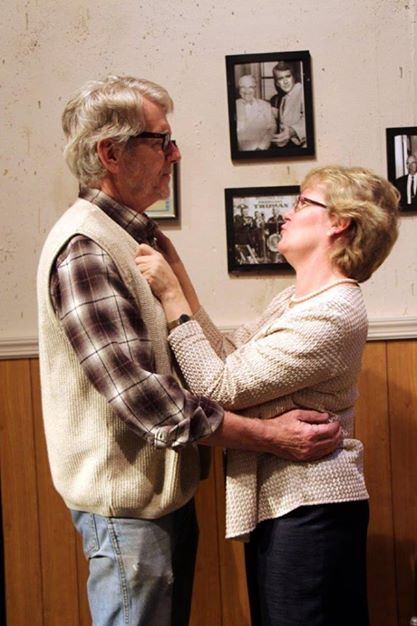
chambers-etiquette“Cheating”, in case you don’t know, is what we call “opening” yourself up, physically, to the audience, even if in real life you’d be facing in a different direction.  For instance, let’s say that two actors are face-to-face downstage center, which means that the fronts of their bodies are perpendicular to the proscenium.  This gives the audience in the center of the theater their profiles.  Anyone sitting on the sides gets a reasonable look at the face of one of the actors, and the back of the head of the other.

For brief moments, this is all right.  If it lasts for more than a few lines, however, it becomes problematic.  The profile view deprives the center of the audience of some emotional impact, which requires a more direct look at the actors’ faces.  The views from the sides of the audience are one-sided – that is, they have a good idea of what one actor is feeling, but can read nothing of the other actor’s feelings except from general body language, since they can’t see his face at all.

Once upon a time (like back in the days of the Greeks and for many centuries afterward), acting was declamatory.  Actors faced the audience fully and spoke.  There was no real pretense at reality as we know it today.

Somewhere along the line – perhaps because of Stanislavsky, or perhaps it began before him – actors began to pull one foot back a little so the front of their bodies were no longer parallel to the proscenium, but they were angled slightly – a bit of acknowledgment that they were talking to someone else on the stage, not to the audience.  These days, 45 degrees is typically the right place to start, and you adjust from there – more “open” (facing the audience more) when you can get away with it, and less “open” (facing another actor more than you do the audience) when the interaction between characters demands it (arguments, etc.)

If you aren’t used to cheating, it feels very unnatural, for the simple reason that it is.  We are accustomed to facing people more directly when we interact with them, and “opening” ourselves up, physically, to the audience for reasons of sightlines is nothing like what we do in real life.  However, it’s a necessary adjustment that adds to the audience’s pleasure and understanding.

The first thing you need to know about cheating is that it looks better from the audience than you think it does.  A few years back, I did a production of Blithe Spirit with an actor who did a lot of musical comedy.  In musical comedy, the cheating is a lot more apparent, because songs are typically directed out to the audience, even if they are being sung to someone else on stage.

When I watched Nick work in scenes I wasn’t in, I studied how he stood and how I felt about it, as an audience member.  He was angled at perhaps 20 degrees, not 45, and from the audience’s perspective, that’s almost as if he is facing them, and yet I never felt like he wasn’t fully involved with his partner.  In other words, it looked perfectly natural and realistic to me.  Why?

There’s two ways to handle this, and only one way works.  The way that doesn’t is to stand as Nick did and turn your head to your partner for the bulk of the scene (both when you’re listening and when you’re talking).  This isn’t much better than if you stood at profile to the audience, or anything between 45 and 90 (or more) degrees.  If the point of cheating is to give the audience a better look at your face, then turning your head defeats the purpose.

What does work?  That’s for the next post!