How I Use Stage Directions

This is just how I use them.  Since I am a big proponent of NOT using them, I think I should probably help you understand exactly what I mean by that.

When I direct, actors love to say to me, “But it says in the stage directions,” to which my typical response is “So?”  But the truth is that I do use them.  I’m just not a slave to them, that’s all.

The first time I read a script, I skip the stuff in parentheses altogether, unless I’m unclear as to what is going on or if the stage directions are very lengthy, in which case they usually represent physical action that isn’t reflected in the dialogue.  In this latter case, what happens is usually material to the plot, and I need to know what is happening.

But my first reading is to get my visceral reaction to the play and to my character.  What hits me between the eyes when I read it?  What is my experience like?  What is the tone of the piece?  In broad strokes, what seems to jump off the page about my character?  What seems important?  Do any images or sounds come up for me?

The second time I read the play, I read it very closely.  I breeze through the first reading, but I slow down the second time, making sure I get every word and its meaning, and this time I read the stage directions, just as carefully.  I know that they are an amalgam of the playwright and the original production, but I like to know what those who have gone before me thought.

The third time through, I highlight my lines.  The fourth time through, I blacken the stage directions with a Sharpie.  But not before reading them again.  Some I actually leave in.  Here’s my logic:20080912-black-marker
Sometimes what is in those parentheses are unnecessary.  A year ago, I did Alan Ayckbourn’s Woman in Mind.  Virtually every adverb instruction (nervously, indignantly, affectionately) was obvious from the writing, I felt.  And with a good writer, this is usually the case.  When that’s the case, I blacken them out.

When I come across an adverb that surprises me, I stop and consider it.  Clearly, I have had a different reaction to the line than the playwright expected.  So what about his choice?  Is it valid?  Is it more interesting than I what I felt?  Does it change the meaning?  Is it playable?

If, after giving it consideration, my reaction is, “Oh, I see!  Of course!”, then I’ll probably blacken it, too.  I’ve made a reasonable commitment to it in that moment, or at least I am confident that I will remember the playwright’s opinion when I rehearse the scene.  But if I’m not confident that I’ll remember, or I find it an interesting idea and want to try it, I’ll let it stand.  Anything I don’t blacken out is there because I want to revisit it, and so I’ll notice it again every time I read the script.  Once I’ve made a decision to use it or not to use it, I’ll blacken it.  (Note that I’m blackening it out whichever I choose.)

The same thing goes for physical movement.  If the business suggested is inherent in the dialogue –   “(lifting his glass)  Here’s to us, darling!” – I’ll strike the “lifting his glass.”  It’s just unnecessary and is cluttering the page, which makes it hard for me to find my lines.  If it’s a physical cross – “crosses to table” – I’ll strike it.  These kinds of movements are entirely flexible and may be different in each production.  “Sits down” may seem obvious, especially if I’ve been invited to sit down, but I want the freedom to sit down when I want to.  Perhaps I’ve been invited to sit, but have reasons of my own to delay sitting.  I’ll sit eventually, but I’ll discover in the course of rehearsals exactly the right moment to sit.

(Bear in mind, too, that actions in the script don’t necessarily happen at the exact moment indicated.  The convention of writing often requires that the movements be noted before or after a line, when in fact they happened in the middle of the line in the original production.  But many actors are determined to do it at the exact moment the words show up in the script!)

Physical action or business which isn’t clearly indicated in the dialogue (such as an ironic lifting of a glass in a silent toast, unaccompanied by the words, “Here’s to us, darling!”) is worth considering.  I may or may not use it, because I may or may not end up coming to the conclusion that it is in character or that it’s an ironic moment.  Or I may find something better to do.

But if it’s worth trying, and I think it is original enough that I might not think of it myself, I’ll leave it be, to remind myself to try it on for size.  If I think it’s an option that will readily occur to me during rehearsals, I’ll strike it.

Any action that is essential to the plotline but isn’t indicated in the dialogue gets to stay in my script.  Descriptions of fight sequences or other complicated physical bits get to stay.  I may or may not use what is suggested, but the stage directions help remind me of what’s important, and give me a base to work from.  A lot of the stage directions in a farce like the Farndale Avenue series stay in, because the script would be incomprehensible without it, there is no need to start from scratch on everything, and it is the cleverness of the authors in coming up with all those sight gags that makes the plays work.

But everything else is pretty much gone after the fourth reading.

salt shaker TooFarNorth textIf you can take the stage directions with a grain of salt, then there is no need to blacken them.  I do it both to clarify what is spoken and what isn’t, as well as to force myself to work a little harder, on the theory that if I have to dig, sometimes I’ll come up with gold.

Every once in a while, I’ll be deep into rehearsals and a scene isn’t working.  So I go back to my script to find how the original production solved it.  Only to find I blackened it out.

But not to worry!  Because most of the actors have left their stage directions untouched, I always have access to them if I need them!

How the Open/Closed Modes Work for Actors

John Cleese talks about open and closed modes, which I’ve noted is what I’m talking about when I say “trial and error.”  (I haven’t been able to find the source for this terminology, if it was originated by someone other than Cleese.)  The modes are very useful in terms of understanding how trial and error works, especially for an actor.

While you don’t want to start rehearsals by saying, “I should do this here!”, it is perfectly okay to say, “Let me try doing this here.”  That’s an open mode decision.  You’re open to possibilities when you say “try.”  Failure or success is not the issue.  We’re just trying something.

Classical_Brainstorming_and_Double_BrainstormingOpen mode is about figuring out what to try.  Brainstorming.  Think of ad execs, sitting in a conference room, throwing around every idea they can think of, many of them stupid, while trying to get pencils to stick in the ceiling tiles.  Saturday Night Live writers toying with skit ideas until they find the ones with the most potential for this week’s show.

That’s what the cast and director should be doing at early rehearsals.  (You can also do some brainstorming on your own time, and bring your ideas of things to try into rehearsals.)

In closed mode, you take the idea you came up with in open mode and take them for a test drive.  (If you’re an SNL writer, this is when you sit down and turn the skit idea into a script.)  You give it the old college try, fully committing to that choice when you run the scene.  Then you go back to open mode, and say, “In what way did that work?  In what way did it not succeed?  What else can I try?”

Note that you haven’t said, “Yeah, I think that works.  Next?”  Instead, you’ve said, “Okay, I know what impact that has.  What else can I try?”  Now you go back to closed mode with the “what else”.  You try as many alternatives as you can think of, and each time you’ve completed the scene, or beat, or whatever, you go back to open mode and evaluate it for pros and cons.

You may not be able to try all the ideas you’ve got for a scene in a single rehearsal.  You have to try out your ideas within the context of how your director wants to use the time.  If you are very confused about your options and want to go through them all in one night, tell your director.  He may be able to accommodate you.  If not, you just try them out as you have opportunities to run the scene.  You’ve got plenty of time.

Once you’ve tried out all the ideas you can think of, you have good information on which to base a decision.  You can choose one of the alternatives, or you can say, “Well, this is the best one I’ve got so far, but it’s not as good as I’d like.  Maybe I’ll find something better down the road.  I don’t really have to choose yet, so I’m going to just put this on the back burner for a while and see if my subconscious can do anything with it.”

Even if you do choose one of your alternatives, keep an open mind.  Something better might pop up, even if you aren’t actively looking for it.  Just be open to it in case it does come knocking.

There is another sort of “openness” you need to maintain even in closed mode, and that is the openness related to staying in the moment.  It’s an ability to recognize when something new and unexpected has arrived, and make room for it and respond to it.  That particular gate needs to always be left open.

Equus, Part III: The First Five Minutes

equus set

The major concern that impacted how my student interpreted the opening monologue in Equus was a need to grab and hold the audience’s attention in the first five minutes of the play.   I agree with the premise in principle.

Should you, as an actor, concern yourself with this?  Honestly, I think it’s the director’s responsibility.  Your responsibility is to make your character a believable person who fairly represents the playwright’s intention.  If you do that and the script is a good one, then the matter of “is the audience going to stay awake for the play” probably won’t arise.  If it does, the director will notice and correct it.

In a quality script, the playwright has eliminated this problem.  Peter Shaffer is one of the best British playwrights of the 20th century.  Equus won a Tony, a Drama Desk, and a Drama Critic’s Award.  It’s very likely that my student was worrying needlessly, but let’s not take anything for granted, and talk about why the script works in this regard.

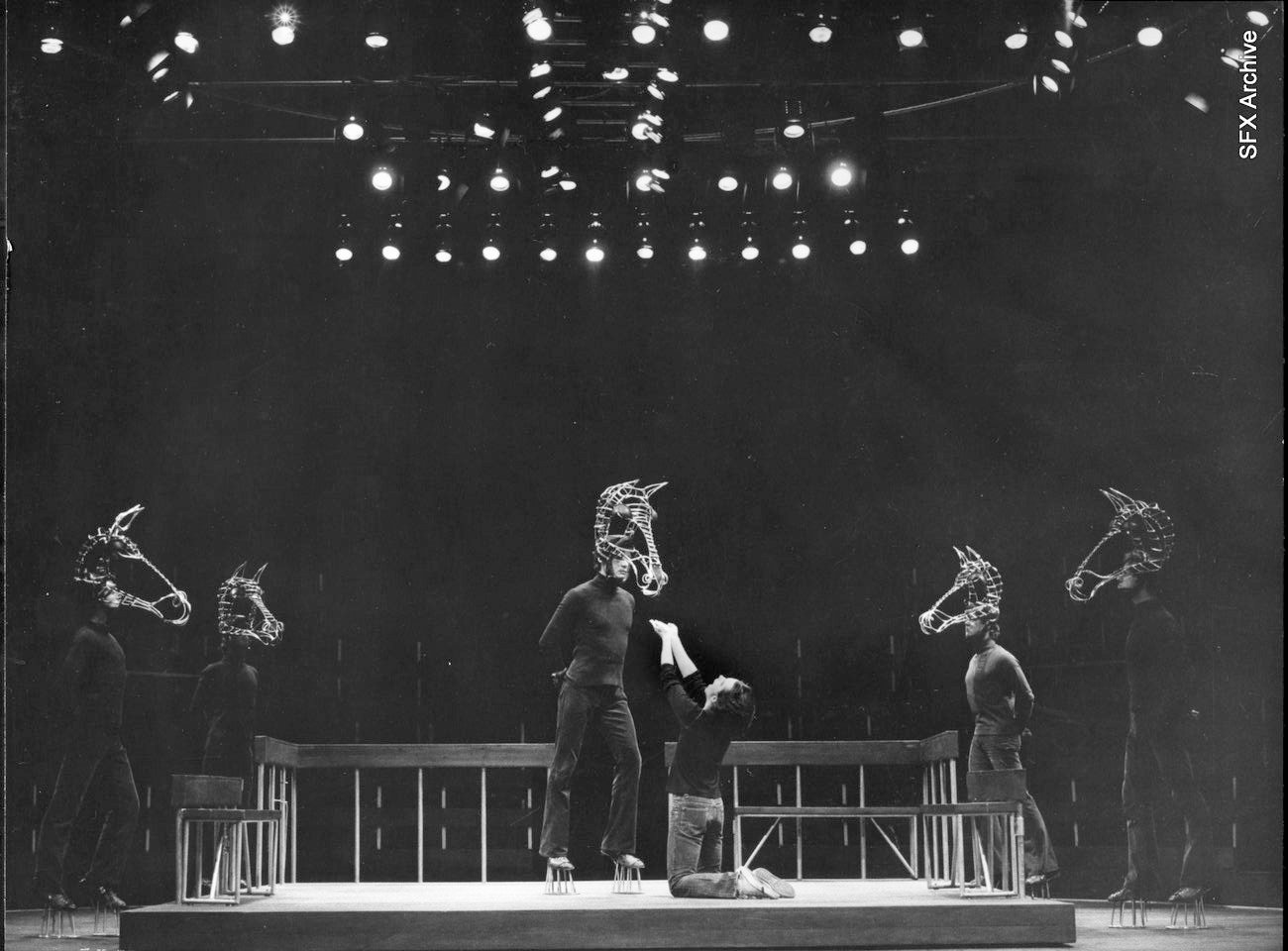
First, Shaffer prefaces the script with some Author’s Notes about the staging.  The photo above is from the recent Broadway revival, and it is loyal to the playwright’s concept in the important ways.  The original Broadway set is below, with the “boxing ring” described by Shaffer.

equus original

Shaffer asks that the entire cast sit on benches behind the boxing ring throughout the performance and enter the ring for their scenes.  When the horses enter the action, the actors playing them rise from the onstage bench and strap on one of the horse heads that hang around the perimeter.  At the start of the play, Dysart sits to one side and speaks to the audience while Alan and Nugget embrace center stage.

The 1974 photo shows you what Nugget looks like.  This highly theatrical and creative imagining of the horse captures the audience’s attention from the moment the lights come up.  All the actor playing Dysart has to do is not lose the audience’s attention in the three minutes between Nugget’s exit and the revelation that the boy embracing him blinded six horses while tending them in the stable.

Shaffer’s gives Dysart a wonderful opening monologue, one that raises more questions than it answers.  Dysart is clearly a man in pain, at a crossroads we don’t yet understand.  He uses words like “lost” and “intolerable” to describe himself, providing intrigue.  Equus plunges us into suspense on a number of levels almost immediately, and when we learn about the blinding at the five minute mark, we are firmly hooked.

This frees the actor playing Dysart to simply play the truth of this man’s life.  At least, this is where he should start.  A month into rehearsals, once he begins to get a good handle on who Dysart is, the director can evaluate whether the first five minutes is strong enough to grab the audience.  A good actor can make the necessary adjustments in a rehearsal or two.  But in the early days of the production, you want to throw yourself into what your character is feeling.

Does the actor need to go out of his way to make Dysart likable?

There is nothing in the script that makes Dysart unlikable.  You may or may not want to have dinner with him, but audiences empathize with good people in painful circumstances.  Make him a real human being with real feelings and needs, and the odds are very good that he will be likable.

What about intentionally playing the humor of the first half of the monologue to deliberately contrast with the serious tone of the second half, as my student did?

The opening of a play is not just about grabbing and holding the audience’s attention.  It establishes the world of the play as well as its tone (hopefully, your director defines both for you; in scene class, you need to figure that out yourself.)  As an actor, you must be faithful to both and not sacrifice either in the name of making yourself well-liked by the audience.  Humor should be injected when it is appropriate, not for its own sake.

The solemn and almost sexual ritual between Alan and Nugget takes place during the first half of Dysart’s monologue.  Use too much or the wrong sort of humor, and you risk mocking this moment, violating the sacredness of what happens between the boy and horse in the rest of the play.

Equus is an intriguing and moving drama, one that doesn’t end on a hopeful note.  It’s not a laugh fest.  All dramas typically have moments of humor, and I encourage you to find and play all of them in order to give your audience some stress relief, BUT you want to discover the tension of the scene first.  Only then can you determine if there is pressure that must be relieved.

We want to entertain the audience, to get and hold their attention.  But we don’t want to make choices that aren’t in keeping with the play.  That’s where you have to start.  When you focus on “likable” and “how can I grab the audience’s attention”, you’re going for product, not process.

I don’t know if humor is appropriate in that monologue or not.  It’s certainly worth investigating.  However, deciding to play up the humor to make the character likable without first examining the character to see if that choice is appropriate is an arbitrary choice.  You can’t choose unless you have options.  Use your rehearsal time to discover the options.  Then, and only then, can you make the best choices.

To read Equus, Part I: The Three Questions, go here.  To read Equus, Part II: Poetic Language, go here.

Actor’s Etiquette: There’s a Director of This Play, and It Isn’t You

51V3ETWY0FLIt is always very bad form to direct another actor or to otherwise ask another actor to do anything for you.

It doesn’t matter if the director isn’t very good.  Or if he seems to have trouble communicating something and you think you know where the disconnect is.  It’s not your show.  Keep your mouth shut.

You undoubtedly have plenty of work to do on your own role.  That’s where your attention should be.

I once watched an actor who wasn’t hired until halfway through rehearsals start directing his scene partner ON HIS VERY FIRST DAY AT REHEARSALS.  My jaw nearly hit the floor.  The director was gracious and let him speak, and the actor to whom he was speaking was so green that he didn’t realize what a faux pas Mr. Newcomer had made.  I probably would have slapped Mr. N. upside the head.  (His behavior only confirmed my feeling that he was a bit full of himself, and it will probably always color how I view him.)

I’ve also seen an actor ask another to alter the timing of his entrance, which was prescribed by the text, because the way he was doing it (at the director’s instruction) “is throwing me off.”  This was even more egregious because the moment belonged to the entering actor, not Mr. Sensitive (see a future post called “It’s Not Your Scene”).

If you genuinely think you can help the director and feel compelled to do so, do it in private, after rehearsal is over.  This gives the director the opportunity to either listen without you undermining his authority in front of the cast or else tell you to mind your own business without making a scene.

Your job is to simply receive and respond to what you get from the other actor, not to demand what he isn’t giving you because he’s not good/clever/insightful enough to give it to you.  Even if you’re asking for the right thing.

Even if the other actor is upstaging you in the worst way and you have every right to be upset, don’t challenge him on it directly.  Let the director know and let him deal with the problem.  He can handle it better than you can.  You risk making the other actor hate you on some level (theater people are not always mature and professional), and it will make the experience miserable for you both and affect the play.

This doesn’t mean that there isn’t room for you to make suggestions in the moment that you think might be helpful to the production, but they should always be made to the director, not to the other actors.  Phraseology matters, too.  “Could we try . . .?”, “I wonder if it might work if we . . .?”, and “Might it be even better if . . .?” leave open the possibility that you’ve just come up with a terrible idea and give the director the ability to turn it down politely.  Creativity in a play is a group activity, and you are a full player in that.  But you aren’t in charge.

And if you aren’t involved in the scene in question, I don’t care how great the idea you have is.  Keep it to yourself and share it with the director privately, after rehearsal.  It’s not the last time the scene will be worked on; it can wait. Never butt in with your two cents on someone else’s scene unless the director expressly asks for suggestions from the cast as a whole.

In brief:  Don’t make the people you work with look stupid or incompetent.

John Cleese on Creativity

Both of the following videos are well worth watching.  After you’ve seen them, read my comments below — just a few things I’d like to highlight about what he says.

http://www.youtube.com/watch?v=zGt3-fxOvug

And then there is the longer 1971 talk:

http://www.youtube.com/watch?v=AU5x1Ea7NjQ

Cleese notes that being creative requires a certain mood:  a willingness to play like a child, exploring ideas not for any immediate practical purpose, but just for enjoyment.  Kids do things for their own sake, without expectations of results.  When you’re playing, nothing is wrong.

Cleese talks about open and closed modes, which is directly related to the concept of trial and error that I have mentioned.  In the open mode, you are deciding what to try.  You go to closed mode to try it, and back to open mode to evaluate its success.  Creativity is a matter of toggling between the two positions, although acting requires that you keep one avenue “open” even while you are trying something in closed mode, and I’ll talk about this in the future.

Space and time, his first two requirements, are essentially about giving yourself permission to play, to be creative without the need to solve problems.  Cleese suggests it takes a half hour to get yourself into open mode for starters, a time frame I concur with.  This half hour is why I suggest that two hour rehearsals are really too short.  Cleese’s audience is made up of businesspeople, and 90 minutes is probably as long as that group will find profitable, but acting is slightly different.  I believe that 2½ hours is the minimum time to maximize the benefit for an actor.  Three is great, if you can manage it, and a ten minute pause in the middle of a 3 to 4 hour rehearsal will not break the spell.  Nor will a lunch break in the middle of a longer stretch.

However, while the entire rehearsal should be about “play” on some level, small segments of it can and should be set aside as “let’s just experiment with this one thing” time, giving the actors the freedom to explore while knowing that the production is still basically on track.  This is a particularly useful approach in community theater, where actors are often results-oriented.

Cleese’s third requirement (also “time”) is what I have referred to as the “subconscious effect” (he calls it the unconscious, but we’re talking about the same thing.)  Creative ideas sometimes need to marinate for a while before they can really germinate.

Cleese uses the word confidence for the fourth requirement, but I use the word courage.  I want a stronger word than confidence to convey the importance of this.  If you are particularly wedded to the idea that there is a Right, then you need courage, not confidence, to break out of that pattern.

To play is to experiment.  To play well, you need to have the courage to fail.  Courage to make mistakes.  A willingness to be open to anything that may happen.  But mostly, as Cleese points out, courage to sit with the discomfort — the absolute anxiety — of uncertainty until you absolutely have to make a decision.

If you can remember that when you’re playing, nothing is wrong, and that you have the ability to evaluate the success or failure of what you’ve tried after the fact, then it is easier to be courageous.  While it feels better to make decisions, if you trust the process and wait until you really have to make decisions to make them (and the more you do this, the later you’ll be able to wait), you’ll find it is worth the wait.  Which will then make it easier to wait the next time.  Once you have experienced the benefit of waiting, you can start to move from courage to confidence.

It’s interesting that Cleese suggests that humor is that fastest way to get into the open mode.  Perhaps this is why I laugh so readily during rehearsals, and try so hard to get my cast to laugh, too.  Laughter is relaxing.  At the very least, don’t take yourself or what you’re doing (even if it’s Medea) too seriously.  It’s not nuclear war.

And lastly, Cleese says this about the Subconscious Effect:  “This is the extraordinary thing about creativity:  If just you keep your mind resting against the subject in a friendly but persistent way, sooner or later you will get a reward from your unconscious.”

It may not come in this rehearsal, or the next.  It may show up in the shower on Friday.  But it will come.  Trust it, and it will come.

To read What is Creativity?, go here.  To read What If I’m Not Creative?, go here.  To read How on Earth Can I Be Creative as an Actor?, go here.

Actor’s Etiquette: Memorize Your Lines

charm-school-for-business-etiquette-6-5-20121I once directed a play with a cast of experienced actors.  At the first rehearsal, I gave them my usual spiel about memorizing lines (you can’t do any real acting until you are off book; the earlier you memorize them, the better your performance will be; I suggest you aim for three weeks before opening; don’t try and go off book until you really are off book, because it’s a waste of everyone’s time and I won’t permit it).

Some directors set “deadlines” for the acts to be memorized, but really – there’s nothing we can do if you miss the deadline, is there?  It’s not like we can send you to bed without supper (not that I think negative reinforcement is a particularly influential approach.)

The actors nodded at me as soon as I began speaking.  As experienced actors, they knew exactly what I was talking about, and three of the actors in this show had a ton of lines each, so they knew what they were facing.

Three weeks before we opened, none of them had come close to memorizing their lines. I hadn’t really focused on this fact.  Yes, I knew they were still carrying scripts around, and yes, they seemed to rely on them more than I thought they should be at that point, but these guys had been around the block more than a few times.  They knew what was required.  They were pros, they’d get it done.

Also, different people handle memorizing differently.  I’ve worked with actors who made me unsure they were ever going to finish memorizing the script, but came in Tech Week solid in their lines and doing some remarkable work.  I hadn’t really worked with two of these actors before.  What did I know about their process?

Three weeks out, it finally occurred to me that I had to bring the obvious to their attention:  “Uh.  You guys might want to think about memorizing your lines.  We open soon.”

I could tell by the expressions on their faces that they hadn’t fully registered the gravity of their situation until I brought it up.  They began to work in earnest on memorizing from that point on, but two of them never really got solid and we had one performance that took a big hit as a result.

As a director, the one thing I DON’T worry about is whether an actor has memorized their lines.  It’s not my butt up on stage, and the one thing the audience won’t blame me for is an actor who forgets his lines.  I have always figured the potential of public embarrassment is sufficient motivation for an actor to hit the books and get his lines down.

I was wrong on this particular point.

I can’t memorize your lines for you.  I also don’t wish to be a nag; it’s an unpleasant role to have to play.  In the future, I’ll remind my casts each week of how far we are from opening and note where I think they are in terms of memorization, but I’m not going to do more than that.  You’re responsible for yourself.

Memorizing your lines is a basic element of being an actor.  Do it early so you are sure to get it done.

Using Subtext to Underscore a Scene

quarterSometimes the text and the subtext are in perfect alignment, and what you say should be taken at face value.  Sometimes “How are you today?” has no hidden meaning behind it.  It’s just something we say in greeting one another.

But they often aren’t aligned.  Sometimes we say one thing and mean another.  Sometimes we feel one thing but pretend we don’t.  Your job, as an actor, is to figure out when there is something hidden, as well as when there isn’t.

Who among us, in our real lives, says everything we think?  How often are we truly honest about what we feel?  And even if we are, how much of what we say is about what we feel?

Very little.  We talk for other reasons.  To gain information, to persuade, to explain, to think through, to debate, to wonder, to entertain, etc.

A single scene in a play may have multiple beats representing Small Verbs (tactics) you use to pursue the Medium Verb that covers the entire scene.  Occasionally, you’ll get more than one Medium Verb in a lengthy scene.  (Your Big Verb for the entire play will remain consistent throughout, however.)

I said that your subtext is both emotions and needs (verbs).  The needs aren’t the Small Verbs, which are simply how you go about getting what it is you want.  Needs are the bigger verbs, both the Big Verb that governs the entire play, and the Medium Verbs that govern scenes.  Added to those needs are any of the emotions that you may be feeling.  That’s your subtext.

Any time what you say and do is not perfectly matched with what you feel or what you want, you’re dealing with subtext.  If you are in touch with those hidden elements, the audience will sense them.  Your given circumstances provide the subtext at the start of the scene, but new information or events can provoke new but unspoken emotions in you that you didn’t have when the scene began, changing or adding to your subtext.

The subtext will typically cover more just the single lines I used as examples in the last post – it will cover one or more beats.

beg-dogFor instance, if I want you to do me a favor, I may not come right out and ask for it.  I need the favor, but I’m afraid it’s something you won’t want to do, and I feel badly about asking for it.  So perhaps I ask you a few questions first, because I want to figure out if it’s really going to be inconvenient for you to do the favor for me.  Perhaps it means driving out of your way, and I want to be sure you have a car in good working condition, and the time to do it in between picking up the dry cleaning and getting your hair cut.

These aren’t idle questions; they are directly related to the matter of asking you to take care of four 8-year-old girls who are having a tea party as their playdate.  How I ask the questions is going to be different than it would be if I was just curious about what you are doing on Friday.  If you start telling me you’re getting your hair and nails done because of a special event you’re going to that evening, I may start feeling guilty about the fact that I’m going to ask you to do me this favor on what is probably a full day for you.  And when you change the subject, I’m going to have to figure out a way to get back to the topic of just what your schedule looks like, so I can determine whether or not I’m going to ask you to do me the favor or find someone else to do it.

I may offer information about my own scheduling problems – the doctor appointment that suddenly became available on Friday, so I don’t have to wait until next week to find out what this strange lump in my body is.  I may share with you my worry that I have the same cancer that killed my mother.  Now I’m giving you a reason to want to help me when I finally get around to asking you the favor.

In other words, on my side of the conversation, it’s ALL about asking you a favor.  THAT’S the subtext of the whole thing.  I don’t ask the favor until the end of the second page, but those two pages are all about asking you a favor.

But again – don’t make the mistake of trying to play the emotional subtext.  Playing emotions for their own sake doesn’t work, whether you’re dealing with text or subtext.  It’s too heavy-handed and not grounded in real desire.

tea partyThis is where the verbs come into play.  They allow you to play the subtext, which includes your emotional state (an altogether different thing from the emotions that may flicker through you during the scene), with subtlety.  I’m not playing guilt, need, fear, envy.  I don’t have to figure out which line is the line to show my guilt on, which line to show my fear on.  I just understand my circumstances:  I am scared that I have a cancerous tumor, and need to visit the doctor on Friday to calm my fears.  My daughter has been planning the tea party for three weeks, and the mothers of the other girls are counting on having the afternoon free and have already made other plans that take them out of town.  You’ve got your own life and your husband is being honored by the Kiwanis Club tonight, and I feel guilty about asking for valuable time to do something that is bound to be stressful.  But I really need this favor, and I’ve asked three other people, all of whom have turned me down.  I really need my friend’s help.

If I understand my circumstances fully, then all I have to do is concentrate on playing my verb – getting you to do me this favor – and everything else, including my emotional life, is largely going to take care of itself in all the right ways.

To read What is Subtext?, go here.

What Is Subtext?

[We interrupt your regularly scheduled programming on Creativity to bring you two posts on Subtext.]

Subtext is what your character isn’t saying.  Not in words, anyway.

ASL_SignerThe playwright provides you with dialogue.  The dialogue is the text. It’s what we are willing to have other people hear.  Sometimes we tell the truth when we talk.  Sometimes we deliberately lie (or fudge the edges). Sometimes we tell what we think is the truth even though it isn’t.  We aren’t ready to face the truth yet, and so we’re lying to ourselves as well as to everyone else.

You don’t have to “play” the text.  The words do that quite nicely without much help from you.  Playing the text is sort of like a fourth grader pointing out where the moon is when he sings about it, and holding his hand over his heart when he sings above love.  It’s unnecessary “sign language”.

What an actor brings to the play is what’s going on INSIDE the character, the stuff he doesn’t say out loud.  The playwright provides clues to that, which are often subtle.  It’s up to you to identify and highlight them for the audience, and to do so not just when those verbal clues arise in the script, but throughout the scene.

In other words, if you get an inkling halfway through a scene that your character is in love with the other person in the scene, you don’t just start giving evidence of that on the line that makes you understand that fact.  You didn’t just start to fall in love when the revealing words come out of your mouth.  You’ve been in love with the other character from the beginning of the scene, in all likelihood.  It is part of the subtext of the scene that will color everything that you say and do.

So how do we find the subtext?

Subtext is both emotions and need: the stuff you carry into the scene and what you’re trying to get out of it.  Your needs are expressed in the verbs you choose.  Your emotions, along with your general nature (your personality and history) help to determine how you go about filling your needs; that is, how you pursue your verbs.

Ask yourself why you say each of your lines.  If you don’t know the answer, read a bit more carefully.  They aren’t just words on the page; they are pieces of information that, put together, create a life. Read them to make sense of the insensible.

But don’t settle for the easy answers to the questions, answers that just rephrase the line you’re working with.

For instance, if an actor has a line that is a question – “What did you mean by that?” – and I ask why he says it, he might tell me, “Because I want to know what she means.”  Well, of course – but WHY does he want to know what she means? Will he be insulted if she means A, or hurt if she means B?  Or is he simply confused by what she’s said – does it seem to him that she is talking about something entirely different than what he thought they were talking about?  And does that worry him?

Look for what we can call the “secondary why”, which has to do with the subtext of the line, and now you are moving closer to understanding what is going on with your character.  Notice that in the examples above, what I am finding is emotional.  I’ve given you an example that is out of context intentionally, so you can see the link to the emotions: insulted, hurt, worried.

Remember, it’s okay to spot the emotion in a scene, as long as you don’t stop there.  Don’t try to play the emotion, but instead just let it inform the scene by influencing how you go about pursuing your verb.  Your emotional state is part of what is called the given circumstances of the scene.  The given circumstances are all the things that have led you to this moment in time (“given”, because the playwright has chosen them).  Understand them and play your verbs, and any new emotions that arise in the scene will take care of themselves.

headacheNow let’s put a question in context and get both the emotions and the verbs.  Let’s say you ask your “husband” in the play, “How are you today?”  Yes, you want to know how he is.  But you have a deeper reason for asking it.  He had a migraine headache last night – you’re hoping it is gone, because you hate to see him in pain.  Or you’re hoping it is gone, because you’re hosting a dinner party tonight, and if he has a headache, it will be a difficult night.

In the first case, you are feeling love and concern for his well-being.  Your verb might be “to take care of him.”  In the second case, you might be worried and just a little overwhelmed.  Your verb might be “to have a successful party.”

Or perhaps you had a fight last night, and you’re testing the waters, to find out if he’s still mad at you.  Or perhaps you want to ask him a favor, to let your parents stay with you for two weeks when they visit next month.  He’s not fond of your father, so you want to make sure he’s in a good mood when you ask him.

In the first case, you might be uncertain and hopeful, and your verb is “to reconcile with him.”  In the second case, you might be feeling anxious and needy, and your verb is “to convince him to let your parents visit.”  (Maybe I have that wrong – maybe you’re uncertain and needy, and anxious and hopeful!)

All of these possibilities are the subtext, the meaning that lies underneath the very simple words, “How are you today?” Read the script over and over again until you find the meaning that is hiding between the lines.

To read Using Subtext to Underscore a Scene, go here.  To read An Example of Why Verbs Make a Difference, go here.

What the Heck Is This Play About?

[This is the first post on the subject of Script Analysis.  It’s a topic I’ll deal with in depth in a month or three, but my current students have need of this right now, so I’m tossing it into the middle of the Creativity series.]

A-Few-Good-MenAs an actor, you have to know this before you can begin to do justice to your role.

Playwrights don’t write plays because the local theater needs a script.  They write because they have something to say that sheds a tiny bit of light – no answers, necessarily, just light – on some aspect of human existence.

You need to figure out why the playwright felt driven to write this particular play.  The answer is going to directly affect the choices you make as an actor.  If you’re going to be a good storyteller – and that’s all an actor really is, a storyteller – then you’d better know what the story you’re telling is about.

The fancy English Lit term for this is “theme.”  I’ve always hated this word.  Never understood it in school, despite asking multiple teachers to explain it.  Whatever words they were using to describe it were too esoteric for me.

I began to get a handle on it during playwriting classes, and finally grasped it fully when I started to direct.  Identifying and articulating the theme and choosing a vision that honors the playwright’s reason for writing the play is the first responsibility of the director.

Why not just wait for the first rehearsal, when the director will share his understanding and vision with you?

First, because it’s lazy.  Understanding the reason for the play in your bones is going to help you produce better work than if you just sign your name to the director’s vision statement.  Yes, you need to understand and subscribe to what he tells you, but you’ll have more luck doing so if you do your own homework.

Second, because not every director is going to share his vision with you, particularly in amateur theater.  Not every amateur director realizes that having a vision and sharing it with his cast is his responsibility.  If he doesn’t, you better find the answer yourself if you hope to turn in a credible performance.

So what’s a “theme?”

It’s what the play is about, not what happens in the play.  What happens in the play is the plot:  Felix Unger gets kicked out by his wife, he moves in with his friend Oscar, they fight and drive each other nuts, but ultimately learn to get along.  (The play in question is Neil Simon’s The Odd Couple, in case you aren’t familiar with it.)

Playwrights use the plot as a means of talking about the issues that matter to them.  Underneath the plot, they are really dealing with high concepts.  Start by going after them.  You can do this by asking yourself, “What is Simon concerned with in this play?  What part of life is he examining?”

Answer:  Loneliness and friendship.  Some other examples?

     King Lear:  Greed, ego, and love.
     Romeo and Juliet:  Love and hate.
     Amadeus:  Talent, desire, envy, and grace.
     A Few Good Men:  Loyalty, honor, justice, and humanity.

You might choose different words to describe these plays, but I hope you get the idea.

If you go no further than identifying the high concepts, you’ve got something valuable to work with.  If you’re in The Odd Couple, you need to look at your role in terms of loneliness and friendship.  What are the moments when loneliness is a part of your existence?  When do you have friendship or are striving to get it?

By looking for the connections between the high concepts and the action or dialogue in the play, you can subtly “underline” them for the audience, which is good storytelling.  Pass everything that happens during the play through the filter of “loneliness” and “friendship”, and the playwright’s message should come through loud and clear.

You can’t possibly do this effectively unless you know what the play is about.

The theme is more than just the high concepts.  The playwright has an opinion about those concepts.  How you interpret the opinion is your vision.  Different people, because they have different personalities and backgrounds, may interpret the playwright’s opinion in slightly or materially different ways.  This is why vision is the director’s choice.  We all have to be on the same page, and the director is the one to choose that page.

So how you string the high concepts together matters.  For The Odd Couple, I might say, “Friendship is the only antidote to loneliness.”

For A Few Good Men, I might say, “When loyalty to corporate bodies harms an individual, it is no longer honorable.”  Or I might say, “Everyone deserves justice, irrespective of rank or prestige.”  Or, “We must never forget that the military is made up of human beings.”  In the first instance, I am emphasizing loyalty and honor.  In the second, justice and equality.  In the third, humanity and compassion.  Whichever alternative I choose determines what I want to most emphasize in my portrayal of whatever character I am playing.  Productions using different visions will, of necessity, have different feels and different impacts.

Which is why the first, most important step in Script Analysis is to know why the playwright wrote the play.  Or at least, why you think he did.

What Is Creativity?

creativityI’m going to shut up for this post.

I know.  Can I even find it possible?

I’m going to let others speak.  And then I’ll pick up the train of thought next time.

“It is a commonplace among artists that masterpieces are made in passing, not by the focused attempt to create one.  That very attempt often skewers the spontaneous internal process, the inspired hunch or ‘fine madness’, that makes great art a happy accident that seems inevitable only in retrospect.”Julia Cameron, Chicago Tribune, 1986.

“You don’t have to be a believer to recognize a moment of grace.  By grace I mean those precious, rare times when exactly what you were expecting gives way to something utterly different, when patterns of thought and behavior we have grown accustomed to and at times despaired of, suddenly cede to something new and marvelous.  It may be the moment when a warrior unexpectedly lays down his weapon, when the sternest disciplinarian breaks into a smile, when an ideologue admits error, when a criminal seeks forgiveness, or when an addict hits bottom and finally sees a future.  Grace is the proof that hope is not groundless.”Andrew Stillman, “Untier of Knots”, 12/17/13.

“I don’t just use bad writing excerpts as prompts for workshops.  I also produce a tremendous amount of bad writing myself.   In fact, if some poor graduate student were assigned to do an audit of my entire literary output over the past twenty years, this person—before killing themselves—would find that about 70 percent of what I write is dreck.

“And I know I’m not alone.  If you go visit the archives of your favorite writer, as I did with Kurt Vonnegut several years ago, you will find a treasure trove of unpublished work.  And, if you’re anything like me, you will be heartened by this discovery.  It’s a great relief to realize that all those published writers we idolize aren’t cranking out epic prose every day at the keyboard.  Sometimes, they’re stinking it up, just like we do. …..My basic theory is that most pieces of failed writing—whether stories, poems, or novels—are usually attempts to tell a story that the author simply wasn’t ready to tell yet.

“This is why so much of my bad poetry is clogged with overwrought language, because I’m stonewalling basically, trying to sound profound and beautiful rather than telling the truth. …..My own belief is that writing is too intimate and arduous an activity ever to perfect.  We need to stop viewing our task as the production of transcendent work. Instead, we should emphasize the process as a gradual reduction of our (necessary and inevitable) imperfections.

“I realize how frustrating it can feel to produce weak work.  Believe me.  But I’ve also come to accept that bad writing doesn’t just mark a creative dead end.  It’s a necessary station on the path to good writing.”Steve Almond, Blog Post on AWP Website, Feb. 2014.

“Fine writing is never one to one, never a matter of devising the exact number of events necessary to fill a story, then penciling dialogue.  Creativity is five to one, perhaps ten or twenty to one.  The craft demands the invention of far more material than you can possibly use, then the astute selection from this quantity of quality events, moments of originality that are true to character and true to world.  When actors compliment each other, for example, they often say, “I like your choices.”  They know that if a colleague has arrived at a beautiful moment, it’s because in rehearsal the actor tried it twenty different ways, then chose the one perfect moment.  The same is true for us.

“Finally, it’s important to realize that whatever inspires the writing need not stay in the writing.  A Premise is not precious.  As long as it contributes to the growth of story, keep it, but should the telling take a left turn, abandon the original inspiration to follow the evolving story.  The problem is not to start writing, but to keep writing and renewing inspiration.  We rarely know where we’re going:  writing is discovery.”Robert McKee, Story, 1997.

A few thoughts from John Cleese:

“…the most creative professionals always played with a problem for much longer before they tried to resolve it.  Because they were prepared to tolerate that slight discomfort and anxiety that we all experience when we haven’t solved a problem.”

“Now, the people I find it hardest to be creative with are the people who need, all the time, to project an image of themselves as decisive.  And they feel that, to create this image, they need to decide everything very quickly, and with a great show of confidence.  Well, this behaviour, I suggest sincerely, is the most effective way of strangling creativity at birth.”

“And if while you’re pondering, somebody accuses you of indecision, say:  ‘Look, babycakes, I don’t have to decide until Tuesday, and I’m not chickening out of my creative discomfort by taking a snap decision before then, that’s too easy.‘  So, to summarise, the third factor that facilitates creativity is time.  Giving your mind as long as possible to come up with something original.”

And I’ll leave the final words to Thomas Edison:

“Negative results are just what I want.  They’re just as valuable to me as positive results.  I can never find the thing that does the job best until I find the ones that don’t.” 

To read What If I’m Not Creative?, go here.  To read How On Earth Can I Be Creative As an Actor?, go here.  To read John Cleese on Creativity, go here.