Exploring the Subtext

rainmaker 2Let’s say that I try the scene from The Rainmaker the way Nash wrote it.  I try it with the alternatives that I’ve suggested, and at the end of the day, apart from the step File takes toward Lizzie, which I think makes no sense at all, I end up using Nash’s choices.

Doesn’t that justify just using Nash’s choices from the beginning?  Should I waste time trying things that ultimately aren’t going to work, that are going to be tossed aside?

First off, I don’t know at the time that I am exploring my options in the scene that I’m going to end up using Nash’s choices.  It’s just as possible that I will use my own.  The only way that I can be confident that his choices are the right ones is if I explore and dispense with any other possibilities.  The confidence I gain is worth the effort.

Second, I get a good deal out of exploring the options that I ultimately don’t use.  It’s called exploring the subtext.

Because we are often unable or unwilling (often out of fear) to be honest with each other, creating the confusion and conflict of good drama, the unspoken thoughts and feelings which make up the subtext are important elements for an actor.  To create a really rich performance, you have to know what the subtext is and play it accurately.

You don’t do that by saying “File and Lizzie have been in love forever, but File keeps resisting it.”  You do it by immersing yourself in the longing you have for the other person, the desire to touch them.  Once you’ve pumped up that desire to its max, you can now layer resistance on to it and the electricity in the scene skyrockets.  Without the intimate understanding of what the love File and Lizzie have for each other really feels like, you can’t know what it is you are resisting.  The audience needs to see not just the resisting, they need to see the love, too.  If you don’t show the audience the love, then all they see is resistance, and they don’t know how to interpret it.  Do they hate each other?  Love each other?  Or are they indifferent?  If you aren’t actively resisting something, it’s apt to come out somewhere in the middle, and that looks a lot like indifference.

It’s the push me/pull you relationship of the love and the “I can’t give in to this” (File) or “I can’t let him know how much I care” (Lizzie) that is dramatically interesting.  Play one without the other, and you’re missing half of the symphony.

So however you choose to stage this scene, you need to explore both elements, text and subtext.  By experimenting with the levels (how much love, how much resistance), you discover the most interesting and powerful way to play the scene.

In other words, when there is clear subtext in a scene – when your feelings are not aligned with what you say – your performance will ALWAYS be best served if you take at least one rehearsal of the scene and play the subtext as clearly as possible (even if it appears to categorically contradict particular lines you speak).

Oh, and the negative “can’ts” up above?  It’s okay to start with them as long as you translate them into positive verbs, as in “I must resist loving Lizzie” and “I must hide my love from File”.


Stage Directions Aren’t Always Right — An Example

rainmakerThere may be no successful playwright who has written more stage directions than N. Richard Nash, the author of the wonderful romantic comedy, The Rainmaker.  (The 1956 movie starred Katharine Hepburn and Burt Lancaster.)  The Rainmaker is chock full of emotional and physical choices, so much so that the usual measures of timing (minutes per page) can’t be used in determining the running time of the show!

Below is a portion of the scene between Lizzie, the old maid daughter of a rancher, and the Deputy Sheriff she has had her eye on for years.  Read the scene through, including the stage directions, and visualize the scene in your mind’s eye.  The directions are so extensive that I hope you can get a clear picture of how it can be played if you stick to everything in the script.

Now I’d like to show you how there are alternatives that ought to be at least considered, and by considered, I mean tried in an actual run-through of the scene.  Because you won’t know if something works or not until you try it.

I’m starting the scene at Noah’s exit, in the middle of page 67 (here’s The Rainmaker Excerpt).

File (Going to the door)  Well –

“Well” might mean, “Well, I guess I’ll be going”, but it doesn’t have to.  Perhaps it means “Well, I’m not sure what else to say.”  And even if it does indicate a departure, that’s a very good reason to not move to the door.  When a character says he’s leaving and he doesn’t leave – or he moves his upper body as if to leave, but his feet stay planted – that’s a loud and clear message that his heart is still in the room.  That’s both powerful and interesting to an audience.

Lizzie (Afraid he will leave)  if File chooses to stay where he is when he says “Well”, perhaps Lizzie isn’t afraid that he will leave after all.  And perhaps Nash is wrong when he says that Noah broke the spell between them.  Perhaps he didn’t break the spell at all, and something monumental is happening between these two.

Lizzie (Snatching for a subject that will keep him here)  If the spell still has them in its hold, then she doesn’t have to snatch.  But more importantly – the topic of his divorce is huge.  You don’t just snatch for such a sensitive topic because you want to keep someone in the room.  You offer him a slice of pie to do that.  No, the better (that is, the more dramatic choice) is for Lizzie to mention the divorce because she desperately wants to hear the details about it.  For her, the divorce is what has kept them apart.  Now is her chance to clear the air.

File:  No – I wasn’t – (Then, studying her, he changes his mind.) – but I will.

The implication is that he is still at the door, ready to leave, until he studies her and changes her mind.  Except that he doesn’t have to.  He can still be standing stock still when he says “No, I wasn’t.”  And he doesn’t necessarily change his mind, he simply decides to tell her.  And that’s a very different thing for an actor.

Lizzie (Helping him to get it said)  Kentucky?

Maybe Lizzie IS trying to help him.  Maybe she is just trying to connect with him, to indicate her understanding.  Or maybe she is covering her own nervousness about the topic but saying something, anything.  Or maybe she is puzzled by someone from so far away stealing File’s wife – how did he come to be so far west?

File (A step toward her)  Yes, she was.

Lizzie (Her hopes dashed)

If File is moving toward her, why are her hopes dashed?  When the man you love moves toward you, it’s a positive sign.  It offsets the “Yes, she was”, or at least should cause confusion.  The moment is probably stronger if he stands still and watches her while she becomes a nervous wreck.

As for Lizzie’s next lines, I almost think the start of the word “afraid” is too much.  It’s implicit in the line and is overkill if she actually says it.  If I had written the play, I would have had her stop at “That’s what I w—“, or maybe even drop the “w”.  And rather than “catches herself”, I might have said “smiles”, as in that bright smile that covers the tears.  But even if we leave the line as written, the smile still works.

Lizzie (Drearily).  Why drearily?  And on her next line, why “Agreeing – but without heart?”  What if Lizzie sincerely believes that women with black hair are the most beautiful, and her mousey brown is unattractive?

File sits when he describes the schoolteacher.  But is there any compelling reason to?  I’d have the actor try it standing, try it pacing, try it with movement that isn’t pacing, AND try it sitting.  I can’t begin to guess which choice better underlines what is going on for File emotionally until I see what impact the movement has on how he behaves and says his lines.

File (Raging)  What if the rage comes between “No I didn’t” and “Why should I?”, instead of before both sentences?

Lizzie (Astounded)   The only problem with this adjective is that the word tends to indicate something big, and the italics in her lines that follow underscore that intention.  But what if she is a combination of exasperated and astonished on “Why should you?” and then goes very quiet and intense on “Why didn’t you?”  Or the opposite:  a very quiet “Why should you?” as if she can’t believe he even asks that, it’s so absurd, followed by a loud, berating “Why didn’t you?”

Lizzie (Desperately)  What if she isn’t desperate on this, but instead challenges him with this line?

I could go on, but I hope I’ve made my point.  Nash’s choices certainly work, but so do mine.  Only by trying them can you determine which works better.  Or perhaps find a way of combining the two!

The Stage Directions You Should Pay Attention To

There is, of course, an exception to every rule.  So there are stage directions that I wouldn’t think about ignoring.

godot3_p1250709Samuel Beckett’s plays are a good example.  Waiting for Godot specifies a single tree in a barren landscape.  To populate the set with some scrub brush as well would be to damage Beckett’s intention.

To have Hamm stand or Clov sit in Endgame would similarly harm the play.

In Equus and in Christopher Schario’s A Christmas Carol, the playwright calls for the actors to be on stage at all times, seated on benches at the sides when they are not part of the action.  This is a choice that should be honored in the production.

Thornton Wilder makes no such request for Our Town, but productions of his play have been staged this way, and I don’t see it as problematic.

Schario’s play calls for a fiddler on stage, who plays music at various points throughout the night.  When I directed the play, there was no fiddler available.  We turned four of the actors into a singing quartet who fulfilled Schario’s intention faithfully, I think.  However, striking the musical component entirely would have lessened the play.

Our townNoel Coward’s estate insists that his plays be staged with complete fidelity to the stage directions, including the smoking.  I’m not sure that every cigarette in Coward’s oeuvre must stand lest his plays be harmed.  (A red pen to some of his dialogue would strengthen the plays, but alas, we must draw the line there.)

Full realistic sets for Our Town would completely contradict the playwright’s purpose; however, if you indicated the gardens with something other than arched trellises, I doubt an audience would be disturbed.

In other words, examine the stage directions, playwright’s notes, and dialogue for the playwright’s intention.  Honor the intention.  If you succeed in this goal, then whatever you do will be all right.

How I Use Stage Directions

This is just how I use them.  Since I am a big proponent of NOT using them, I think I should probably help you understand exactly what I mean by that.

When I direct, actors love to say to me, “But it says in the stage directions,” to which my typical response is “So?”  But the truth is that I do use them.  I’m just not a slave to them, that’s all.

The first time I read a script, I skip the stuff in parentheses altogether, unless I’m unclear as to what is going on or if the stage directions are very lengthy, in which case they usually represent physical action that isn’t reflected in the dialogue.  In this latter case, what happens is usually material to the plot, and I need to know what is happening.

But my first reading is to get my visceral reaction to the play and to my character.  What hits me between the eyes when I read it?  What is my experience like?  What is the tone of the piece?  In broad strokes, what seems to jump off the page about my character?  What seems important?  Do any images or sounds come up for me?

The second time I read the play, I read it very closely.  I breeze through the first reading, but I slow down the second time, making sure I get every word and its meaning, and this time I read the stage directions, just as carefully.  I know that they are an amalgam of the playwright and the original production, but I like to know what those who have gone before me thought.

The third time through, I highlight my lines.  The fourth time through, I blacken the stage directions with a Sharpie.  But not before reading them again.  Some I actually leave in.  Here’s my logic:20080912-black-marker

Sometimes what is in those parentheses are unnecessary.  A year ago, I did Alan Ayckbourn’s Woman in Mind.  Virtually every adverb instruction (nervously, indignantly, affectionately) was obvious from the writing, I felt.  And with a good writer, this is usually the case.  When that’s the case, I blacken them out.

When I come across an adverb that surprises me, I stop and consider it.  Clearly, I have had a different reaction to the line than the playwright expected.  So what about his choice?  Is it valid?  Is it more interesting than I what I felt?  Does it change the meaning?  Is it playable?

If, after giving it consideration, my reaction is, “Oh, I see!  Of course!”, then I’ll probably blacken it, too.  I’ve made a reasonable commitment to it in that moment, or at least I am confident that I will remember the playwright’s opinion when I rehearse the scene.  But if I’m not confident that I’ll remember, or I find it an interesting idea and want to try it, I’ll let it stand.  Anything I don’t blacken out is there because I want to revisit it, and so I’ll notice it again every time I read the script.  Once I’ve made a decision to use it or not to use it, I’ll blacken it.  (Note that I’m blackening it out whichever I choose.)

The same thing goes for physical movement.  If the business suggested is inherent in the dialogue –   “(lifting his glass)  Here’s to us, darling!” – I’ll strike the “lifting his glass.”  It’s just unnecessary and is cluttering the page, which makes it hard for me to find my lines.  If it’s a physical cross – “crosses to table” – I’ll strike it.  These kinds of movements are entirely flexible and may be different in each production.  “Sits down” may seem obvious, especially if I’ve been invited to sit down, but I want the freedom to sit down when I want to.  Perhaps I’ve been invited to sit, but have reasons of my own to delay sitting.  I’ll sit eventually, but I’ll discover in the course of rehearsals exactly the right moment to sit.

(Bear in mind, too, that actions in the script don’t necessarily happen at the exact moment indicated.  The convention of writing often requires that the movements be noted before or after a line, when in fact they happened in the middle of the line in the original production.  But many actors are determined to do it at the exact moment the words show up in the script!)

Physical action or business which isn’t clearly indicated in the dialogue (such as an ironic lifting of a glass in a silent toast, unaccompanied by the words, “Here’s to us, darling!”) is worth considering.  I may or may not use it, because I may or may not end up coming to the conclusion that it is in character or that it’s an ironic moment.  Or I may find something better to do.

But if it’s worth trying, and I think it is original enough that I might not think of it myself, I’ll leave it be, to remind myself to try it on for size.  If I think it’s an option that will readily occur to me during rehearsals, I’ll strike it.

Any action that is essential to the plotline but isn’t indicated in the dialogue gets to stay in my script.  Descriptions of fight sequences or other complicated physical bits get to stay.  I may or may not use what is suggested, but the stage directions help remind me of what’s important, and give me a base to work from.  A lot of the stage directions in a farce like the Farndale Avenue series stay in, because the script would be incomprehensible without it, there is no need to start from scratch on everything, and it is the cleverness of the authors in coming up with all those sight gags that makes the plays work.

But everything else is pretty much gone after the fourth reading.

salt shaker TooFarNorth textIf you can take the stage directions with a grain of salt, then there is no need to blacken them.  I do it both to clarify what is spoken and what isn’t, as well as to force myself to work a little harder, on the theory that if I have to dig, sometimes I’ll come up with gold.

Every once in a while, I’ll be deep into rehearsals and a scene isn’t working.  So I go back to my script to find how the original production solved it.  Only to find I blackened it out.

But not to worry!  Because most of the actors have left their stage directions untouched, I always have access to them if I need them!

I Don’t Know If I’m Supposed to Be Submissive or Aggressive in This Scene

Agnes_of_God_GozoAt first blush, you might think that the actress who said this hasn’t got a clue about her character.  I mean, these are polar opposites, right?  They can’t possibly both be right in the same scene.

Actually, her instincts are correct.  The scene is from Agnes of God, pages 23 to 25.  It’s a scene between Agnes and the Mother Superior, two years before Agnes’ pregnancy.  Agnes has stopped eating, because she believes saintliness requires her to be skinny, and she wants to suffer as the saints do.  The Mother Superior is worried about her health and wants her to eat.  Agnes is bound by her vows to obey the Mother Superior, who is also a surrogate mother to her.  But she also feels that she has been instructed by God to lose weight, that unless she does so, he will be angry with her.  She won’t let the Mother Superior overrule God’s instructions.

The actress playing Agnes sensed that she has moments of strength and weakness in the scene, but had trouble sorting out when to use which.  Despite the fact that she had only been working with me about a month at the time, with no prior acting experience, she had learned enough that when I replied by saying, “Submissive or aggressive?  I think you’re on the right track, the only problem is that th . . .”

“They’re adjectives,” she finished for me, shaking her head, vexed at falling into the trap again.

Listen, it’s okay to come up with adjectives and emotions when you are first talking about a scene.  That’s what we respond to as human beings.  The problem comes when we can’t move past them and we use them as the primary guidance for how we play the scene.  No matter how good your instincts are, unless you can build into those emotions by discovering the character’s history and what they want most, playing the emotions will be general and superficial.  You need to clearly understand why THIS particular character is [insert adjective] at THIS particular moment in her life.

So once you’ve identified the emotions or the adjectives that seem appropriate to you, simply translate them into verbs.  As I’ve mentioned before, you do this by asking, “Why would I be submissive?”  The answer?  “Because I’m a nun, and I have to do whatever my Mother Superior says.”  The verb?  To obey.

“Why would I be aggressive?”  “Because she is trying to make me do something that I know is wrong, that God would hate.  I can’t let her force me to eat.”  The verb?  When I asked the actress to tell me what the scene was mostly about for her, she named her verb in response to the idea of being aggressive:  To escape.

These are two strong verbs in opposition.  “To obey” implies, on some level, “to stay”, which is the direct opposite of “to escape.”

When you can find contradictory motivations like these, scenes can become electric as you go back and forth between two opposing needs in one person.  On the one hand, I have to obey her, on the other hand, I have to resist her power and do what I know is right.  The conflict is no longer just between Agnes and the Mother Superior, it is also within Agnes herself.  The tension of what is going on onstage just tripled.

Why (and How) I Use Verbs

verbs (1)I wasn’t introduced to verbs as a dramatic concept as an actress.  When I was learning to act, we talked about “motivations” and “objectives” without distilling it to the very simple idea that these multi-syllabic high concepts can be put into verbs.

No, I encountered verbs much later, in playwriting class.  It occurred to me then that they had use for actors, but I wasn’t acting at the time.  Another decade, probably, passed before the use of verbs infiltrated the acting community in a meaningful way.  (Like everything else, acting has its “fashions”.)

As an instinctive actress, talking about objectives was sufficient for me; I was playing verbs without having any idea that was what I was doing.  But in recent years, I have taken to sitting down with my script before rehearsals start, whether I am directing or acting, and doing some intentional verb work.

First, I break the scene into beats, which I mark with a pencil in case I want to change my mind later.

Then I give each beat a name that says something to me about what happens in that beat.  It’s an outline of the play, basically.  It’s my big picture feel for the play, and it helps me to get a stronger sense of the flow of the play, as well as to cement the structure in my head.  Knowing, generally speaking, what happens next is essential if you are going to help “save the day” when someone forgets his line.

It also can help me to spot what is humorous and what is not.  If I’m in a comedy, it helps me to clearly identify when the dramatic moment starts and ends, and vice versa if I’m in a drama.  In a drama, I’m always looking to find ways to lighten the piece, and clarifying which beats are humorous allows me to extend the humorous moment throughout the entire beat, rather than just using it on the punchline.

And then I go back to Beat One and identify my verbs, beat by beat.  It can be laborious work, if I have a large role.  But as instinctive as I am, I find it does a few things for me:

  • It helps me to get more specific about my verbs.  When a general verb shows up on my list (“to find out”), I know to go looking for a more interesting version (“to inquire”; “to demand to know”; “to cross-examine”; “to probe”; “to dig”).
  • It helps me to make distinctions between beats that have similar verbs.  If I have “to find out” on three different beats in the same scene, I know I need three different verbs for each, and I head for the thesaurus.
  • It helps me spot my own stereotypes.  We all have them, but it can be hard to see them ourselves.  It allows me to take a third-person position and evaluate my own choices with a certain amount of objectivity.  I’m not afraid to call my own choices “trite” when I do this.
  • It helps me to identify the areas of the script I’m apt to have difficulty with.  If I have trouble choosing a verb, I know I don’t understand that beat well enough.  I may not solve the riddle of this particular beat today, but it now has a red flag on it, and I know I need to give it special attention throughout rehearsals.
  • It helps me to see patterns.  If I have the same general verb several times in one scene, I know I’m probably dealing with something that needs to escalate.  I might notice the scene is framed by similar beats.  It also helps me to see patterns across the full play, e.g. a repetition or a reversal in the second act of something that happened in the first.
  • It helps me to know who is the aggressor in the scene, or if we change positions during it.  If I’m the weaker character, it might help me to identify the moment when I start to develop a spine.  It doesn’t just happen on the line when I explode in my own defense.  It has probably started several beats before that explosion, and I need to know when that is.
  • It helps me to identify things about my character that are revealed later in the play but which need to be foreshadowed in the first scenes.
  • I’ll usually notice who is the “star” of the beat, if there is one.  Even if I’m playing the lead and all the action of the play centers on me (e.g., Woman in Mind, Trudy Blue), it doesn’t mean the attention should always be on me.  It’s important to know when to defer the limelight to the other character.  Among other things, this will affect the blocking of the beat.

For me, this is pretty intense, conscious detective work, and it may easily take me four hours if I have a leading role, but I have a strong sense that its benefits are worth the time.  This is also the one thing I commit to writing when I act.  (I know actors who write formal and extensive biographies of their characters, but I’ve never found that useful for myself.)

Beyond this, I don’t do much with the verbs.  I trust that my subconscious has gotten the message and will do what needs to be done.  While you’re learning how to use verbs, you may need to play at least some them a little more consciously, while you’re getting the hang of it.  Don’t worry if you don’t manage to hit every single verb during the course of a single run-through.  It can be difficult to make all those switches effectively.  If you manage to get 25% of them the first time, that’s probably pretty good.  Over the course of several run-throughs, you’ll be able to hit the most important ones.  But don’t worry if you don’t intentionally play every single verb you’ve identified.  That’s normal.

I have a good memory, and I’ll probably remember the verbs in some haphazard fashion during rehearsals.  By that I mean that I’ll sense that a scene isn’t going as well as it should, that I’m being superficial or monotonous, and I’ll remember to think in terms of verbs.  (Because the beat divisions are marked in my script, they remind me on a semi-subliminal level of when things change on stage.)

If I’m really struggling with a section of the play a month into rehearsals, I’ll ask the director if we can run it a few times, and I’ll do some very conscious work with tools at this point.  It is likely that I’ll play with verbs a bit on at least one of the run-throughs, or perhaps several as I ratchet up the intensity of my choices.

An Example of Why Verbs Make a Difference

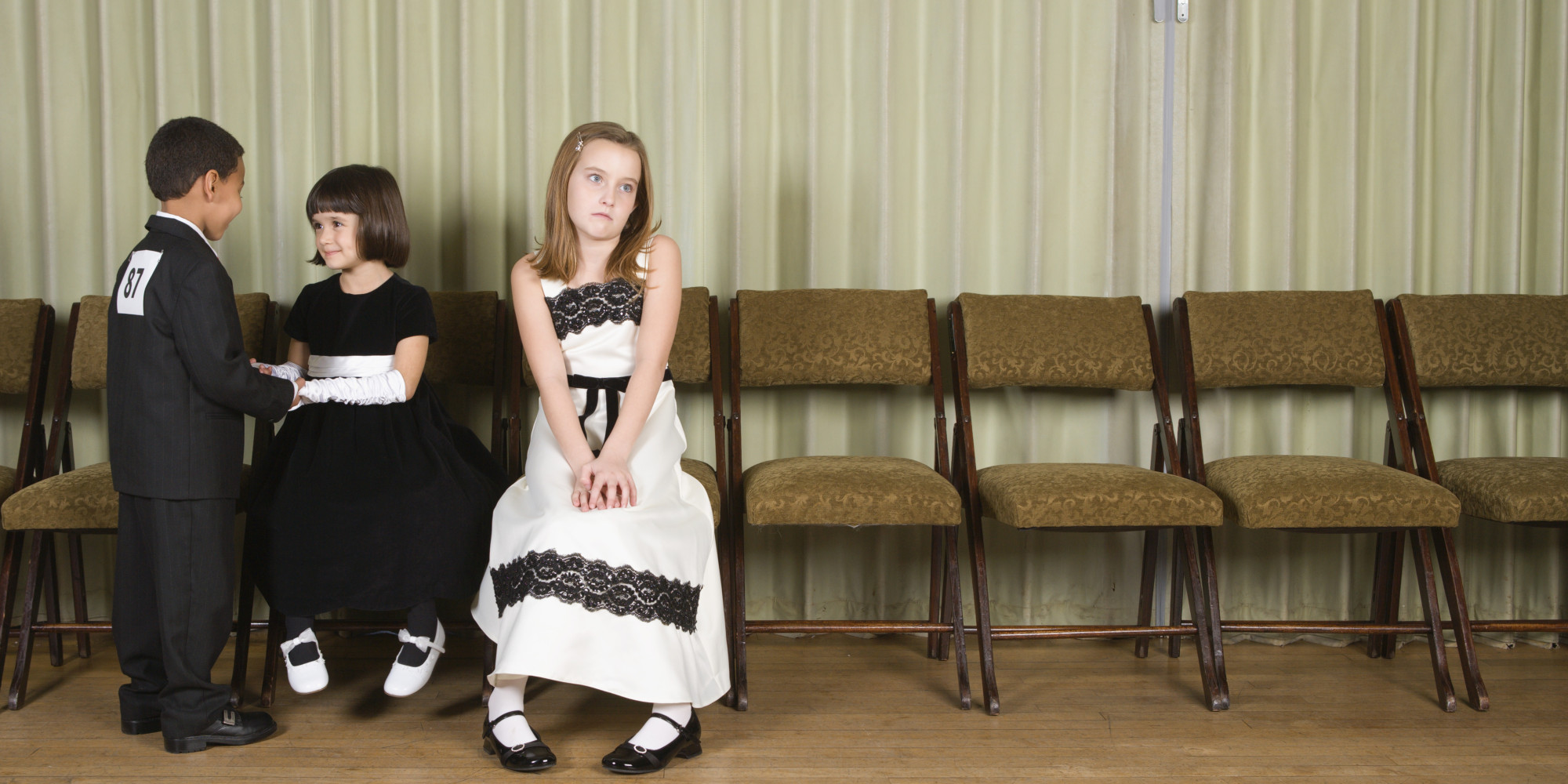
wallflowerOne of my students is rehearsing a play that requires her character to be at a dance.  I happened to see a few minutes of rehearsal, and noticed that she kept looking to the floor, which is a choice I try to encourage actors to not use to excess.  Audiences like to see your eyes.

She explained that she was looking at the floor because she was waiting for someone to ask her to dance.  In other words, she had chosen to have her character be bashful and demure, and so refusing to make eye contact with any men, to put any pressure on them to ask her to dance, or to invite them to do so with her eyes seemed to be the way to go.

Except that it doesn’t work, and not only because the audience can’t see her eyes.

It doesn’t work, because bashful and demure are adjectives.

But wait! I hear you say.  She said she is waiting for someone to ask her to dance!  “Wait” is a verb!

It is.  But it’s a pretty dull verb to watch on stage.  As actors, you need to choose active verbs, and verbs that have some strong needs driving them.  There isn’t a lot of strong need behind the verb “to wait”.

The direction the actress is heading is fine.  Let’s see if we can translate what her instinct is telling her into something that is more active that will create more interest in the scene.

I think back to my junior high dances, and what it was like to wait for some boy to work up the courage to ask me to dance.  None of the girls wanted to be categorized as wallflowers; we all wanted to be dancing all night long, but this was back when it wouldn’t have occurred to us to ask a boy to dance.  So we waited.  But “waiting” wasn’t actually what we were doing.  We were praying someone would take us away from the wall, to prove to everyone else that we were desirable.  And to prove to ourselves that we were.

There was a lot of emotional energy coursing through us, and that’s a strong thing to bring on stage.  A desperate need to be wanted.  So instead of looking at the ground shyly (an adverb), she can be looking around for someone to ask her to dance.  Maybe smiling at someone who glances her way, issuing a shy invitation.  Or darting her eyes away when she’s afraid a handsome man noticed her staring at him, sure that he couldn’t be interested in her.

Let’s take it a little further.  What if the character doesn’t want just a dance – she wants a boyfriend?  She clearly doesn’t have one, or he’d be dancing with her.  So she’s standing at the wall, desperate to be taken away from it so that no one feels sorry for her, and desperate to have a boyfriend who will be a regular Saturday night date and keep her out of these situations.  Someone she can bring to parties and family dinners.

So now she’s scanning the crowd, not just looking for someone who might be interested in her, but also looking for someone she could care for.  Now she has a reason to be a bit braver in smiling at the men who really catch her eye, and looking away when the men who she doesn’t want to dance with look her way.

Let’s take it even a little bit further.  We want to ramp up what’s at stake for her as high as possible.  Never settle for something short of the peak.  Always push it up the mountain as high as you can.

What if she isn’t just looking for a boyfriend, but she’s looking for a husband?  Not just any husband.  Her dream man.  The man she will adore until the day she dies.  The man whose children she wants to bear.

What if our young lady is on a quest for nothing less than True Love?

Love is a powerful choice.  If you can, always, ALWAYS choose it.

What if our young lady has spent too many years alone, and can’t bear it anymore?  She’s tired of waiting for the right man; she wants him to enter her life NOW.  Maybe she needs something good to happen in her life, and she thinks the right man will bring about that change.  Maybe she is desperate to have a child, but isn’t willing to settle for a child by just any man.  He has to be the right one.

Suddenly, there’s a lot at stake for the young lady at the dance.  Suddenly she’s no longer just waiting for something to happen TO her, she is taking action herself.  She has come to the dance for the express purpose of finding her Knight in Shining Armor.  Everything is on the line for her at this dance, and so whatever she does, and whatever she says, is going to be driven by this need to find True Love.

To find True Love is the objective; the strategy is to meet him at the dance; the tactics may be to pray, to flirt, to invite, to smile, to encourage, to identify potential lovers, to avoid men she knows are wrong for her.  Etc.

wallflower 2Can you see how much stronger a choice this is than the choice to look at the ground because that’s what women might do in this situation?  Looking at the ground is an external action that is grounded in nothing specific.  Bashful and demure are general terms.  Until you can get at why this particular character is bashful and demure, you can’t do anything with it, and looking at the ground is going to appear to the audience as what it is – a superficial choice.

But take the motivation of wanting to find True Love and add to it an obstacle that is keeping her from finding it – her own insecurity, her own shyness and awkwardness in social situations, her own conviction that no man can love her that deeply because she doesn’t deserve that sort of love – and now you REALLY have something to work with.  Now, you can toggle throughout the scene between desperately wanting love and fearing you’ll never find it because you aren’t good enough.  Maybe you cast your eyes to the floor now and then, maybe you don’t.  But whatever you do, the audience will feel the power of both your need and fear.

THAT’S good acting.

Can’t I Make Any Decisions?

DECISIONS-DECISIONS1Of course you can, and you will.  There are three different ways decisions get made:

Sometimes conscious choices that have to be made.  This doesn’t mean that you can’t change them down the road if you realize there is a better alternative.  Blocking choices are an obvious example.  We’ve got to get you off stage somehow, so we explore the options we think are available and choose from among them.  We may revise it later, but we’ve got some place to start.

When it comes to comedic action, I do a lot of exploring in rehearsal and choose the funniest alternatives.  I once directed a play that had a young woman sneaking through the window of her own apartment in order to spy on her roommate.  We worked to find all the ways we could to make it difficult for her to do so and comic ways for her to overcome the difficulties.  The exploring happened over a number of rehearsals, and with each rehearsal, the bit got longer and deeper and funnier.  Explore, then choose.

These decisions often have to do with storytelling.

This is one of the times when the director is invaluable as a third eye:  Yes, that works.  No, that is too small for the audience to be able to read clearly.  What if we do this instead?  Or even better, what if we try . . .?  Yes, that’s good.  I like that.

It’s intentional, conscious decision-making, but it comes out of trying alternatives.  It’s for the actor to say, Yes, this is emotionally true and I can play it, or No, we need to find something better.  But we can choose something that is dramatically interesting, that tells the story as well as we think it can be told right now.

The second sort of decision is when you’re rehearsing and a moment happens and we recognize its goodness and say, “Eureka!” or “Thank God.”  Moments when we know that something has fallen into place the way it should.  Again, it doesn’t preclude the possibility that we can find a way to make it even better.  But we know we are moving in the right direction, and so we choose to stick with it, for now at least.

The third sort of decision is the one that just seems to make itself, over time.  This is your subconscious at work.  Just keep providing it with information and trust that it will do its job.  Most of your decisions will be made this way.

What if you find, three-quarters of the way through rehearsals, that there are decisions that it hasn’t made?  Now you can feel free to make them consciously, and spend the rest of your rehearsal time to really making them work.  They are decisions that have not been rushed to, that have considered everything you have learned about the character up to this point.  You aren’t forcing anything on to your role.  Rather, the role has revealed itself to you over time so that you can make the best choices possible.

To read How to Make Decisions About Your Character, go here.

How to Make Decisions About Your Character

chrysanthemumBefore I get into how to use trial and error effectively (and why it matters) in the first half of rehearsals, let me answer the questions that have probably flitted through your brain by now, if they haven’t taken up permanent residence:

“But I have to make choices eventually, don’t I?  Ultimately, even if I’m choosing what is ‘best’ rather than what is ‘right’, I have to determine what is ‘best’, right?  So how do I do that?  And when do I do it?  When is it safe to make choices without worrying that I am choosing the wrong ones?”

Truthfully, I’m not sure how many active decisions you need to make if you are working properly.  Try enough different things often enough, and those decisions will start to make themselves.

Let’s say you’re working on Scene 1.  You try it three or four different ways, and they each have their merits.  Should you weigh their merits, debate the pros and cons, and make a choice to use Option C?

Not yet.  No need to, yet.  You’re still in the early days of rehearsal.  There’s still a ton of things to learn about the character.

Characters don’t reveal themselves easily.  If you think they do, then you’ve probably chosen a stereotype.

No, characters reveal themselves over time, over the course of weeks, as you read and reread the play.  As you rehearse each scene again and again.  The more you review the play, either through study or performance, the more it will open itself to you, in the same way that a chrysanthemum moves from a tight bud to a fully open blossom with a hundred petals revealed to you.

As you work on each scene, trying a variety of approaches, a pattern will start to emerge.  You’ll start to see some consistencies in the character from scene to scene.  You’ll start to see how a character trait in one scene is more fully developed in a second scene.  How something that happens later in the play reveals something about your character in an early scene.  That something which was confusing to you is suddenly explained by a line you never took much notice of before.

By remaining open to possibilities for longer than you may be comfortable with (thank you, John Cleese), you will discover that the possibilities that don’t work will simply fall by the wayside.  It’s like letting the chaff blow away in the wind.  Give the wind enough time, it will reveal the wheat to you.  What you will be left with is a focused performance with both adequate consistency and surprise.

Decisions get made for you over time without you having to do much about it, if you’ve explored sufficiently.

To read Can’t I Make Any Decisions?, go here.

Equus, Part III: The First Five Minutes

equus set

The major concern that impacted how my student interpreted the opening monologue in Equus was a need to grab and hold the audience’s attention in the first five minutes of the play.   I agree with the premise in principle.

Should you, as an actor, concern yourself with this?  Honestly, I think it’s the director’s responsibility.  Your responsibility is to make your character a believable person who fairly represents the playwright’s intention.  If you do that and the script is a good one, then the matter of “is the audience going to stay awake for the play” probably won’t arise.  If it does, the director will notice and correct it.

In a quality script, the playwright has eliminated this problem.  Peter Shaffer is one of the best British playwrights of the 20th century.  Equus won a Tony, a Drama Desk, and a Drama Critic’s Award.  It’s very likely that my student was worrying needlessly, but let’s not take anything for granted, and talk about why the script works in this regard.

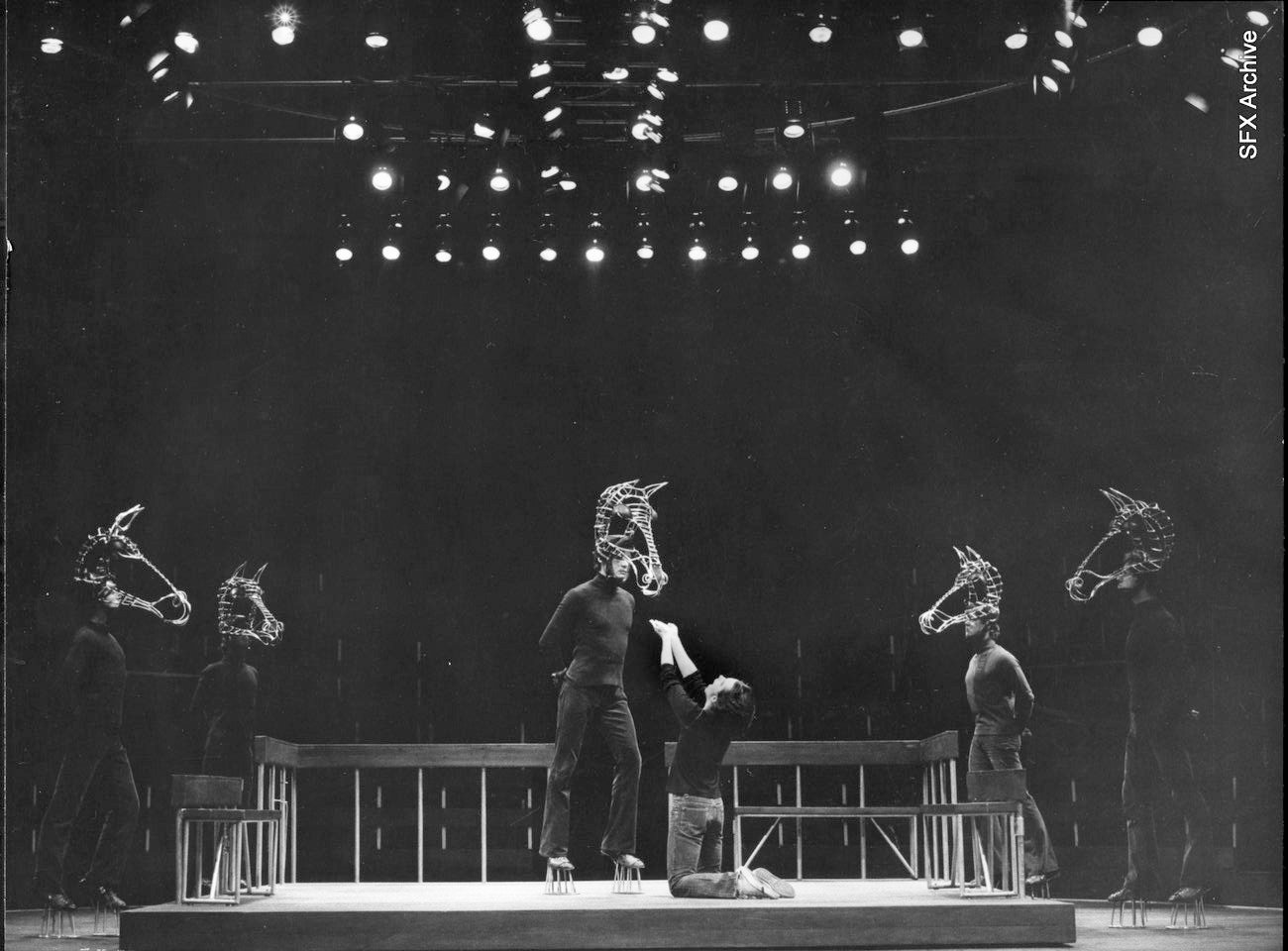
First, Shaffer prefaces the script with some Author’s Notes about the staging.  The photo above is from the recent Broadway revival, and it is loyal to the playwright’s concept in the important ways.  The original Broadway set is below, with the “boxing ring” described by Shaffer.

equus original

Shaffer asks that the entire cast sit on benches behind the boxing ring throughout the performance and enter the ring for their scenes.  When the horses enter the action, the actors playing them rise from the onstage bench and strap on one of the horse heads that hang around the perimeter.  At the start of the play, Dysart sits to one side and speaks to the audience while Alan and Nugget embrace center stage.

The 1974 photo shows you what Nugget looks like.  This highly theatrical and creative imagining of the horse captures the audience’s attention from the moment the lights come up.  All the actor playing Dysart has to do is not lose the audience’s attention in the three minutes between Nugget’s exit and the revelation that the boy embracing him blinded six horses while tending them in the stable.

Shaffer’s gives Dysart a wonderful opening monologue, one that raises more questions than it answers.  Dysart is clearly a man in pain, at a crossroads we don’t yet understand.  He uses words like “lost” and “intolerable” to describe himself, providing intrigue.  Equus plunges us into suspense on a number of levels almost immediately, and when we learn about the blinding at the five minute mark, we are firmly hooked.

This frees the actor playing Dysart to simply play the truth of this man’s life.  At least, this is where he should start.  A month into rehearsals, once he begins to get a good handle on who Dysart is, the director can evaluate whether the first five minutes is strong enough to grab the audience.  A good actor can make the necessary adjustments in a rehearsal or two.  But in the early days of the production, you want to throw yourself into what your character is feeling.

Does the actor need to go out of his way to make Dysart likable?

There is nothing in the script that makes Dysart unlikable.  You may or may not want to have dinner with him, but audiences empathize with good people in painful circumstances.  Make him a real human being with real feelings and needs, and the odds are very good that he will be likable.

What about intentionally playing the humor of the first half of the monologue to deliberately contrast with the serious tone of the second half, as my student did?

The opening of a play is not just about grabbing and holding the audience’s attention.  It establishes the world of the play as well as its tone (hopefully, your director defines both for you; in scene class, you need to figure that out yourself.)  As an actor, you must be faithful to both and not sacrifice either in the name of making yourself well-liked by the audience.  Humor should be injected when it is appropriate, not for its own sake.

The solemn and almost sexual ritual between Alan and Nugget takes place during the first half of Dysart’s monologue.  Use too much or the wrong sort of humor, and you risk mocking this moment, violating the sacredness of what happens between the boy and horse in the rest of the play.

Equus is an intriguing and moving drama, one that doesn’t end on a hopeful note.  It’s not a laugh fest.  All dramas typically have moments of humor, and I encourage you to find and play all of them in order to give your audience some stress relief, BUT you want to discover the tension of the scene first.  Only then can you determine if there is pressure that must be relieved.

We want to entertain the audience, to get and hold their attention.  But we don’t want to make choices that aren’t in keeping with the play.  That’s where you have to start.  When you focus on “likable” and “how can I grab the audience’s attention”, you’re going for product, not process.

I don’t know if humor is appropriate in that monologue or not.  It’s certainly worth investigating.  However, deciding to play up the humor to make the character likable without first examining the character to see if that choice is appropriate is an arbitrary choice.  You can’t choose unless you have options.  Use your rehearsal time to discover the options.  Then, and only then, can you make the best choices.

To read Equus, Part I: The Three Questions, go here.  To read Equus, Part II: Poetic Language, go here.