Equus, Part III: The First Five Minutes

equus set

The major concern that impacted how my student interpreted the opening monologue in Equus was a need to grab and hold the audience’s attention in the first five minutes of the play.   I agree with the premise in principle.

Should you, as an actor, concern yourself with this?  Honestly, I think it’s the director’s responsibility.  Your responsibility is to make your character a believable person who fairly represents the playwright’s intention.  If you do that and the script is a good one, then the matter of “is the audience going to stay awake for the play” probably won’t arise.  If it does, the director will notice and correct it.

In a quality script, the playwright has eliminated this problem.  Peter Shaffer is one of the best British playwrights of the 20th century.  Equus won a Tony, a Drama Desk, and a Drama Critic’s Award.  It’s very likely that my student was worrying needlessly, but let’s not take anything for granted, and talk about why the script works in this regard.

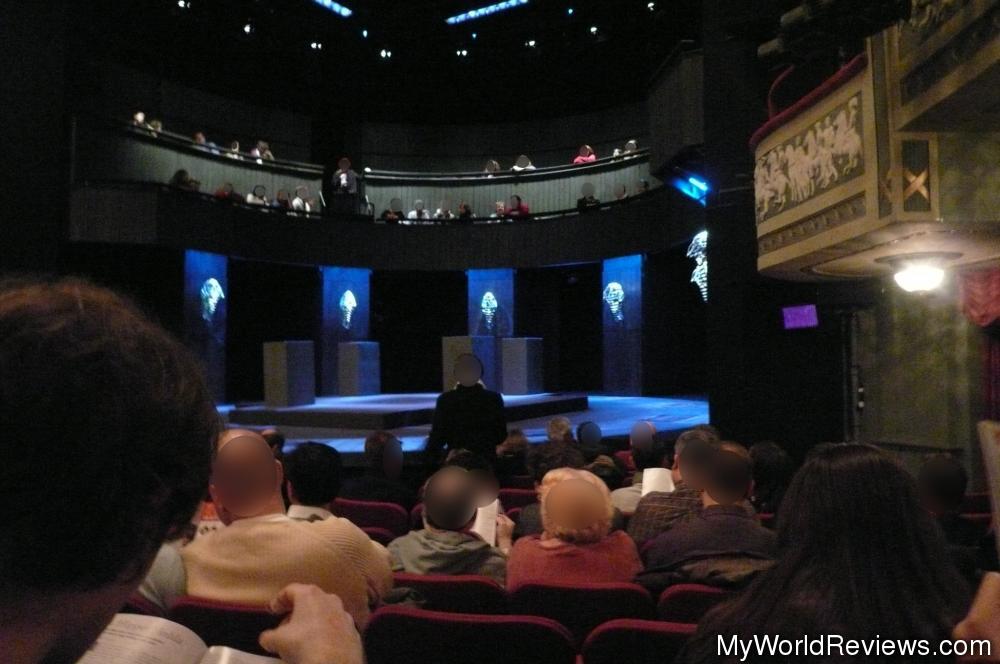
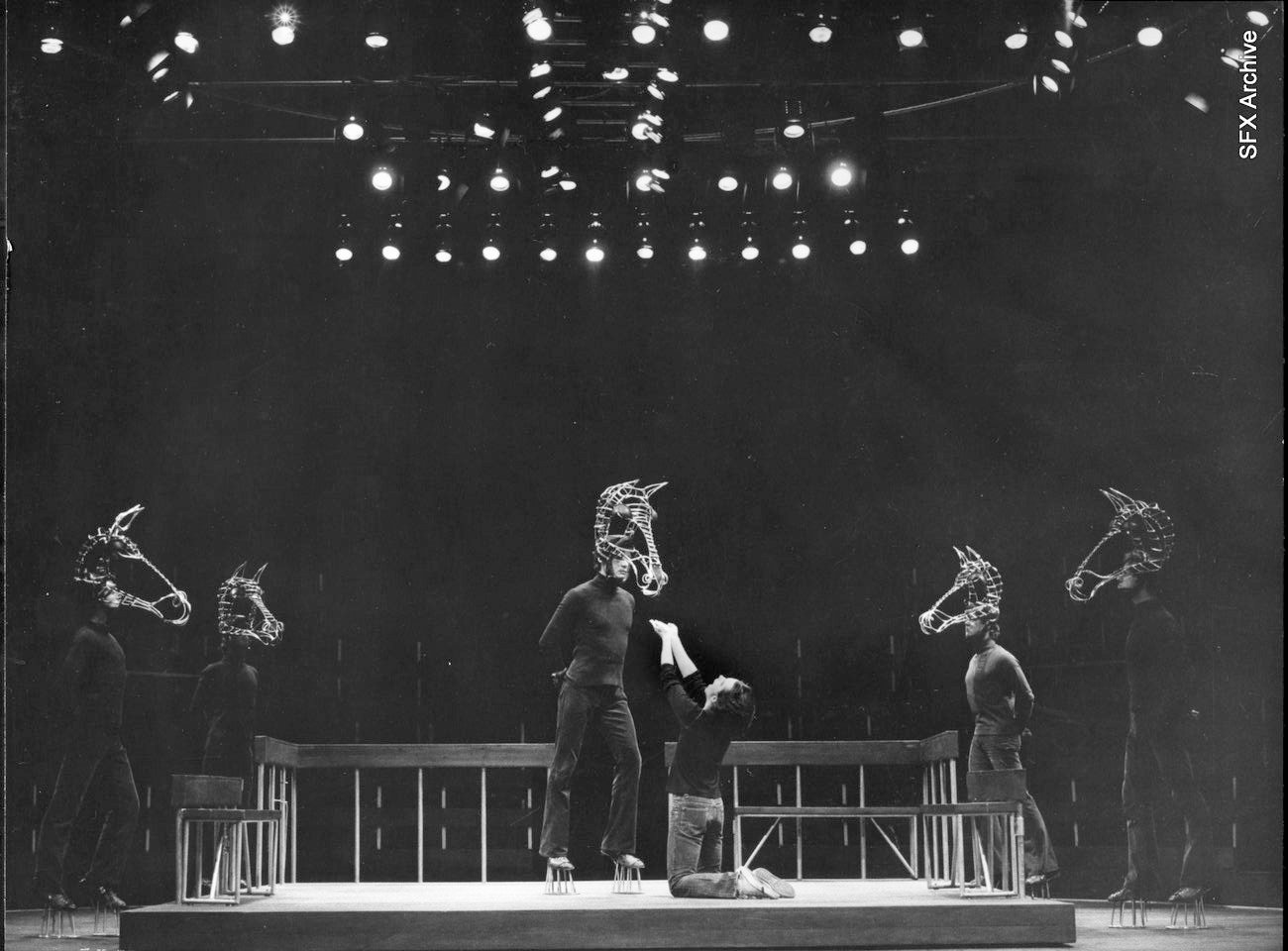
First, Shaffer prefaces the script with some Author’s Notes about the staging.  The photo above is from the recent Broadway revival, and it is loyal to the playwright’s concept in the important ways.  The original Broadway set is below, with the “boxing ring” described by Shaffer.
equus original

Shaffer asks that the entire cast sit on benches behind the boxing ring throughout the performance and enter the ring for their scenes.  When the horses enter the action, the actors playing them rise from the onstage bench and strap on one of the horse heads that hang around the perimeter.  At the start of the play, Dysart sits to one side and speaks to the audience while Alan and Nugget embrace center stage.

The 1974 photo shows you what Nugget looks like.  This highly theatrical and creative imagining of the horse captures the audience’s attention from the moment the lights come up.  All the actor playing Dysart has to do is not lose the audience’s attention in the three minutes between Nugget’s exit and the revelation that the boy embracing him blinded six horses while tending them in the stable.

Shaffer’s gives Dysart a wonderful opening monologue, one that raises more questions than it answers.  Dysart is clearly a man in pain, at a crossroads we don’t yet understand.  He uses words like “lost” and “intolerable” to describe himself, providing intrigue.  Equus plunges us into suspense on a number of levels almost immediately, and when we learn about the blinding at the five minute mark, we are firmly hooked.

This frees the actor playing Dysart to simply play the truth of this man’s life.  At least, this is where he should start.  A month into rehearsals, once he begins to get a good handle on who Dysart is, the director can evaluate whether the first five minutes is strong enough to grab the audience.  A good actor can make the necessary adjustments in a rehearsal or two.  But in the early days of the production, you want to throw yourself into what your character is feeling.

Does the actor need to go out of his way to make Dysart likable?

There is nothing in the script that makes Dysart unlikable.  You may or may not want to have dinner with him, but audiences empathize with good people in painful circumstances.  Make him a real human being with real feelings and needs, and the odds are very good that he will be likable.

What about intentionally playing the humor of the first half of the monologue to deliberately contrast with the serious tone of the second half, as my student did?

The opening of a play is not just about grabbing and holding the audience’s attention.  It establishes the world of the play as well as its tone (hopefully, your director defines both for you; in scene class, you need to figure that out yourself.)  As an actor, you must be faithful to both and not sacrifice either in the name of making yourself well-liked by the audience.  Humor should be injected when it is appropriate, not for its own sake.

The solemn and almost sexual ritual between Alan and Nugget takes place during the first half of Dysart’s monologue.  Use too much or the wrong sort of humor, and you risk mocking this moment, violating the sacredness of what happens between the boy and horse in the rest of the play.

Equus is an intriguing and moving drama, one that doesn’t end on a hopeful note.  It’s not a laugh fest.  All dramas typically have moments of humor, and I encourage you to find and play all of them in order to give your audience some stress relief, BUT you want to discover the tension of the scene first.  Only then can you determine if there is pressure that must be relieved.

We want to entertain the audience, to get and hold their attention.  But we don’t want to make choices that aren’t in keeping with the play.  That’s where you have to start.  When you focus on “likable” and “how can I grab the audience’s attention”, you’re going for product, not process.

I don’t know if humor is appropriate in that monologue or not.  It’s certainly worth investigating.  However, deciding to play up the humor to make the character likable without first examining the character to see if that choice is appropriate is an arbitrary choice.  You can’t choose unless you have options.  Use your rehearsal time to discover the options.  Then, and only then, can you make the best choices.

To read Equus, Part I: The Three Questions, go here.  To read Equus, Part II: Poetic Language, go here.
Actor’s Etiquette: There’s a Director of This Play, and You Should Listen to Him

9780520267848Directors have a number of responsibilities regarding the production that are different from yours as an actor.  Among them is the responsibility (and right) to determine how to generally interpret the play, which includes his vision for it and the tone the production should strike.

You may not agree with his choices, but you have to make your way to being at peace with them, or the production will suffer.  You can discuss your opinions with him, if you differ in a material way.  You may find you aren’t really far apart; you’re just using different language.  Or you may find he’ll appreciate your input and adjust his vision in some way.

But you may just have very different views, and in that case, he wins.  Ties always go to the director.  This means that it is your job to listen carefully to what he has to say and to try to adjust your own thinking to meet what he is asking for.  Lecturing him on what YOU think is right is only going to create bad feelings.  Take it too far, and the director may wonder if he can ask you to do anything without you putting up a fight.  (I’ve seen this in action.)

Even differences of opinion about small character choices should be dealt with this way.  Yes, you know the character better than the director does.  Eventually.  A good director, if he’s done his homework properly, knows more about your character initially.  My actors start to overtake me in this department somewhere around the halfway mark.

If a director makes a suggestion to you about your character, listen with an open mind.  Trust that he has a reason for it, and that it has something to do with the fact that he is seeing how what you are doing is playing out in the house.

It’s not always easy to do this, I know.  When a director makes a suggestion to me, sometimes I immediately know that he’s right, and all is well.  Sometimes I am in a generally receptive mood and consider it and we have a nice conversation about it.  Sometimes it sounds to me like an idiotic idea, but because I am in a receptive mood, I do my best with it.  If it’s really idiotic, it will probably become apparently in playing it.  If it doesn’t and he still seems attached to the notion, we can now have an honest discussion about its merits and I can politely and reasonably defend my opinion.

And sometimes my worst self emerges and I have a kneejerk reaction that sounds something like this:  “No, my character wouldn’t do that.”

These are words that should never be uttered.  They will, and I’ll probably be one of the actors saying them.  But they shouldn’t be said.

Don’t assume that suggestions from the director are inflexible mandates.  They may be, but they won’t always be.  So go ahead and try what he suggests and see if there is any merit to it.  You’d want the same courtesy if you suggested something; extend it to him.

When my bad self rejects an idea, I always end up considering it later.  “Later” may mean five minutes, and if it does, I make sure I respond to the director before the rehearsal is over, and tell him that I’ll try his idea the next time we do that scene.  Sometimes I think about it overnight, and I’ll talk to him about it at the next rehearsal.  The important thing is that I get back to him about his comment.  Integrating it without acknowledging that is what I am doing isn’t enough.  I need to keep the lines of communication with my director open, and to show him that I respect his input.

Most of the time, I end up realizing that he has a point, and that whatever he is suggesting is more creative and interesting than what I’ve been doing.  It’s easy to get stuck in a rut, and he is throwing me a lifeline.  If I can’t come around to his way of thinking, the time between rehearsals gives me a chance to figure out how to explain my objection to my director, which may open up new possibilities for us.

The director’s “third eye” is critical to a good production.  Trust it.  At the very least, respect it.

Equus, Part II: Poetic Language

equus burton

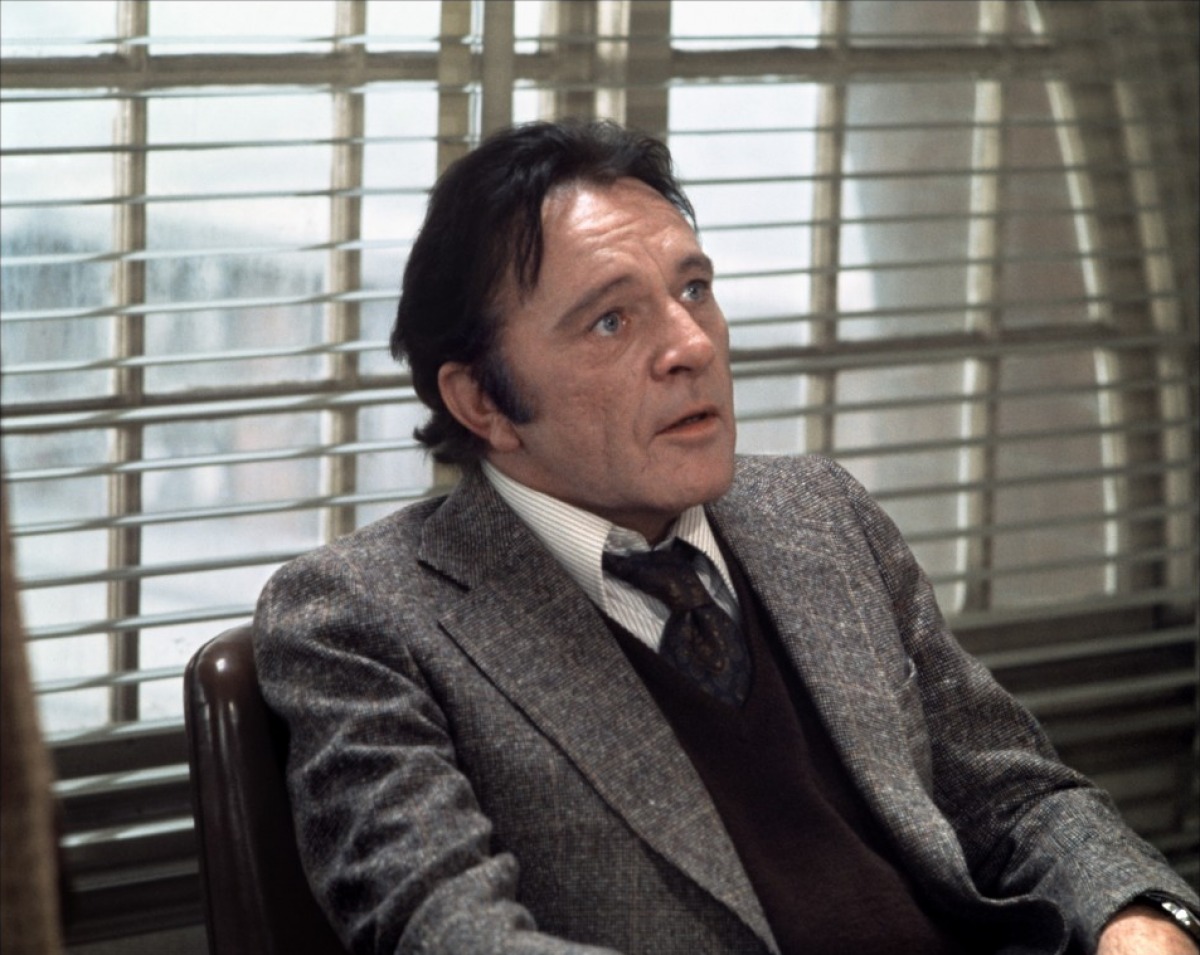
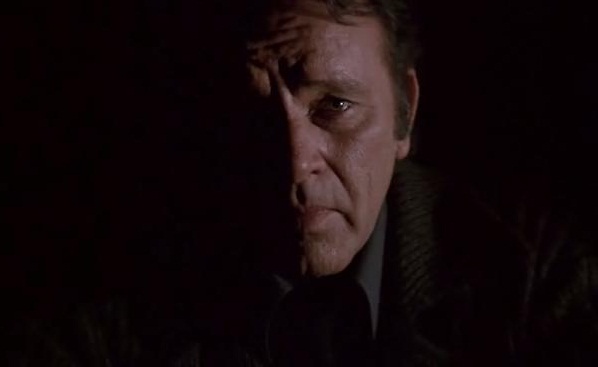
I am in complete sympathy with the actor about not feeling up to par against Richard Burton when it comes to speaking the poetic language in Equus.  If you don’t feel you have the resonant, deep voice that Burton possesses, or the hypnotic charm of Anthony Hopkins’ tenor, feeling inadequate is completely understandable.

Ignoring that aspect of the writing this early in rehearsals isn’t really a problem.  Going for the emotional connection to the material is the primary concern when you first pick up a script.  Getting to know who your character is and why he responds to his circumstances as he does is more important than the language that he uses.

There is plenty of time to give close attention to the nature of the language later in the rehearsal period.

On the other hand, I’m not sure that you should entirely ignore it up front.  My own inclination when I deal with poetic plays is to pay attention to the language for its own sake first, for a single reading.  To say the words out loud, to feel them in my mouth, to hear the sounds mingle, to let the images they create rise up before me.

I don’t read much poetry.  It’s not my thing.  But poetic prose grabs my attention.  There is an element in it that doesn’t exist in non-poetic prose and which cannot be separated from the meaning of the words.  They are entwined.

What is poetic prose?  It’s when a character speaks in a way that people don’t ordinarily.  Newspapers write to an eighth grade education level, and most of us use that same vocabulary in everyday speech.  But poetic language is different.  It uses words and phrases like “embrace”, “straining to jump clean-hoofed”, and “one more dented little face”.  When was the last time you spoke like that?

There is a reason why Burton and Hopkins have played this role.  They are unafraid of poetic language.  They are happy to savor it, to lay it out for your inspection.  They understand its power.  It is subtext on steroids.

Their success lies not so much in their vocal instrument as it is does in their appreciation of the power of language and their willingness to let the words work their magic.  That is something you are capable of doing, as well, no matter what sort of voice you have.

Part of the key to understanding Dysart involves throwing yourself into the language.  You may not reach a full appreciation of it until deep into rehearsals, but you need to deal with its impact on the play well before then.  You can’t separate out the fact without the feel that goes along with it.  Shaffer’s later works are ALL poetic in nature.  It is part of who he is as a playwright.

No, you shouldn’t try to imitate Richard Burton’s way of wrapping his voice around words.  But you do have to find your own way of entering them and letting them wash over your tongue.

Poetry is dense.  It takes a while to uncover its mysteries.  Understanding poetry is work for the subconscious.  You must revisit it, over and over, out loud – not silently, in your head, for poetry is meant to be spoken – in order to let your subconscious infiltrate it and unwrap its meaning.

But apart from that – to refer back to what I wrote last time – Shaffer begins both acts with the same eight words:  “With one particular horse, called Nugget, he embraces.”  It begs the question, “Why?”

Not having worked on the play, I don’t have the answer to that, and in any case, my answer might not be yours.  But it’s a question I would ask myself at the start of rehearsals.  I would revisit it every day until I had the answer.  Playwrights only repeat themselves when it matters.  (The repetition of the chained mouth seems to me much more evident.  I assume it is to you, too.  If not, do let me know.)

To read Equus, Part I: The Three Questions, go here.  To read Equus, Part III:  The First Five Minutes, go here.

Equus, Part I: The Three Questions

equus-1977-07-g

In class, an actor was working with Martin Dysart’s opening monologue in Equus.  He had done a cold reading of the speech the week before, and we had talked about the need to understand what the play is about, who the protagonist is, and why Shaffer has Dysart talking to the audience throughout the play.

When he brought the monologue back the following week, he had clearly done some work on it.  The speech was segmented into three parts, aligned with the divisions marked by the stage directions.  The first part was said in profile, with a certain amount of professorial distance and bemusement.  The second part connected him to the audience, and the third part gradually became more serious and contemplative.

I asked him if he had found the answers to the questions I’d asked the week before.  He had not.  In fact, it seemed that he still hadn’t thoroughly read the script, but was really just focusing on the monologue in isolation.

As for his choices, he told me that he couldn’t compete with Richard Burton and so had to start with himself, a position I affirmed.  We had talked about the fact that Equus is a poetic play in its use of language, but he had decided, at least for the moment (or permanently?  I couldn’t tell which), to ignore the poetry.

He was also concerned with the need to “grab” the audience in the first five minutes of the play, and in service of this goal, to make Dysart a likable character.  I think he had read something about the importance of doing this with any play.  It was certainly governing his performance that night.

Where do I begin?

The first problem is that you can’t work on any part of a play without reading the whole play attentively at least once.   I talk about this in an Actor’s Etiquette post, so I won’t go into the reasons here.  But you just can’t.  Don’t waste your time.

Here are just two of the things you will notice if you read Equus in its entirety, both of which impact this monologue.  The first is that the same sentence opens both acts:  “With one particular horse, called Nugget, he embraces.”

The second is that five sentences into the play comes the line, “I keep seeing that huge head kissing him with its chained mouth.” The last lines of the play are:  “There is now, in my mouth, this sharp chain.  And it never comes out.”

I’ll talk about the opening sentence when I talk about poetry.  But the part about the chained mouth bears directly on the question of what and who is this play about.

Equus is NOT about a boy who blinds horses.  It is about the psychiatrist who treats him realizing that the boy lives with a passion that he, Dysart, does not.  In the opening monologue, we meet a man in crisis.

While he does talk with another character about his life, it is the monologues that reveal the true torment he experiences.  In them, he shares secrets we just don’t share with other people, except perhaps a psychiatrist.  Dysart is psychoanalyzing himself.  The fact that he has no close friend or lover with whom he can share his feelings is part of the point – part of the reason he is in this predicament.

And when he talks about the horse’s head, he is talking about himself.  He admits as much in the second half of the monologue, and the final lines of the play remind us of this sympathy he has with the horse.  This identification has to be present from the beginning of the monologue.  It’s not intellectual curiosity on Dysart’s part that makes him wonder about what the horse feels.  He – and Shaffer – are indirectly examining Dysart’s own internal goings-on.  The horse is merely metaphor.

Understanding the answers to the three questions I raised in the opening paragraph gives you some clear direction as to where to take the monologue.  You’ll find those answers only by reading the play.

I’ll talk about other issues with this monologue in the next two posts.

To read Equus, Part II: Poetic Language, go here.  To read Equus, Part III:  The First Five Minutes, go here.
Actor’s Etiquette: There’s a Director of This Play, and It Isn’t You

51V3ETWY0FLIt is always very bad form to direct another actor or to otherwise ask another actor to do anything for you.

It doesn’t matter if the director isn’t very good.  Or if he seems to have trouble communicating something and you think you know where the disconnect is.  It’s not your show.  Keep your mouth shut.

You undoubtedly have plenty of work to do on your own role.  That’s where your attention should be.

I once watched an actor who wasn’t hired until halfway through rehearsals start directing his scene partner ON HIS VERY FIRST DAY AT REHEARSALS.  My jaw nearly hit the floor.  The director was gracious and let him speak, and the actor to whom he was speaking was so green that he didn’t realize what a faux pas Mr. Newcomer had made.  I probably would have slapped Mr. N. upside the head.  (His behavior only confirmed my feeling that he was a bit full of himself, and it will probably always color how I view him.)

I’ve also seen an actor ask another to alter the timing of his entrance, which was prescribed by the text, because the way he was doing it (at the director’s instruction) “is throwing me off.”  This was even more egregious because the moment belonged to the entering actor, not Mr. Sensitive (see a future post called “It’s Not Your Scene”).

If you genuinely think you can help the director and feel compelled to do so, do it in private, after rehearsal is over.  This gives the director the opportunity to either listen without you undermining his authority in front of the cast or else tell you to mind your own business without making a scene.

Your job is to simply receive and respond to what you get from the other actor, not to demand what he isn’t giving you because he’s not good/clever/insightful enough to give it to you.  Even if you’re asking for the right thing.

Even if the other actor is upstaging you in the worst way and you have every right to be upset, don’t challenge him on it directly.  Let the director know and let him deal with the problem.  He can handle it better than you can.  You risk making the other actor hate you on some level (theater people are not always mature and professional), and it will make the experience miserable for you both and affect the play.

This doesn’t mean that there isn’t room for you to make suggestions in the moment that you think might be helpful to the production, but they should always be made to the director, not to the other actors.  Phraseology matters, too.  “Could we try . . .?”, “I wonder if it might work if we . . .?”, and “Might it be even better if . . .?” leave open the possibility that you’ve just come up with a terrible idea and give the director the ability to turn it down politely.  Creativity in a play is a group activity, and you are a full player in that.  But you aren’t in charge.

And if you aren’t involved in the scene in question, I don’t care how great the idea you have is.  Keep it to yourself and share it with the director privately, after rehearsal.  It’s not the last time the scene will be worked on; it can wait. Never butt in with your two cents on someone else’s scene unless the director expressly asks for suggestions from the cast as a whole.

In brief:  Don’t make the people you work with look stupid or incompetent.

What Do Arbitrary Choices Look Like?

In class two weeks ago, the actors were busily making arbitrary choices about their characters.

It’s fascinating to watch.  Despite talking about how unproductive this approach is, people instinctively use it.  It’s almost an uncontrollable impulse.  (I’m not criticizing my students for doing this.  We all do it.  Learning how to act is, in part, learning when we’re being arbitrary so that we can stop.  When I point out to my students what they’re doing, they quickly recognize what I’m talking about and why it matters.  Which is why they are such wonderful students!)

Arbitrary choices are the ones we decide on before trying them to see if they work.  “This is what I should do here.”  They don’t spring organically out of what actors call “the work”, but are intellectual choices we impose on our performances.  It’s the “decider” in us looking for certainty.  “There!  Thank goodness, another problem put to bed!”

Deciding upon them in advance can prove fatal.  We become so attached to them that we will give them up only if they prove to be disastrous.  The moment we make the decision, we have closed ourselves off to ANY OTHER possibility, no matter how good it is.  Our subconscious even stops working on the problem.  It’s done!  Solved!

Happy couple embracing and laughingOne actress, following the first read-through of a brand new scene, responded to my question about her gut reaction to the character by saying, “I didn’t really notice, I was busy trying to figure out where I should be laughing.”

Laughter is not something you should plan for unless the dialogue makes it clear that you have to laugh.  Then you have no choice.  Otherwise, laugh if, as the character, you genuinely find something to be funny.  Don’t if you don’t.

I asked her about the times when she did laugh during the scene.  Were they the “right” times?

        Her:  “Well, they were pretty much real laughs.”

        Me:  “No wonder they worked so well!”

Lesson:  Real emotions are very effective on stage.  Laughing was entirely appropriate to her character, so those real laughs worked.  Artificially imposed laughs rarely are believable.

Another actress, who performed a lengthy monologue, opted to sit at one point in the middle of the speech and then sprang up almost immediately, standing or walking for the remainder of it.  We talked about it afterwards.

        Me:  You sat down at one point . . .

        Her:  Yes, and it was a mistake.

        Me:  I’m not so sure it was.  It actually seemed to suit the moment very well.  It was the springing back up that
seemed 
out of place.

I suggested that there was good dramatic support for sitting for a portion of the monologue, but that there were a variety of options in terms of timing the sit and stand.  At which point, she said, “I know!  I should sit on THIS line.”

Maybe.  Maybe not.

It is perfectly okay to say, “Let me try doing this here.”  That’s a very different thing than saying, “I should do this.” Once you’ve tried it, you can determine its effectiveness.  You can then try other alternatives and compare the results.  In her particular situation, there were a variety of choices worth exploring.  The line she selected was the most obvious choice – predictable, even – but that doesn’t automatically make it the best.

When you make intellectual decisions outside of the framework of actually running the scene, you are making arbitrary choices that have nothing to do with the emotional life of your character.  It is an external you are strapping onto your character, whether she likes it or not.

If you find that choice through trying various options during a run-through of the scene, great.  But if you choose it based on your intellectual assessment of the play, it will never work well, no matter how “right” the choice is.  Like line readings, such choices have a foundation of quicksand that will give way at some point.

To read Isn’t the Obvious Choice Sometimes the Right Choice?, go here.

John Cleese on Creativity

Both of the following videos are well worth watching.  After you’ve seen them, read my comments below — just a few things I’d like to highlight about what he says.

http://www.youtube.com/watch?v=zGt3-fxOvug

And then there is the longer 1971 talk:

http://www.youtube.com/watch?v=AU5x1Ea7NjQ

Cleese notes that being creative requires a certain mood:  a willingness to play like a child, exploring ideas not for any immediate practical purpose, but just for enjoyment.  Kids do things for their own sake, without expectations of results.  When you’re playing, nothing is wrong.

Cleese talks about open and closed modes, which is directly related to the concept of trial and error that I have mentioned.  In the open mode, you are deciding what to try.  You go to closed mode to try it, and back to open mode to evaluate its success.  Creativity is a matter of toggling between the two positions, although acting requires that you keep one avenue “open” even while you are trying something in closed mode, and I’ll talk about this in the future.

Space and time, his first two requirements, are essentially about giving yourself permission to play, to be creative without the need to solve problems.  Cleese suggests it takes a half hour to get yourself into open mode for starters, a time frame I concur with.  This half hour is why I suggest that two hour rehearsals are really too short.  Cleese’s audience is made up of businesspeople, and 90 minutes is probably as long as that group will find profitable, but acting is slightly different.  I believe that 2½ hours is the minimum time to maximize the benefit for an actor.  Three is great, if you can manage it, and a ten minute pause in the middle of a 3 to 4 hour rehearsal will not break the spell.  Nor will a lunch break in the middle of a longer stretch.

However, while the entire rehearsal should be about “play” on some level, small segments of it can and should be set aside as “let’s just experiment with this one thing” time, giving the actors the freedom to explore while knowing that the production is still basically on track.  This is a particularly useful approach in community theater, where actors are often results-oriented.

Cleese’s third requirement (also “time”) is what I have referred to as the “subconscious effect” (he calls it the unconscious, but we’re talking about the same thing.)  Creative ideas sometimes need to marinate for a while before they can really germinate.

Cleese uses the word confidence for the fourth requirement, but I use the word courage.  I want a stronger word than confidence to convey the importance of this.  If you are particularly wedded to the idea that there is a Right, then you need courage, not confidence, to break out of that pattern.

To play is to experiment.  To play well, you need to have the courage to fail.  Courage to make mistakes.  A willingness to be open to anything that may happen.  But mostly, as Cleese points out, courage to sit with the discomfort — the absolute anxiety — of uncertainty until you absolutely have to make a decision.

If you can remember that when you’re playing, nothing is wrong, and that you have the ability to evaluate the success or failure of what you’ve tried after the fact, then it is easier to be courageous.  While it feels better to make decisions, if you trust the process and wait until you really have to make decisions to make them (and the more you do this, the later you’ll be able to wait), you’ll find it is worth the wait.  Which will then make it easier to wait the next time.  Once you have experienced the benefit of waiting, you can start to move from courage to confidence.

It’s interesting that Cleese suggests that humor is that fastest way to get into the open mode.  Perhaps this is why I laugh so readily during rehearsals, and try so hard to get my cast to laugh, too.  Laughter is relaxing.  At the very least, don’t take yourself or what you’re doing (even if it’s Medea) too seriously.  It’s not nuclear war.

And lastly, Cleese says this about the Subconscious Effect:  “This is the extraordinary thing about creativity:  If just you keep your mind resting against the subject in a friendly but persistent way, sooner or later you will get a reward from your unconscious.”

It may not come in this rehearsal, or the next.  It may show up in the shower on Friday.  But it will come.  Trust it, and it will come.

To read What is Creativity?, go here.  To read What If I’m Not Creative?, go here.  To read How on Earth Can I Be Creative as an Actor?, go here.

Actor’s Etiquette: Memorize Your Lines

charm-school-for-business-etiquette-6-5-20121I once directed a play with a cast of experienced actors.  At the first rehearsal, I gave them my usual spiel about memorizing lines (you can’t do any real acting until you are off book; the earlier you memorize them, the better your performance will be; I suggest you aim for three weeks before opening; don’t try and go off book until you really are off book, because it’s a waste of everyone’s time and I won’t permit it).

Some directors set “deadlines” for the acts to be memorized, but really – there’s nothing we can do if you miss the deadline, is there?  It’s not like we can send you to bed without supper (not that I think negative reinforcement is a particularly influential approach.)

The actors nodded at me as soon as I began speaking.  As experienced actors, they knew exactly what I was talking about, and three of the actors in this show had a ton of lines each, so they knew what they were facing.

Three weeks before we opened, none of them had come close to memorizing their lines. I hadn’t really focused on this fact.  Yes, I knew they were still carrying scripts around, and yes, they seemed to rely on them more than I thought they should be at that point, but these guys had been around the block more than a few times.  They knew what was required.  They were pros, they’d get it done.

Also, different people handle memorizing differently.  I’ve worked with actors who made me unsure they were ever going to finish memorizing the script, but came in Tech Week solid in their lines and doing some remarkable work.  I hadn’t really worked with two of these actors before.  What did I know about their process?

Three weeks out, it finally occurred to me that I had to bring the obvious to their attention:  “Uh.  You guys might want to think about memorizing your lines.  We open soon.”

I could tell by the expressions on their faces that they hadn’t fully registered the gravity of their situation until I brought it up.  They began to work in earnest on memorizing from that point on, but two of them never really got solid and we had one performance that took a big hit as a result.

As a director, the one thing I DON’T worry about is whether an actor has memorized their lines.  It’s not my butt up on stage, and the one thing the audience won’t blame me for is an actor who forgets his lines.  I have always figured the potential of public embarrassment is sufficient motivation for an actor to hit the books and get his lines down.

I was wrong on this particular point.

I can’t memorize your lines for you.  I also don’t wish to be a nag; it’s an unpleasant role to have to play.  In the future, I’ll remind my casts each week of how far we are from opening and note where I think they are in terms of memorization, but I’m not going to do more than that.  You’re responsible for yourself.

Memorizing your lines is a basic element of being an actor.  Do it early so you are sure to get it done.

How on Earth Can I Be Creative As An Actor?

creativity_or_Art_by_amr_nkim5Dictionary.com calls creativity the ability to transcend the traditional and to create something new.  In other words, don’t settle for the obvious, the stereotypes, the ordinary.  Don’t go for hackneyed line readings or hang on for dear life to the first decent idea that comes down the pike.

But something new?  Really new?  Well heck, if that doesn’t put pressure on you, I don’t know what will!  So let me rephrase that in a way that will put a lot less pressure on you.

Creativity is about making something unique.

Fortunately, since you ARE unique, you are completely capable of creating something unique, as long as you stay true to yourself.  That means avoiding all those obvious choices, because you know what?  They aren’t new, and they aren’t you.  They are copies of what you’ve seen before, in movies and on television, or on Broadway the last time you visited NYC.  They are an imitation of things that impressed you on some level.  But even at their best, they are an imitation of someone else.  They aren’t uniquely “you”.

Let me repeat what John Cleese said in his 1971 presentation on Creativity:  It is NOT a talent.  It is simply a way of operating.  A way of going about things.

Exactly how you go about being creative depends on your own personality type.  Certain types of creativity are easier for each of us, and certain types harder.  If you know what it comfortable for you, you can use it to your advantage, probably without thinking too much about it.  And if you know what isn’t comfortable for you, you can intentionally go after it, because you’ll be inclined to avoid it otherwise.  You expand your own creative potential when you work this way.

The most important thing is to recognize that deep inside you is a completely unique interpretation of any role you might play.  It’s deep inside you.  It’s not the stuff floating on the surface.  What you’ll find there is whatever you’ve most recently absorbed from others, or the stereotypes.  You’ll find the flotsam and jetsam.

We’re looking for sunken treasure ships.

It’s okay to start with the obvious, with the stereotypes.  Use them as warm-up exercises.  Use them to get them out of your system, to understand their limitations.  Just don’t stop there.  Keep looking for the sunken treasure.

Sometimes you can intentionally dive for it.  This is called trial and error.  You keep trying different stuff until you yell, “Eureka!”  Sometimes all you do is open the hatch to the hull of the ship and get out of the way, and trust that the jewels will float to the surface in their own good time.

Avoiding the stereotypes and seeking out the less obvious alternatives is an act of courage, and some people find it easier to do than others.  Trying things you think will fail or at the very least, aren’t sure will succeed is hard.  Isn’t it a waste of valuable rehearsal time?

No.  As Ben Franklin said, “Just because something doesn’t do what you planned it to do doesn’t mean it’s useless.”

Very often, the stuff that falls on its face helps you to find the thing that soars.  Something you would never have found if you hadn’t tried that stupid idea.

To read What Is Creativity?, go here.  To read What If I’m Not Creative?, go here.  To read John Cleese on Creativity, go here.