Actor’s Etiquette: It’s Not Your Scene

Etiquette-Book_webKnowing what to focus on and when is part of good storytelling.

Is your character the focus of the scene, or does it “belong” to someone else?  For instance, when one character has a long monologue, she is generally the focus of whatever is going on onstage.  That’s pretty obvious.  But all scenes have a focal point, and it’s your job to figure out who and what it is.  Focal points exist no matter how many people are on stage, and they often change throughout the scene.

For instance, there are a number of scenes in A Streetcar Named Desire that have Stanley, Stella, and Blanche on stage at the same time.  Stella is often a secondary character during them, although she has moments when she comes to the forefront.  The actress playing Stella needs to know when to “retire” to the background and when to insert herself into the action.

Having speaking lines doesn’t necessarily mean that you are the focus of attention, however.  Playwrights often have a primary character be silent during a scene, and yet all the attention needs to be focused not on the ones busily talking around them, but on the silent character.  How he is taking in everything that happens in the scene is the point of it.  For instance, when Prof. Higgins and Colonel Pickering ignore Eliza Doolittle in the scene after the ball in My Fair Lady, it is Eliza whom the audience needs to be watching.  The whole point is that the men are ignoring her, and she doesn’t like it.

Focal points can easily change multiple times during scenes.  Even if there are just two people on stage, one character is probably dominant at any given moment.  If you look at my beat breakdown for Moonlight and Magnolias, which you can find here, you’ll see that I list one character in each beat as being “major” and everyone else is “minor”.  Whoever is the “major” character is where the audience’s focal point will be, and the actors have to be sensitive to that.

The identification of where the focal point is in each beat was something I did as the director – that’s one of my jobs as a director, to make sure the focal point is clear.  However, the actors need to be sensitive to it as well.  It’s a dance.  Deferring to the “major” character in the beat is sort of like opening the door for someone.  Be gracious when it is someone else’s “scene”, but don’t be afraid to walk through the door yourself when it becomes yours!

Drama is Conflict

renoirThis may seem to go without saying, but actors sometimes forget this.

A good scene has two characters in conflict about something.  About whether or not Mom should be cremated or buried at sea.  About who should get the Renoir knock-off and who gets the Ming vase.  About whether we should order in Chinese or pizza while we argue about it.

Both characters want something, but what they want is in conflict.  That is, if you want to cremate Mom and I think she should be buried at sea, one of us doesn’t get what we want if the other one does.  (Unless we agree to cremate her and spread her ashes at sea.)  If I want both the Renoir and the Ming, and so do you, one of us will be unhappy if we get neither, and both of us will be unhappy if I get the Renoir and you get the Ming.  And if I hate Chinese food and you insist on ordering it, then I’m going to grouse through dinner.

The fact that not getting what we want in a scene is going to make us profoundly unhappy is what helps to heighten the drama (remember those “stakes” we talked about.)  And so we fight for what we want, for what we believe, in this moment, is the thing we need in order to be happy.

It really is that basic.  Our lives are driven by the need to be happy.  Eating the last piece of chocolate cake will make me happy.   Getting a raise will make me happy, because now I’ll be able to buy a new car, one that is reliable, fuel efficient, and beautiful, none of which can be used to describe my current car.  Marrying the man of my dreams will make me happy.  Getting revenge on the co-worker who screwed me out of that promotion will make me happy.

Or so I think.  I might discover that revenge isn’t what I hoped it was.  Or that it backfires on me in some disastrous way.  But at the moment that I am seeking revenge, I am positive that it alone will make me happy.

ming vaseBut in art, as in real life, happiness is rarely handed to us on a silver platter.  As in my “dead mother” scenario, two people often have contradictory desires, and that makes us go to war over what we want.

If there is no conflict, there is nothing to watch.  It’s boring, and we don’t care.  So it is up to you as an actor to find the conflict, and to make the most of it.  The more you fight for what you want, the more we want to watch you do it.


Actor’s Etiquette: Diction

oetiquetteActors have to have good diction.  I don’t care what sort of character you are playing or what their accent is.  Diction is essential to comprehension.  Remember, the audience has never heard these words before, or at least, you should assume they haven’t.  (Even if you’re doing Shakespeare, operate on the assumption that at least some of the audience has never heard or read Hamlet before.)

Diction relies upon consonants being fully pronounced.  American English is much more focused on vowel sounds than consonants.  British English is the reverse.  The British use their lips much more than Americans do (if you’re doing a British accent in a play, and doing it well, you’ll find that your lips will get fatigued in your first week or two!), and this contributes to the fact that their diction is so much more precise than ours.

I’m not suggesting that you use a British accent, but you should be sensitive to the fact that we Americans sometimes get very lazy in our speech and so glide through the harder consonants that help to define the perimeters of words.  In real life, I can ask you to repeat something if you’ve slurred a word.  The audience can’t do that.  So you need to be sure that you are more careful in your speech when you are onstage than you are in everyday life.

And If There Isn’t Enough Rehearsal Time?

hourglassSo now you have a way of judging whether or not your director has allowed for adequate rehearsal time.

(This isn’t a perfect science, by the way.  The level of experience and skill the actors have will have an impact on how much time is needed, too, and the director may have sufficient personal knowledge of his cast’s abilities to know how that impacts rehearsal time.  What seems a little scant to you may actually be enough.

But all directors get surprised sometimes.  Things that we thought would go so smoothly are a mess, and things we thought would be extremely difficult prove to be very easy for this particular group of actors.  But we do the best we can when we plan.)

If the rehearsal schedule is set in stone, but you’ve decided you don’t have enough time to do what needs to be done, what can you do?  Generally speaking, the answer is to work harder at home.  The more effort you put into preparing for your role when you aren’t at rehearsal will free up time at rehearsal.  When you come to rehearsal better prepared, rehearsals become more efficient and productive, both for you and for everyone around you.  But here’s a few specific thoughts:

  • Memorize your lines as fast as you can.  No matter which challenge you’re facing, getting your lines down will make anything and everything easier.
  • If your challenge is physical movement that doesn’t involve other actors (much), ask the director if you can come early or stay late to run through those sections on your own.  Most directors will be happy to accommodate you.
  • If you have complicated bits of physical business (e.g., mixing cocktails), practice them at home until they become effortless.
  • See if you can work privately with a scene partner to reduce the amount of time needed to work that scene in regular rehearsals.  It needn’t be the complicated scene that needs the extra rehearsal time.  Working privately on anything in the play frees up rehearsal time for the tougher stuff.
  • If there are very physical scenes in the show that you know will take extra work, ask for a schedule of when those particular scenes will be rehearsed.  If you don’t think there is adequate time set aside for them, now is the time to express that concern, because two weeks before opening will probably be too late.


Actor’s Etiquette: Mind Your Sightlines

RequiredEtiquette-CD_1In a perfect world, the audience should be able to clearly see everyone on stage all the time.

It’s not a perfect world, but here are some guidelines.

If you’re doing a large musical with chorus people in the background, it’s okay for the leads to stand in front of them.  But the primary characters in crowd scenes should all be visible.

It’s okay to cross in front of someone when they aren’t speaking as long as you do it reasonably quickly and, heaven forbid, don’t stop in front of them.

Don’t forget the people sitting in the front row against the walls.  They need to be able to see you, too.  If you are upstage of other actors, pay attention during each performance so that you can adjust your position if necessary to give those audience members a glimpse of your face.  Similarly, if you are the downstage actor, be courteous to those upstage and adjust your own position if you are aware that you are blocking them.  Play with it in rehearsals so you will know what kind of flexibility you’ve got on performance nights without having to stare at the end seats to figure out if you need to move.

If you find that you are positioned on one side of the stage and looking toward the other side of the theater for a prolonged period of time, find reasons to turn your head in the other direction with some frequency.  The audience on your side of the theater deserves more than just your profile, too.

And lastly, remember that when you’re backstage, be careful about peeking through the curtains to watch the action on stage.  If you can see the audience, they can see you!

What Kinds of Plays Need Extra Rehearsal Time? Part II

Blocking issues aren’t the only challenges that may add extra time to rehearsals.  Here are some other things to consider:

One or two roles that carry the lion’s share of the play.  This includes two-handers, star vehicles, and wordy plays.  Some plays just seem to have a lot more words in them than others, and even if there isn’t one character with more than anyone else, there may be several who have more than the lead in an average play.  Plays like these typically require an extra week, just for memorization purposes.

Complex characters.  Plays with one or two roles that are particularly complicated and challenging characters probably take a little extra time to allow for the actors to do them justice.  Conversely, a well-balanced play with straightforward characters and actors who seem to be typecast in their roles may require a little less time to rehearse.

A_Few_Good_Men_CostumesMilitary, period pieces.  Some plays require body movement that is different from what we ordinarily use in real life.  Plays like A Few Good Men, where the majority of the characters are in the military, means that the actors need to learn military bearing in how they stand, walk, etc., and to maintain that consistently throughout the play.  Similarly, the manners at the Elizabethan court in Mary Stuart as well as the difference in attire will affect how actors need to move.

Physical ailments.  An actor who needs to limp, pretend to be paralyzed, use a wheelchair, or make any other notable physical movement changes may need additional time to practice them.  Some modifications, such as Laura’s limp in The Glass Menagerie, may not need much additional time, as the actress playing Laura can work on most aspects of the limp privately in her own time.  However, the actor playing the title role in The Elephant Man needs to contort his body sufficiently that extra rehearsal time is probably required.

Mind-altering conditions.  Scenes where an actor is drunk, high, crazy, or mentally challenged may need some extra rehearsal time.

Playing multiple characters.  Some people are very skilled at this and don’t need any additional time to rehearse.  However, actors who need assistance in creating clear identities for multiple characters, or who need to switch between them within a single scene, such as in The 39 Steps, benefit from additional time.

39steps3Plays requiring perfect timing or which rely on speed.  Not only does this include farces, but it also includes episodic plays like The 39 Steps and The Front Page, wherein much the fun and humor is dependent on fast-paced timing, both of lines and physical action.

Love scenes.  In theory, this shouldn’t take any extra time unless the scene is lengthy and requires a lot of physical movement, in which case it is much like a dance.  However, some actors have more inhibitions about the level of intimacy required by a love scene than others, just as some plays are more demanding in this regard than others.  Bell, Book and Candle is a good example of a play that requires considerable highly-charged physical intimacy.  If the actors playing the lovers are at all shy about entering into the demands of the scene, rehearsing them early and often to allow the actors to achieve  familiarity with each other and comfort with the physical contact is the only way to make them believable.

Foreign languages, accents, or gibberish.  A play like Enchanted April, if you have a non-Italian speaker playing the role of the cook/housekeeper who only speaks Italian, may need a little extra time, although much of her work will be done outside of regular rehearsal time.  Plays where all the characters adopt an accent, such as British English (Received Pronunciation) may take extra time to teach the cast the rules of the accent and correct them when they go astray.  Plays like Woman in Mind, the opening scene of which is conducted partly in gibberish, take additional time to rehearse, to get the actors comfortable with what the gibberish is supposed to mean and how it is to be delivered.

Classics.  Playwrights like Chekhov, Shakespeare, and Moliere present their own performance challenges that might warrant an extra week of rehearsal.

Children.  Depending on the age of the children and their level of experience, it may take a little extra time to get them to understand what they need to do.


Actor’s Etiquette: Caring for Your Costumes

etiquette_Introduction_fromBook_xsm_04032348_11051341If you are working in a college or professional theater, there may be staff in charge of caring for your costumes.  If so, it is your responsibility to treat your costume with care:  pull up your trousers when you sit so you don’t stress the crotch seam; don’t let your dress’ train sweep the dirt off the floor; don’t eat in costume unless you have a robe or towel covering your front and your lap.

Your other responsibility in this situation is to alert the staff in a timely fashion to any problems with your costumes:  tears in the fabric, buttons that are coming lose, seams that are straining.  The sooner they know about it, the sooner they can be fixed.

If, however, you are doing a show where there is no one assigned to take care of costumes, then guess what?  Anything to do with your costumes, including the above, is also your job.

Maybe not the repair work.  Maybe.  But the daily cleaning and caring for your costume is.

What should you be doing?

When the make-up stains on your shirt collar start to become evident to those in the first row, you need to wash it.  When your costume starts to stink, either wash it or spray it with vodka (the cheapest and best way to freshen costumes, believe it or not.  Just don’t use Absolut.)

And please – iron it.  In between shows.  If you’re doing three or four performances a week, by the time you get to the last one, your pants look like you’ve spent all day in the car.  If your character is arriving at the girl’s house for a first date, rumpled is usually not the look you’re going for.

If your costume is a slip or a satin dress that’s been stored in a box in the theater, please iron it before the first show!  I did a show once with a young woman who had a simple satin wedding dress as one of her costumes.  It was her first show at this theater, so I assumed that she thought someone would be ironing it for her, and didn’t have time to do it herself on opening night after she got to the theater.  I expected, however, that she’d either ask about who was taking care of the costumes or iron it herself before the next performance.

Wrong assumption.  After a few nights, I took to ironing it myself before she got to the theater.  (I couldn’t figure out how to gently suggest that she do it, and so left it to the director to mention, which he didn’t.  But I found the wrinkly dress a bit embarrassing on stage and so did it myself.)

And while we’re on the subject – if you use anything (costume or props) that has been collecting dust for years on some back shelf – please clean it.  The dust on a patent leather purse, the dirt on the flowers on your hat, and the dull scuffs on your shoes can all be seen from the audience.  Leave them in that condition ONLY if it is appropriate to your character, please!

What Kind of Plays Need Extra Rehearsal TIme? Part I

Once you’ve figured out how many rehearsal hours your play’s length requires, the following issues may warrant adding some time.  How much extra time depends on the actors involved and the demands of the particular play.  Here are some blocking considerations you might want to think about when planning your rehearsal time:

fezziwigFights and Dances.  Be they swordfights, fist fights, wrestling matches, or slapfests, any “fight” needs to be choreographed and rehearsed like a dance.  As for dances, sometimes even straight plays will have a single musical moment requiring coordinated action (e.g. The Fezziwigs’ Christmas Party in A Christmas Carol).  Choreography takes repetition to become seamless and natural; the complexity of the physical action and the coordination of the actors will determine how much extra time is required.

High levels of physical activity.  Physical activity that involves lots of props, like setting a table for a formal dinner for eight, usually requires coordinating the activity with dialogue.  This is like rubbing your belly while patting your head, and so takes a bit of extra time to make it run smoothly.  Reasonably complicated physical activity that doesn’t involve dialogue, such as scene changes made by the actors or complex physical business that either moves the plot forward or else is used for comic relief, usually requires extra time, too.  It requires a memorization of movements that can really only be learned during rehearsals.

Crowd scenes.  Any time you have more than four people on stage, it’s almost a dance to move them around.  Even one scene with six to eight people moving around over the course of six pages can add enough complexity to require extra attention.

Farces.  Because of the number of slamming doors typically found in farces, as well as the need to have exquisitely timed entrances or other physical movements (double-takes, etc.), farces usually take at least one week longer than other plays.  Farces often are longer than two hours in playing time, as well, which also means extra time.

Miming.  Not everyone is good at mime, and even if you have some talent for it, you probably don’t do it much.  Or at least, you probably don’t usually mime whatever motions the play you are in requires.  Some of this is work you’ll need to do at home, but sessions where the actors get feedback on their miming is usually a good idea if you want to really make them completely believable.

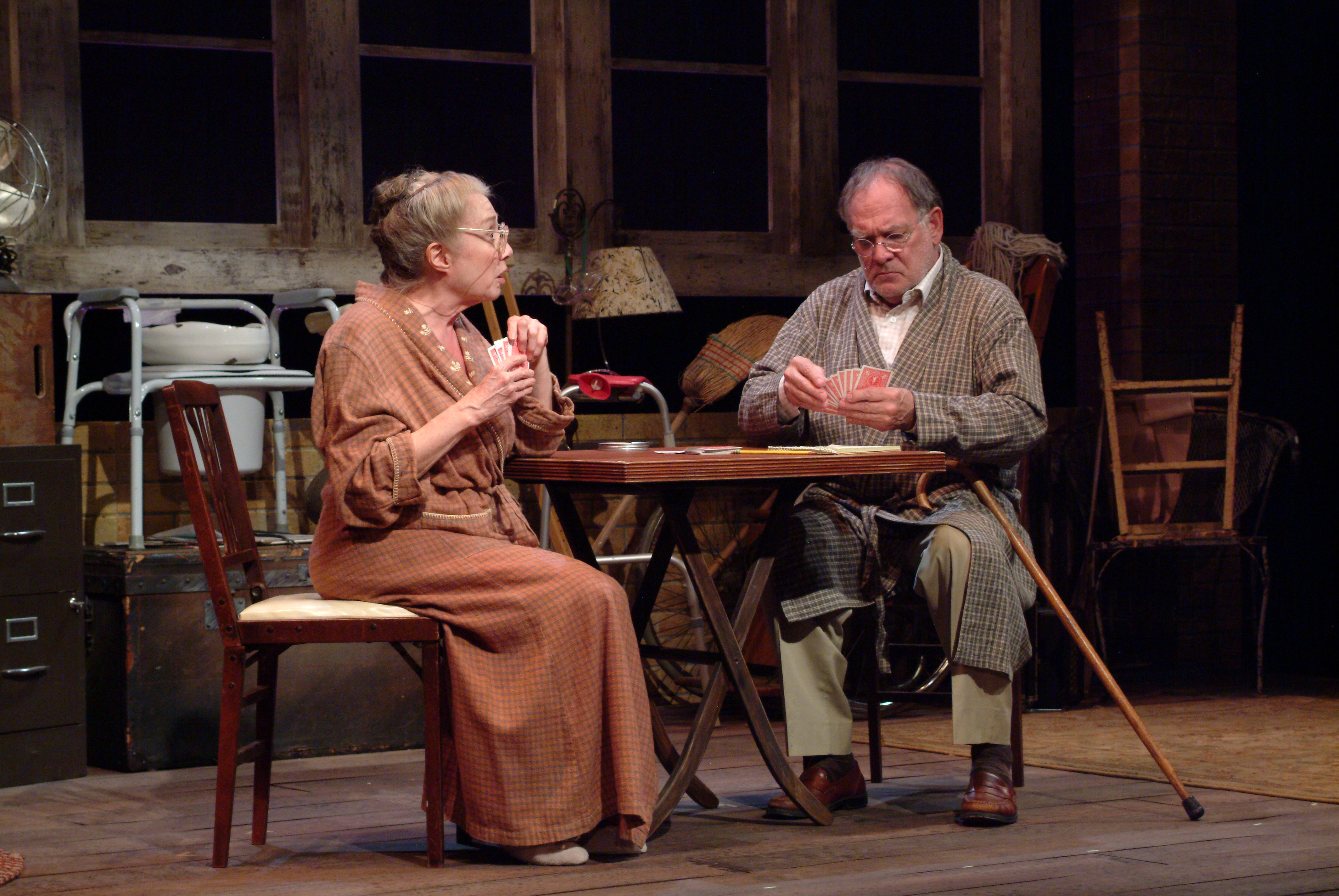
gin gameCard games.  You might not think of a card game as requiring blocking, but it does.  Plays like The Gin Game and Born Yesterday have dialogue that refers to certain things happening in the card games the characters play.  Learning when to draw and discard, when to deal, and when to shuffle your cards around in your hand, all while saying your lines, takes repeated practice to make it happen effortlessly.  The challenge is made all the more difficult because the cards you are looking at aren’t going to be the ones that are actually in the character’s hand.  That is, you may call “Gin” when you don’t actually have “Gin.”

Sleight of hand.  Magic tricks, juggling, and other similar special abilities need extra rehearsal unless the actors cast are already skilled in them.  While the actor responsible will need to practice the skill at home, integrating it into a scene where other things are happening is an extra challenge.

wait until darkThe blind.  If your character is blind, as is Susan in Wait Until Dark, you need extra rehearsal time to learn to move around the set as if you can’t see a thing.  Wait Until Dark and Black Comedy also have scenes where the stage lights are completely extinguished, but the actors have to move around the stage and do very specific actions in the dark despite not being able to see.  It takes extra practice to get so familiar with the floor plan that you can make this sort of scene flow smoothly without hurting yourself.


Actor’s Etiquette: The Little Old Deaf Lady in the Back Row

Etiquette-vector

This is a matter of courtesy to your audience, not your co-workers.

The audience would like to hear what you are saying.  A good script has had all extraneous words excised from it.  The audience needs to hear every one that remains.

Think of a stage as a room.  Whatever voice is adequate to fill that room, whether it’s the size of a standard classroom, or your living room, or a spacious great room, there is a voice that will fill it appropriately.  We don’t shout in kitchens unless something is burning or you’re about to pour vinegar into the pot, thinking it is wine.  Most kitchens aren’t that big that we need to raise our voices above normal speaking tones.

Remember that “normal” is dependent on the size of the room you’re in.  The larger the room, the louder your voice needs to be in order to be heard by anyone in that room.

Many new actors use a volume level that is appropriate to the size of the stage, but NOT to the stage plus auditorium.  The room you are occupying and have to fill is the entire space used by both actors and audience.  It doesn’t matter that the person you are speaking to is a character standing four feet away.  Your Four Foot Voice isn’t going to make it to the tenth row.

Some people have naturally loud voices, and some people have very small, quiet voices.  I’ve had students doing a scene six feet away from me, and I can barely hear them, their voices are so small and shy.  It’s fine to use that voice off stage, but on stage, your voice has to be big enough to be heard, as the saying goes, by the Little Old Deaf Lady in the Back Row.

In other words, the person sitting furthest away from you needs to be able to hear what you say as clearly as they could if you were sitting next to them.

Don’t worry about the fact that you’re speaking louder than the person in the front row needs in order to be able to hear you.  Your responsibility isn’t to him.  Your responsibility is to Grandma, who can’t walk well and so parked herself in the first empty seat she found when she walked into the theater.

Sometimes when I stand in the back of the theater and ask someone to shout, I still can’t hear them.  They are sure they are roaring, but I have to strain to understand them.  So have someone give you feedback on how audible you are from the back row.  Once you get a thumbs-up from them, you know what is required and that you can actually produce that volume, even if you aren’t accustomed to speaking at that level.  (If you can’t produce that volume or sustain it over multiple performances, that’s when you need to seek the help of a vocal coach, who can teach you how to use your vocal instrument.)

Remember that the quieter moments in a play nevertheless have to be heard by those in the last row.  Stage whispers aren’t like ordinary whispers.  Check with your director on your levels, and take his admonitions seriously.

megaphoneIf you are challenged in this area, then it’s going to be even harder for you to learn to shout when you need to in the context of a play (because you’re angry, for instance).  Best to overcome the challenge now, before you’re faced with that kind of scene in rehearsals!

One last thing:  Remember that people absorb sound in the same way that the soft materials used in soundproofing equipment do.  In other words, the larger the audience, the louder you have to be to be heard.

Do We Have Enough Rehearsal Time?

calendarI’m going to address this simply from the point of view of community theater.  The time needed for college or professional productions probably differs.  I’m also starting with choices that are largely made by the director, but I’ll finish with how it impacts you as an actor.  If you can identify upfront that the director may not have given you enough time to rehearse, you can handle how you rehearse a little differently to overcome this deficit.

In community theater, time is your best friend, but I don’t mean just the number of hours you spend in rehearsal.  Yes, that matters.  But the number of weeks from the first reading to opening night matters as well.

Why?  Because it gives your subconscious time to do its thing.  This is what John Cleese talks about when he says the third requirement for creativity is Time.  Ideally, you want seven weeks of regular rehearsals and one week of technical rehearsals.  Let’s say it takes you five weeks to get off book.  That gives you one week to REALLY get off book; that is, to reach the point where the words come out without you having to think about them.  It gives you one more week to do the fine-tuning that can only happen once you are REALLY off book.  And it gives you the eighth week to adjust to technical issues.

If the entire cast can get off book in four weeks and you’ve got a compelling reason to not use an eight week period, then for an “ordinary show” (see below), you can shorten the rehearsal period to seven weeks.  However, it’s my experience that at least some of the cast will still be on-book in that fifth week.  But the theory here is that you should put the script down no later than three weeks before opening night in order to benefit from what I will call the “subconscious effect.”

Has there ever been a community theater production you’ve been part of that seemed to be noticeably better on the second weekend of performances?  If so, you’re looking at the “subconscious effect”.  Once you get off book and are “fine-tuning” your performance, your subconscious gets very busy and does work on your role that you aren’t aware of.  Even if all you do in the week after opening is look at your script three times and have one pick-up rehearsal, your subconscious is still working and getting more comfortable with your choices.  Magical stuff happens when you give it this time to work.  So if you can give it that extra week before opening night, you’ll get better buzz to help fill the house on the second weekend!

As for the number of hours you need, my general rule of thumb is that a production with no special needs that will run for 2 hours including one 15-minute intermission requires 54 hours of rehearsal time prior to Tech Week.  To get the most out of this time, you need rehearsals that last at least 2½ hours long, three or four times a week.  (Rehearse them more often than that, and they have no time to work on their part at home as well as do their laundry.)

If the play is longer or shorter than two hours, you can adjust the total rehearsal time up or down.  But length is not the only consideration in choosing the number of hours for rehearsal.  Special considerations can increase the amount of time you need to work outside of rehearsals as well.

What do I mean by special considerations?  I’ll talk about them next time . . .