On Censoring (and why you shouldn’t!)

The moment I read a script, I’ve made dozens of decisions about a character.  Who she is.  How she speaks.  How she moves.  How this or that line probably should be said.  What sort of movement is required.  What I want.  Etc.  You do, too.  We can’t help it.

Human beings are always judging and evaluating new information placed before us.  We like to categorize things.  When you meet someone, you immediately start “identifying” who it is.  What are some of the favorite questions we like to ask new people?  Where are you from?  Do you have brothers and sisters?  Where do you work?  What do you do for a living?  Are you married?  Where did you go to school?woman_clipboard

And we assess the other person’s appearance immediately, too.  Are they attractive?  Do they dress neatly or sloppily?  Do they care about their appearance?  Do they have good taste in clothes (according to our lights, that is).  Are they color blind?  Do they need a haircut?  Is that blond real or bottled?  Are they athletic or bookish?  Funny or annoying?

We aren’t always right about our assessments of people.  Ever know someone who makes snap judgments about people, pronouncing someone to be a “jerk”, only to tell you months later, after he’s gotten to know the guy, what a “good guy” he’s turned out to be?  Or who praises someone to the hilt after a single meeting, only to discover later that it was all a show and that he’s done someone wrong?  If you don’t, then look in the mirror, because the odds are that you’ve misjudged someone along the way.  But knowing that doesn’t stop us from making quick judgments about those we meet.

Real people have the opportunity to change your mind about them.  But characters in a play aren’t as forceful.  They won’t resist your labels, at least not loudly enough to get your attention.

What seems obvious on the first read-through often IS part of the scene, and part of the character.  But it is only one part.  Human beings are much more complicated than the broad strokes we sometimes settle for as actors, without even realizing that is what we are doing.

In fact, human beings are not just complicated, but they are also often contradictory, and their behavior and dialogue reflect that.  When you are inclined to say, in response to a director’s suggestion, “But my character wouldn’t do that,” you are often censoring it on the basis that the director’s suggestion is blue, but you’re creating a character based on oranges and reds.  What if, instead, you chose to go for a rainbow?  Or instead of a quartet, for a symphony?  When you do this, you not only surprise the audience, but you make the play richer and more layered.  And you create characters who, by virtue of their very contrariness, seem like very real human beings.

Acting is Exploring, Not Deciding

Forgive the length of this post, I couldn’t find a way to split it in two!

Your subconscious is the most amazingly sophisticated computer.  I almost wrote “known to man”, except that we cannot, with our conscious brains, begin to appreciate all that our subconscious can do.

I say “can” do, because our conscious brain is apt to interfere with the process.  We think far too much and do ourselves a disservice by doing so.  If, instead, we would listen for the words our subconscious whispers to us, we’d all be better off.  Learning to do something well is in large part a product of learning to shut up and listen.

Remember the old adage about computers, “Garbage in, garbage out”?  When we use our conscious brains too much, we tend to put garbage into the computer.  I’ll explain why it’s garbage another time, but garbage confuses the subconscious, which doesn’t know what to do with it.  The garbage doesn’t fit with what’s true, but the fact that you’ve entered this data makes your subconscious try to work with it, to fit the square peg into the round hole.  Because here’s the funny thing about your subconscious:

It doesn’t have a value system.

Binary codeIt’s like Binary Code computer language.  It knows 0s and 1s, but it doesn’t have an opinion as to which is better.  It just knows they are different.  It understands frequency, however.  Here’s my golf analogy:  If you hit a ball in the water the last time you played, you’ll worry that you’ll do it again during your next round.  So you’ll think things like, “Just don’t hit it in the water.”  “Just get it over the water, I don’t care where it ends up.”  “Oh my God, I hit it in the water last time, I don’t want to do that again.”

Your subconscious doesn’t understand the word “don’t”.  Instead, it homes in on the word “water”.  “Oh,” says your subconscious, “he keeps talking about the water.  That must be where he wants his ball.”  And Bingo! That’s where your ball goes.

On the other hand, if you simply present ideas to your subconscious without stressing one over another, your subconscious is free to choose what works best, and it is smart enough to do precisely that.

It is easy to rush to make choices as an actor.  After all, you have a finite rehearsal period in which to put a play together to show the public.  No one wants to make a fool of themselves, so making choices early makes us feel that we’ll be able to practice those choices often enough to make them look good.  This theory is fine as long as the choices are good ones, but they often aren’t.  It’s impossible to understand your character in the first few weeks of rehearsal.  And even if the choices are good, making them early often precludes choosing a better one later.

Rehearsals are instead best used as explorations into what is possible.  In experimenting, we often come across things that don’t work, but those “mistakes” often lead us to things that do.  The creative process starts, I’m afraid, with a lot of garbage, but the garbage is the warm-up.  Your work at the end of the night is always better than the work at the beginning, isn’t it?

Once your creative juices get warmed up, they start to produce quality stuff you can keep.  Do enough exploring and, after a few weeks, the pattern starts to emerge, a pattern that is impossible to see with any clarity before then.

This is an uncomfortable approach at first.  It’s easy to get scared by an opening night that seems to loom larger with each passing day.  Making choices makes us feel secure, but if you can have the courage to trust the process and explore every conceivable option throughout the first half of your rehearsal process without making choices, you will find that a great performance will be the natural result, and that it will come together fairly effortlessly in the last few weeks of rehearsal.

I’ve seen this happen time and again.  I make my actors a nervous wreck when I direct, because I refuse to let them settle into complacency early on.  I am continually pushing and asking questions and trying new things through Week 5 (assuming an eight-week rehearsal period).  They are sure, I think, that this thing will NEVER come together!  Can’t we please have more run-throughs?  (Run-throughs are an actor’s greatest security blanket.)  But the work starts bearing fruit after Week 5, and the payoff in performance is self-evident.

By delaying choosing, you turn the decision-making process over to your subconscious, which is better qualified for the job.  You will also find that you don’t have many choices to make after all, that it has made them for you.  All you need to do is run with them!

Acting is NOT a Linear Process

Most complex activities are not linear in nature.  Whether you are good at painting, cooking, or playing a sport, you gradually developed your expertise.  For instance, I am currently learning to do yoga.  Sometimes I pay attention to the positions I am trying to achieve, to make sure my form is good; sometimes I concentrate on making sure my abs are employed throughout.  Sometimes I pay attention to whether I’m inhaling and exhaling in the right places.

non linearWhen I pay attention to one aspect, I am NOT paying much attention to the others.  It’s impossible to focus on more than one thing at a time.  Whatever I focus on is probably what I feel is my weakest link at this moment.  By jumping back and forth between the aspects, I’m building expertise in all of them “at the same time”, just not simultaneously.  I keep a certain amount of parity in all areas by not developing my skill in one aspect to the exclusion of the others.

It is difficult to become great at one aspect if you don’t improve the others at the same time.  Because the aspects work together to create a single whole, you need to develop them all gradually and not leave one behind.  Imagine putting on a pair of jeans and getting your left leg in all the way up to your crotch before starting on the other leg.  You’ll find the jeans have to come down to at least your knee in order to get your right toe in the pants.

Because each new part in a play is a fresh learning experience, hopscotching from one approach to a role to another is just part of the creative process.  As long as you hit all the squares at some point and revisit them as necessary during the rehearsal process, the exact order you follow probably isn’t critical.

I start with my emotional response to the text, probably because that’s where I started when I read plays at eight years old.  That was my entrée into the life of a play, because most of my theater experience at the time was confined to reading the script, apart from an occasional school production.  Opening myself to the possible emotions my character feels is still my starting point.

Because the way I move on stage is driven largely by the emotions I feel, blocking comes after this initial emotional investigation, never before.  It doesn’t necessarily come second, though.  If I get a script before rehearsals start, I may mark the beats in my script.  I may look for the verbs for each beat, or I may just look for my verb for the entire play.  I may examine the language to see what it can tell me.  I may look for the arc of my character, or for the ebbs and flows of the play.  I may study the relationships between the characters.

All of the tools I’m introducing you to are tools you can use in whatever order suits you best, or suits a particular play best, and are probably best revisited periodically throughout rehearsals.  As long as you expose your subconscious to the opportunities these techniques provide you, the order doesn’t really matter, because your subconscious is clever enough to use them properly, no matter what order you choose.  But that’s a story for another day . . .

Acting Beats, Part II – A Practical Example

Diagramming the beats of a scene is an art, not a science.  There is room for reasonable people to disagree.  A change in your scene partner’s emotion or tactic doesn’t necessarily mean anything changes for you.  Some actors will identify the smallest nuances, while others will take a slightly broader view.  (Taking the more detailed approach isn’t necessarily “better”; it is entirely possible to identify fewer “formal” beats but nevertheless play the subtleties within them.  Going the detailed route can also become tedious by the second act if you have a major role in the play!)

I typically mark the beats in my script in pencil, because as I go through the rehearsal process, I may find that I change my mind about a beat’s placement.  Even if I give them no conscious thought after I mark them, the slashes serve as a subsconscious reminder of where there is a bend or turn in the road.

Here’s a monologue by Dora Strang, from Equus, by Peter Shaffer.dora strang

Look, Doctor:  you don’t have to live with this.  Alan is one patient to you:  one out of many.  He’s my son.  /  I lie awake every night thinking about it.  Frank lies there beside me.  I can hear him.  Neither of us sleeps all night. /  You come to us and say, who forbids television?  Who does what behind whose back? – as if we’re criminals.  /  Let me tell you something.  We’re not criminals.  We’ve done nothing wrong.  We loved Alan.  We gave him the best love we could.  /  All right, we quarrel sometimes – all parents quarrel – we always make it up.  /  My husband is a good man.  He’s an upright man, religion or no religion.  He cares for his home, for the world, and for his boy.  Alan had love and care and treats, and as much fun as any boy in the world.  /  I know about loveless homes:  I was a teacher.  Our home wasn’t loveless.  I know about privacy too – not invading a child’s privacy.  /  All right, Frank may be at fault there – he digs into him too much – but nothing in excess.  He’s not a bully. . . /  No, doctor.  Whatever’s happened has happened because of Alan.  Alan is himself.  Every soul is itself.  If you added up everything we ever did to him, from his first day on earth to this, you wouldn’t find why he did this terrible thing – because that’s him; not just all of our things added up.  /  Do you understand what I’m saying?  I want you to understand, because I lie awake and awake thinking it out, and I want you to know that I deny it absolutely what he’s doing now, staring at me, attacking me for what he’s done, for what he is! /  You’ve got your words, and I’ve got mine.  You call it a complex, I suppose.  But if you knew God, Doctor, you would know about the Devil.  You’d know the Devil isn’t made by what mummy says and daddy says.  The Devil’s there.  It’s an old-fashioned word, but a true thing . . . /  I’ll go.  What I did in there was inexcusable.  I only know he was my little Alan, and then the Devil came.

The slashes mark the start/end of the beats I’ve chosen on my first pass.  As I say, there is no right or wrong here.  You might want to have “We loved Alan” begin a new beat.  You might want to put all the lines about “privacy” into one beat, beginning with “I know about privacy too” and ending with “He’s not a bully.”  You might want to include “Do you understand what I’m saying?” in the beat that precedes it, and start the next beat with “I want you to understand.”

Wherever you choose to place your slashes will impact how you deliver the monologue.  Make the changes I’ve proposed in the preceding paragraph, and it will change how you say the lines.  In subtle ways, perhaps, but there will be a distinct change in what is going on inside of your character.

I won’t go through the piece to describe the changes from one beat to the next; for the moment, I prefer to let you understand them in your own way.  I’ll give you a detailed analysis of it when we get to talking about playing verbs.  But if my choices confuse you in any way and you’d like some clarity now, just let me know, and I’ll be happy to explain my logic.

See Part I here.  See Part III here.  Or just skip to Why Playing Verbs is (Ultimately) Easier than Acting Emotions here, which is where you can read about the changes from one beat to the next (which uses this monologue as an example).  See Playing the Verbs Part II here.

Acting Beats, Part I

There are two kinds of “beats” in acting.  We use “beat” as another way of saying “pause”, because it denotes a particular period of time, something on the order of a second.  So if your director says, “take a couple of beats after that line”, it means keep your mouth shut for two seconds.  A very good thing to do after delivering a punchline, for instance.

But the other, and more complicated, sort of “beat” is one that refers to a small group of lines in the play.  A scene can be broken into a number of beats, which may be as short as a word or a sentence, and may be as long as a page or two.  Generally speaking, they probably include an exchange between characters of anything from one to four lines apiece.  (I haven’t done the math on this, I’m simply guessing based on where I typically draw the lines in my scripts.)

running tracks with three hurdlesWhat delineates one beat from another?  Either a change in emotion or a change in tactic.  (Beats may also change when a character enters or leaves the scene or the topic of conversation changes, but those are pretty obvious.)  Very often, both are involved, but at least one must change for a new beat to start.  We haven’t talked about tactics yet; we will once we begin scene work, which we’ll do shortly.

In memory monologues, the change in beats is usually driven by an emotional change.  In a regular monologue, both may be at work.

Understanding what the beats are in your scenes is critical to understanding the flow of the play, what your character is going for, and how to focus what you do to the audience’s greatest benefit.  Your understanding may be instinctive; if so, you don’t need to do a lot of conscious work in this regard.  You may come to your understanding by trial and error, and your process may seem haphazard, but all that matters is that you arrive at a conclusion that makes sense to the audience.  Or you may take a more formal, conscious approach.

In the next post, I’m going to explain the conscious approach, but it doesn’t mean that you have to use it.  As long as you arrive at the same destination, how you get there is up to you.  But if you aren’t unwilling to use the conscious approach on some level, you may find it shortens the process for you or that it turns your mind in directions you might not otherwise go.  I’m a very instinctive actress, but I go through the process at the start of each new play.  I’m not sure that it does anything for me, but I am certain that it doesn’t hurt.  At least, I’ve never found any visible wounds!

I suggest that no matter what your own process is, you try the conscious approach at least once so that you have a clear sense of the potential nuances of a scene or monologue.  Acting is not a matter of driving down the freeway.  If you treat it that way, watching it can be akin to driving through the flat farmland of western Oklahoma, where all that’s on the radio is the Pig Report.  As actors, we want to take the winding backroads to our destination, which is always the more interesting, scenic route!

See Part II here.  See Playing the Verbs Part II here.

Why the Playwright’s Words Matter, Part II

Second, lines with clear rhythm.  Tempo.

This is particularly important with verse plays (Shakespeare, Moliere), but applies to lyrical or poetic plays, too.  Change a word in Equus, which is very poetic, and you mess with the character, with the meaning of the play, with the rhythm (and therefore magic) of the piece.  Plays which weave a spell around the audience do so in large part because the writing permits it.  Change the writing, and you may break the spell.

Remember, I said that studies have shown that when the spell is broken, it takes up to five minutes to get an audience connected back to the play?  Changing the words can break the spell.  Do it at your peril.

Third, playwrights use literary techniques just the way novelists and poets do.Books

Literary devices like onomatopoeia.  Assonance.  Alliteration.  Parallelism.  Etc.

If a sentence has a staccato feel to it, that is probably intentional on the playwright’s part.  It may reflect a character’s jitteriness, for example.  A sentence with powerful, active words may be spoken by someone in anger, someone who expresses themselves very physically.  Change a word, and you may limit your ability, as an actor, to express a character’s emotions, because you’ll be disconnected from what the playwright actually wrote.

For instance, let’s say you have the line, “He blasted into the room,” or perhaps, “He burst into the room.”  Change the line to “He came into the room” or “He rushed into the room” or even “He pushed his way into the room”, and you’ve changed the feel of it.  The plosive “B” in the first two matches the feel of a door swinging hard against the wall as it is thrown open.

Playwrights are just as prone as novelists and poets to spend days agonizing over the choice of a single word.  I’ve seen actors change the way a line is worded because “it feels more comfortable.”  Because “I think this is how he’d say it.”  Because “this makes more sense to me.”  Quite frankly, this makes me want to scream just a little bit.  The actor has probably only worked with the script for a few weeks when he casually makes this decision.  Forget the fact that the playwright lived with the play for months, maybe years.  Forget that the playwright may have once written the line exactly as the actor is proposing, and changed it because he decided the word he replaced it with was a better choice.

Bottom Line:  If you think you know better than the playwright, it probably means you haven’t studied the script enough.

See Part I here.

Why the Playwright’s Words Matter, Part I

I’d like to give you a few more examples of why changing the playwrights’ words can be very problematic.

First, the easy one.  Jokes.  Punchlines.

Change one word, one simple innocuous word, and you might find it’s no longer funny.

Add a word, or two, or three, and you throw the joke off entirely.  It’s not the gist of the thing that makes it funny.  It’s the way it’s phrased.  Take a word out, you run the same risk.

sunshine boysA rule of thumb in vaudeville (see The Sunshine Boys) was that words with the “K” sound are funny, those without it aren’t.  And it’s true.  “M”s and “L”s just aren’t funny.  Harder, more plosive sounds are.  Substitute a funny word with an unfunny one, you ruin the joke.

Johnny Carson’s rule of thumb was that three is funny, four isn’t.  Talk about “She took my house, my car, and my parakeet”, and it’s funny.  (Notice that parakeet is funnier than dog; it’s got a K in it.)  “My house and my car” – not so much.  Even “my house and my parakeet” isn’t as funny as when the list has three items.  And add a fourth to the list – “my house, my car, my parakeet, and my shopvac” – it’s too many.  We start to lose interest before we get to “shopvac”.  (Take out house, and it becomes much funnier.  Two Ks, plus the unexpectedness of both the parakeet and the shopvac.)

In other words, our attention span only goes so far, and comedy is light, a fourth item weighs it down.  We’re looking for the punchline after three.  But you need three, not two, to set up the joke.  Don’t leave one of the three out!  And don’t add a fourth for any reason.  (Sometimes the playwright has added the fourth.  Sadly, that’s his mistake and you have to live with it.)

If you aren’t a natural comic, you might not understand why this matters.  The meaning is still there, right?  And isn’t it the meaning that is funny?

No.  Not all by itself.  Trust me on this.  Say the line as written.

And if you do consider yourself a comic, and you break these rules, the lines won’t get laughs, or you sure won’t get the kind of laugh the line deserves.  You’ll spend the run of the play wondering why the audience has no sense of humor, when in fact it is your editing of the playwright’s words that is ruining the joke!

See Part II here.

Word Choice, Memorization, and Script Analysis, Part II

Let’s examine a few related words to see what I mean:  cute, attractive, pretty, and beautiful.  And let’s do it with some of the cast of Glee.

glee-emma-pillsbury-290x400“Cute” is the pert girl with the dimples, a ready smile, and a bubbly personality.  She’s attractive, sometimes very attractive, but her features are probably not classic, and her beauty is as much a function of her effervescent personality as it is her physical appearance.  Think Jayma Mays (Emma Pillsbury).

glee brittany“Attractive” is a girl who is pleasant to look at, but who probably isn’t going to turn a lot of heads, or not for very long.  She’s probably got a feature which isn’t classic, but it doesn’t disturb the whole visage enough to make her unattractive.  Think Heather Morris (Brittany S. Pierce).

glee quinn“Pretty” is the stereotypical blonde cheerleader with the chiseled features.  Think Diana Agron (Quinn Fabray).

“Beautiful”?  Well, I’m not sure there are any real beauties on Glee.  No dogs, just no one who meets this high bar.  Let’s just say Giselle Bundchen.  Brooke Shields.  Cindy Crawford.

You’d never use the words “cute”, “attractive”, or “pretty” to describe these supermodels.  If you did, there’d be great confusion and a lot of misunderstandings.

Change a word in the script, and you can cause equal confusion without even realizing it.

I’ve had occasion, in writing these posts, to look for synonyms, and am surprised by how difficult it is, in the language that has more words than any other, to find good substitutes when I want to say something without using the same word I did in the previous sentence.  There aren’t many true synonyms which can be used interchangeably without altering the meaning of the sentence materially.

“Oh,” I hear you say, “that matters for a lot of lines, but not for many of the simple, throwaway lines.”  Okay.  Let’s look at a simple exclamation:  “Oh my god!”  Here are some logical alternatives:  “Oh my goodness!”  “Oh my lord!”  “Oh my gosh!”  “Oh Christ!”  “Oh lord!” and “Omigod!”

I’m not trying to get religious on anyone here, but I would suggest to you that seven different people would use each of these expressions in the same situation.  That even “Oh my god” and “Oh my lord”, while probably the two most similar phrases, nevertheless reflect a different relationship with their Maker.  That “Oh my god” and “Omigod”, while technically the same phrase despite a different pronunciation, nevertheless would come out of two very different mouths.

First, you have to respect these differences.  The playwright chose the words he chose for a reason.  Trust that, even if you don’t understand the reason initially.

Second, use these differences to help you understand your character better.  When we talk more about script analysis, you’ll see why this is useful.

See Part I here.  See Memorizing Your Lines Part I here.  See Memorizing Your Lines Part II here.  See Why the Playwright’s Words Matter Part I here.  See Why the Playwright’s Words Matter Part II here.

Word Choice, Memorization, and Script Analysis, Part I

Word choice matters.

The playwright has limited means of conveying an entire world to the audience, and to you, the actor.  He has only words.  And he has a limited number of them, at that.  He cuts out lots of words en route to the final draft of a play, and so every word that he leaves in counts and often has to carry out several assignments at the same time.

Which words he chooses tell you everything you need to know about the play and the characters.  The words are your clues to put the puzzle of the play together.  Think of the pieces as Easter eggs.  eastereggIn an Easter egg hunt, some of them eggs are so obvious that they dare you to ignore them.  Some are tucked behind a vase, their noses sticking out.  And some are so hidden that you need to move something in order to find them.

These last clues in a play may not surface enough for you to see them until halfway through rehearsal, but they’re there, hidden in the text.  But if you’ve changed the playwright’s words in the course of memorizing your lines, you’ll never find them.

It’s easy to change lines.  Sometimes we paraphrase lines to muddle through them because we have a mental block about them, and it gets us to the rest of the scene.  Before you know it, we’ve convinced ourselves that that is, in fact, the way the line is written.

Sometimes we change lines because we, personally, would use a slightly different phrase, and so it seems more natural to us to use our own words.  We may not even realize we’ve changed them.  If someone brings it to our attention, we’ll probably argue with them and stare at the script in disbelief.

Sometimes we change lines because we can’t understand why the playwright wrote it as he did, and rather than figure out the answer to that question (which might have a profound influence on how we play the character), we change the line so that it fits in with our notion of the character.  This is akin to taking a jigsaw puzzle piece and forcing it into a place where it doesn’t belong or, even worse, shaving the side of it so it will fit.

And sometimes (horror of horrors), we just think that we, who are so new to the material, know better than the writer who created these characters and slaved over each word in the script for many months.

But word choice reveals character, and so when you change your character’s lines, you change your character.  And usually not for the better.

Next time, I’ll give you some specifics about the kind of damage changing the playwright’s words can do.  But in the meantime, do your best to memorize his words, and not yours.

See Part II here.  See Memorizing Your Lines Part I here.  See Memorizing Your Lines Part II here.  See Why the Playwright’s Words Matter Part I here.  See Why the Playwright’s Words Matter Part II here.

Memorizing Your Lines, Part II

Davina made a great observation on Monday when I asked her to make an adjustment in how she was doing the scene.  Afterward, she said, “Because I haven’t been practicing it that way, it threw me off, and I had trouble remembering my lines.  I guess it’s better to memorize your lines just as words.”

Bingo.

It’s easier to memorize your lines when you have a rhythm, a tempo, a lilt, a melody to put with them.  Song lyrics are easy to memorize for this reason.  I forget my lines in a play within a month or so of closing, but I have retained hundreds of song lyrics for decades.  So if your lines in a play are at all musical, they are easier to memorize.

At some point, we’ll talk about a playwright’s use of “the poetic.”  Some playwrights have a talent for using poetic language, or else make intentional use of certain writing “tools” to evoke poetic effects.  Paula Vogel and Peter Shaffer come to mind as playwrights who do this.

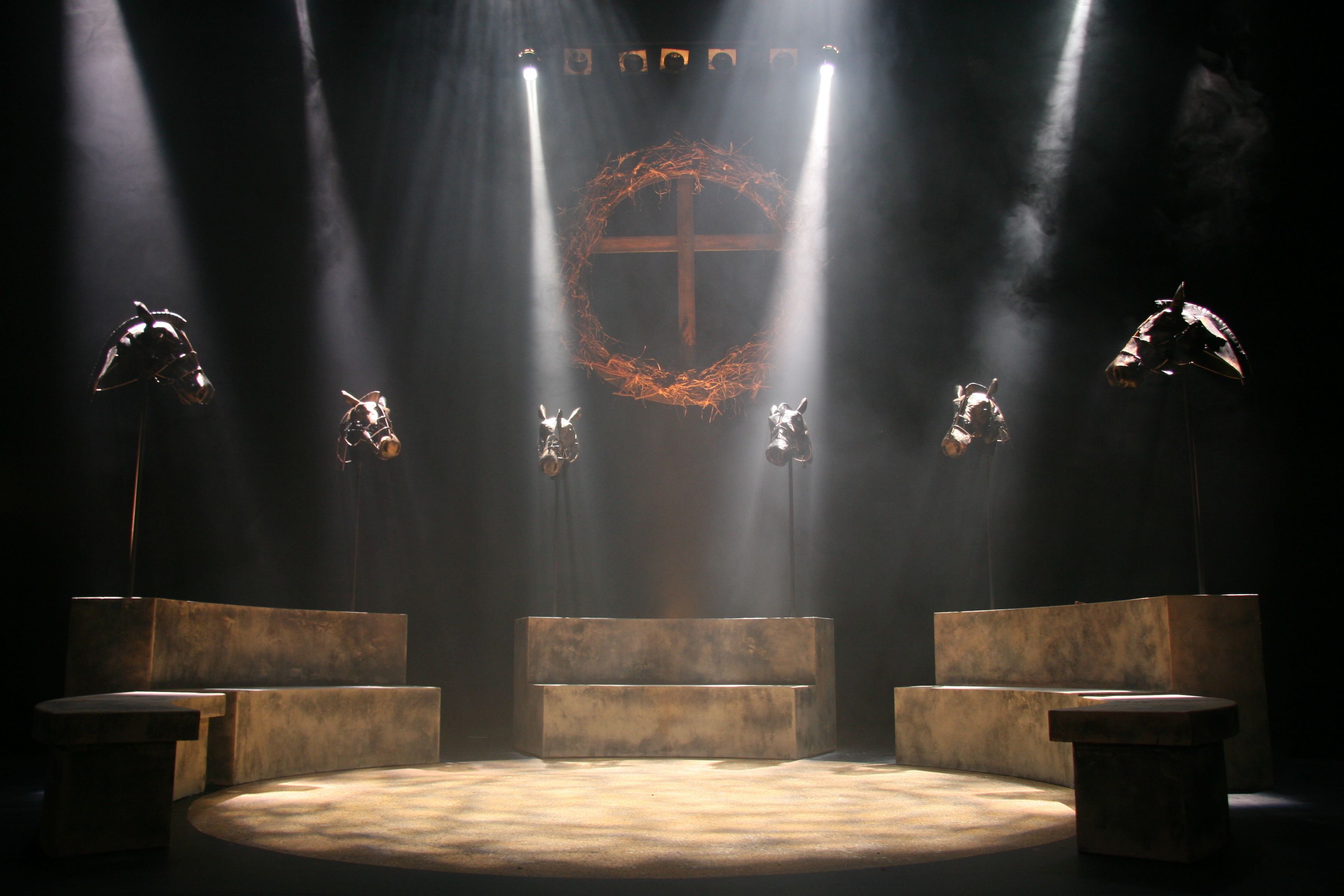
Kerry Bradley's design for "Equus"

Kerry Bradley’s design for “Equus”

This literary technique can make lines easier to memorize, because they build “music” into the line.  So can attaching a particular line reading to a line.  A line reading is a predetermined way of saying a given line.  Once you choose it, you have effectively chosen the melody of the line.  And when you try to “act” a line while you are working on memorizing lines, you will choose line readings that you will also memorize, whether you realize it or not.

Because you are working on memorizing the line more than you are studying your character, the line reading that sounds “right” to you initially is no longer just a placeholder, a way of saying it so that you can get the words in your head.  It is likely that you will say it that way every time you rehearse it, and every time you recite it when you are learning your lines.  And if you later learn something about the character that suggests a different way of saying the line is appropriate, you will find it difficult to do so, because your line reading has become ingrained.

I have record albums I have listened to so many times that I not only know in the pause between songs what song is coming next, but I also know the note it begins on.  I even know how many seconds come between songs.  That’s how much repetition can give you.  When your lines are on this sort of automatic pilot, there’s no opportunity for acting to happen.

I’ve known actors who have inadvertently memorized pauses in the middle of their speeches, or directly preceding some of their lines.  This happens when they aren’t quite comfortable with the line, and it takes them an extra moment to remember what they are supposed to say.  They never make the effort to overcome it, and the pause is in there forever, no matter how much the director urges the cast to speed things up.

So memorize the words without regard to how you say them.  Stack them up like railroad cars on the line and just move through them as quickly as possible.  When you memorize this way, you leave open all the possibilities for your character.  You won’t know which choices are the right ones for your character for weeks, so don’t tie yourself into choices early by choosing how to say the lines yet.

See Part I here.  See Word Choice, Memorization and Script Analysis Part I here.  See Word Choice, Memorization and Script Analysis Part II here.