Playing the Verbs, Part III — Raising the Stakes

One of the keys to good acting is figuring out what your character wants, slavishly sticking to trying to get it, and not worrying too much about how you feel.  If you really know what you want, why you want it, and everything hangs on your getting it, then most everything else is going to fall into place without you having to work too hard.

Let’s go back to our party; notice that each option begins with the word “because”.

“I want to make sure this party comes off perfectly, because I will feel embarrassed if it isn’t successful” or “because if I can’t control my world, I won’t feel safe and will freak out” or “because if it is successful, I will get the job I want more than anything in the world, the one that will both set  me up for the rest of my life and make me happy to go to work every day.”

What do I want?  To give a perfect party.  Why do I want it?  “Because . . .”

As for “everything hangs on your getting it”, this is about what we call “stakes”.  Every character has something at stake, which means that whether or not they succeed at something MATTERS.  I mean REALLY, REALLY MATTERS.

Whether I am fourth or fifth in line doesn’t matter much if I’m making a bank deposit, I’ve got time to kill, and there is plenty of money already in the bank to pay my bills without bouncing a check.  If my family is starving and there are only four loaves of bread left at the bakery, it does matter.

Whether I am hired for a job doesn’t matter much if I’m already employed and simply looking to move up the ladder, but it matters a ton if I’ve been out of work for eight months, my unemployment has run out, and I have a child who needs a life-saving operation.

Whether a man asks me out for a date doesn’t matter much if I just think he’s cute; but if I have fallen head-over-heels in love with him and want to bear his children, it matters a great deal.

poker chipIn each of these cases, I can RAISE THE STAKES for my character by choosing the second alternative or something like it.  The higher the stakes for your character, the better.  When everything seems to hang on whether or not you what you want more than anything in the world, it’s fun theater to watch!

A good way to do this is to think in terms of Life and Death circumstances, at least figuratively.  The higher you can build your house of cards, the more things you can hang on whether or not you succeed, the more it becomes a tightrope act.  And the audience is on the edge of its seat.

Let’s take the first “I am bossy, because”, which is to avoid embarrassment.  This is good, but the stakes aren’t high enough to be as interesting and dramatic as possible.  We can amp up “embarrassed” by changing the word to “mortified”.  But even this isn’t enough.  To really make this work, you have to understand WHY your character is mortified.  Does her self-esteem depend on appearing to be perfect?  Has she never failed at anything?  Does she feel inferior to all her invitees, and “knows” they will judge her as being inadequate if the party isn’t perfect?

Whatever you choose, make the consequences of failing to get what you want as dire as possible.  If this party isn’t successful, will she be ostracized by the group?  Is the party for her husband’s coworkers, and her husband will be furious and withhold his love if they don’t walk away impressed?  Or better yet, is their marriage on the rocks and depends on this party being a success?  Will her husband file for divorce if someone leaves the party unhappy?

Or does his getting a promotion depend on her impressing the boss with her social skills, and they need his promotion to buy their apartment, which has just gone co-op?  Or to pay for private school for their children?  Or to bail her mother out of jail?

Sometimes the playwright will clearly define what your character wants and why he wants it so badly, but more often than not, it is written “between the lines” and is part of the subtext.  If the playwright doesn’t explicitly tell you either the desire or the reason for it, then you are free to choose whatever you like.  Just be sure that nothing in your choice conflicts with any of the information the playwright does give you.  Your choices must always make perfect sense in the context of the play.  But make clear choices that give you something to go after and a compelling reason to do just that!

See Part I here.  See Part II here.  See Why Playing the Emotions Doesn’t Work here.  See Why Playing the Verbs is (Ultimately) Easier than Acting Emotions here.  See Choosing Verbs here.  See Big Verbs vs. Little Verbs here.  See How to Learn to Play the Verbs here.  See An Example of Why Verbs Make a Difference here.

How Action Enhances the Play

Most physical action used in plays is not indicated in the script.

Yes, sometimes there are stage directions that appear in parentheses.  Some scripts have more of this than others.  These days, playwrights steer away from including any stage directions unless they are absolutely necessary to understanding what is going on in a scene.  For instance, if a character says “Here”, and then pulls a packet of unmarked bills from his jacket pocket, and the other character says “Thanks”, you’d have no reason to know that it’s a bribe and not a throat lozenge unless the playwright tells you.  But directions such as “sits” or “stands” are rare in today’s scripts.  The playwright understands that it often doesn’t matter exactly when the sitting or standing happens, and that if it does, a good actor will be able to figure it out without assistance.

But even in older scripts where stage directions are sprinkled in here and there (and sometimes these are not the playwright’s opinions but merely the stage manager’s recording of what was done in the original production, which you should not consider to be sacrosanct), there is much that isn’t included.  It’s your job as an actor to add physical movement that underscores, enhances, or adds to the fun of the play.

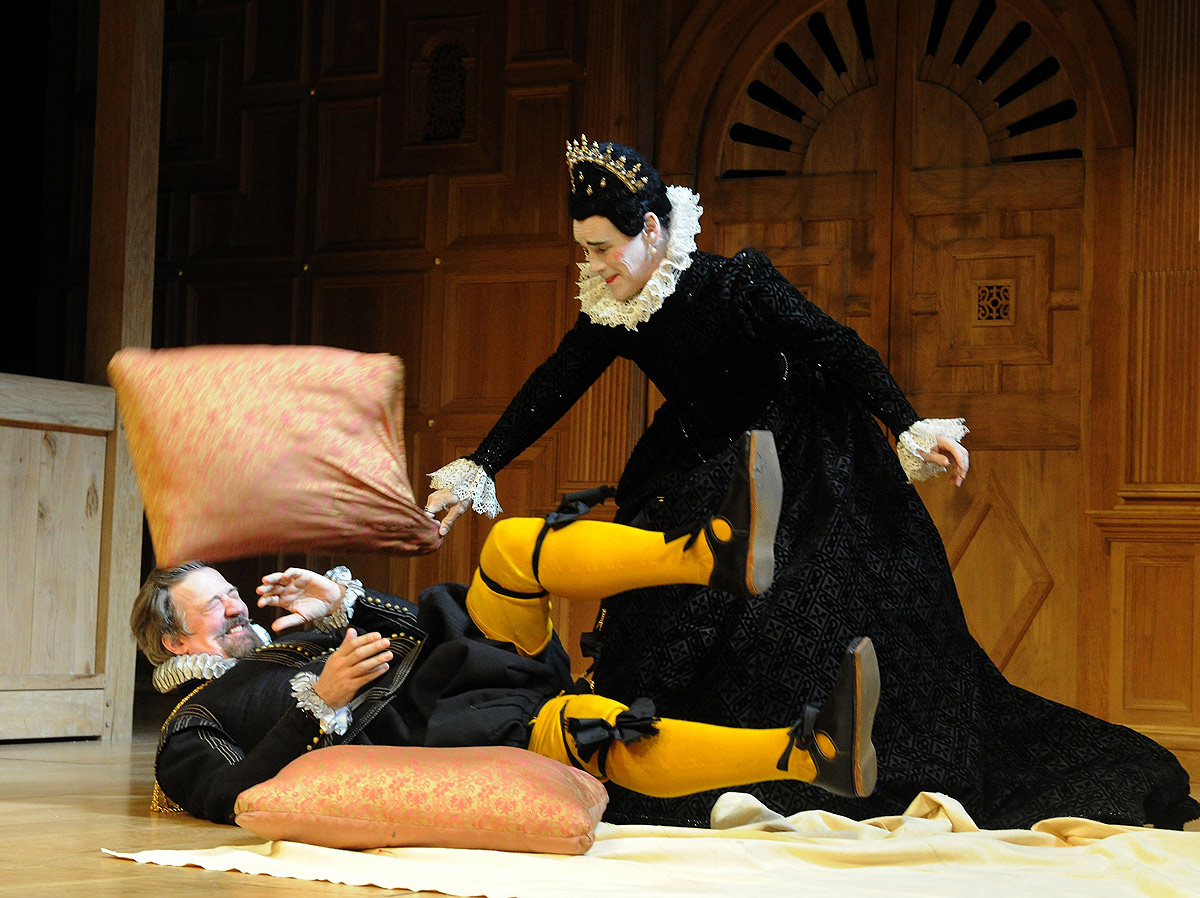
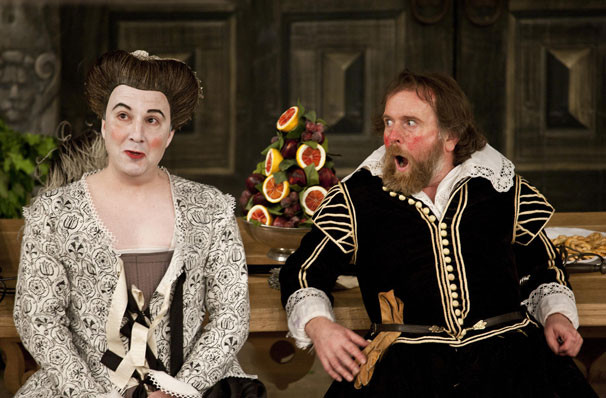
If you’ve ever read a Shakespeare play, you’ll know that aside from entrances and exits, there isn’t much recorded in the script in terms of movement.  Watch a good production, however, and you’ll find lots of action, especially in the comedies.  I just saw the London production of Twelfe Night with Mark Rylance and a host of exquisite actors at the Belasco Theatre in New York, and it was full of marvelous physical bits that made us all laugh.  Here’s a few photos to give you an idea of what is possible when you let your imagination loose and express yourself through more than words (you can also check out Youtube for the American Conservatory Theatre’s commedia del’arte production of The Taming of the Shrew — links in the right column — for some very physical Shakespeare!):

TN4

TN3

Twelfe Night

TN6

TN1

Playing the Verbs, Part II – Going After What You Want

Untrained actors act the adjectives and adverbs; trained actors act the verbs.

“Acting the verbs” means figuring out what your character wants and trying to get it.  This is really pretty simple, although it requires a large shift in how you look at a scene.

Instead of thinking of your character as being “needy”, think in terms of “I want you to love me.”  Instead of thinking of your character as being “bossy”, think in terms of “I want to make sure this party comes off perfectly, because I will feel embarrassed if it isn’t successful” or “because I need to control my world in order to feel safe” or “because if it is successful, I will get the job I want more than anything in the world.”

myriam-hands-on-hipsI hope you can see that the three options I’ve given for why your character might be bossy are very different, and will probably produce different results.  The sort of “bossy” you are will change, because what is driving it is different.  But if you just play “bossy”, you’re apt to go for the same kind of “bossy” no matter who your character is or why he is doing what he does.

And let’s be honest:  in your real life, do you ever decide to “be” bossy?  No, you decide you want to give the best party ever.  You decide that the people around you are incompetent or slow or uncreative, and they need you to direct them.  You have a strong attachment to your vision, and you want to see it achieved.  You may end up bossing people around and irritating them in the process, but it’s not like that’s what you’re striving to do.  You’re just trying to give a really good party.

EVERYTHING we do in our real lives is in service of getting something we want:  a quart of milk, an answer to a question, an experience, a job, love, pleasure, prestige, power, money.  No matter how trivial the goal is (I want to read a book I am enjoying; I want to snack on something to take off the edge before dinner; I want to straighten that picture on the wall because it’s driving me nuts), EVERYTHING we do is to get something we want.

It’s the same for your character.  EVERYTHING your character says or does is in service of getting something she wants.  It isn’t about feeling her emotions.  The emotions are simply a by-product of who you are, what you want, how you try to get it, and whether or not you are successful in getting it.

See Part I here.  See Part III here.  See Why Playing the Emotions Doesn’t Work here.  See Why Playing the Verbs is (Ultimately) Easier than Acting Emotions here.  See Choosing Verbs here.  See Big Verbs vs. Little Verbs here.  See How to Learn to Play the Verbs here.  See An Example of Why Verbs Make a Difference here.
Why Acting the Emotions Doesn’t Work

All actors begin by acting the emotions of their characters.  Emotions draw us to the theater, so we think that is where we have to start.  I’ve talked about some of the reasons why this isn’t effective:  it is superficial, tends to lead to one-note performances, and often keeps us from finding the more interesting choices.

But the biggest reason why it doesn’t work is what my actress friend Sharon mentioned at dinner the other night.  Emotions are always IN motion.  They change in split seconds, flicker through you and mutate into another emotion so quickly and often so dramatically that they can’t be captured intentionally particularly well.  It is also impossible to consciously act two emotions at once, while we regularly feel multiple emotions concurrently.  Our conscious brain is the tortoise, while our subconscious is the hare.  Trying to act the emotions tends to iron out the wrinkles in a performance, and the wrinkles, quite honestly, are much more interesting than the Botox version you otherwise get.

At last week’s class, Nora asked if it is possible to act an emotion without actually feeling it.  There are actors who regularly do this, and unfortunately, there are professional actors among them.  But as Davina noted, the audience knows the difference between an actor who is actually feeling the emotion on some level and one who is pretending to do so.  Audiences are infallible lie detectors; they know when you’re faking it.

“Well, if I’m not supposed to play the emotions, what do I do?  My character is emotional, I can’t just ignore that!  If I do, how can I possibly feel the emotions so the audience sees them?”

Simple.  Understand enough about who your character is and where he is coming from, and then just try to get what you want and keep the conduit to your inner emotional life open.  If you do that, the emotions will not only take care of themselves, they will also show up in far more interesting ways than if you strive to be angry, resentful, disappointed, gleeful, etc.

Yes, the major emotions you have identified in your first read-through will probably end up being a part of the scene, but if you don’t focus on them but INSTEAD focus on getting what you want, all the subtleties of emotion that we regularly experience will come through as well.

This is acting distilled to its simplest components.  It’s good, sound theory, but it IS theoretical, not practical.  So next time, I’ll talk about how to translate it into something practical!

Playwrights are literary (and how this affects acting beats and performance)

A good playwright doesn’t just know how to develop a plot, maximize conflict, and create interesting characters.  All these things help plays to be successful, but playwrights aren’t merely practical creatures.  They (the good ones, anyway) also know how to use literary devices to their best advantage on stage.

The kinds of literary devices I’m about to talk about help to focus the audience’s attention on what is important, as well as to make what is happening as clear as possible.

Here is the monologue from Agnes of God that Davina is working on, along with the Beat marks she is presently using.  They are slightly different than the ones she started with, because it became clear that the literary choices of the playwright help to determine the Beat divisions.agnes1

Dr.  Livingstone:  How dare you march into my office and tell me how to run my affairs – how dare you think that I’m in a position to be badgered or bullied or whatever you’re trying to do.  Who the hell do you think you are?  /  You walk in here expecting applause for the way you’ve treated this child.  /  She has a right to know!  That there is a world out there filled with people who don’t believe in God and who are not any worse off than you!  People who go through their entire lives without bending their knees once – to anybody!  And people who still fall in love, and make babies, and occasionally are very happy.  She has a right to know that.  /  But you, and your order, and your Church have kept her ignorant, because ignorance is next to virginity, right?  Poverty, chastity, and ignorance, that’s what you live by.

What are the literary devices John Peilmeier uses in this monologue? 

REPETITION.  Repetition means at least two of something.  It’s typically used to emphasize something, and Peilmeier uses it (forgive me) repeatedly in this monologue.  Two examples:  “how dare you” and “She has a right to know.”

GOOD THINGS COME IN THREES.  We talked about lists of threes in comedies, that three is the necessary number for a joke to be funny when it involves a list of some sort.  It doesn’t just apply to jokes, however.  When a writer wants to emphasize a point, he often builds to it by using a list of three.  Such lists can be used in a number of ways, but typically they escalate upwards emotionally, as in big, bigger, biggest.  (Choose to use them differently if you like, but be sure that you recognize that there are three related items which need to be delivered with some sort of variety in order to be effective.)

This monologue has a number of lists:

  • How dare you/how dare you/who the hell – forget that the third element doesn’t begin with “how dare you”, it is nevertheless the climax to this list of three.
  • Badgered/bullied/whatever you’re trying to do
  • People who/people who/people who
  • You/your order/your Church (and notice how each element is tied to the Mother Superior)
  • Ignorant/ignorance/ignorance
  • Poverty/chastity/ignorance (notice that “ignorance” is part of two separate lists)

FRAMING.  Framing is when the repetition begins and ends a thought.  “She has a right to know” is used to frame a list.  Just in case you forget where she started, why she made the list, Peilmeier reminds you by hammering it home with the closing frame.

A less obvious frame is in the last two sentences.  It is an implied frame, because it begins with “you, your order, and your Church” and ends with “that’s what you live by”, which is another way of saying the list that begins this section.  Just in case you forget that Dr. Livingstone is directly accusing the Mother Superior, the phrase “that’s what you live by” brings you back to where she started.

Peilmeier uses these devices to make sure you get his major points.  Words in a play can fly by, and you don’t know which words are the most important ones unless the actor and/or playwright help to underline them for you.  Peilmeier presents the actress with some great tools in this monologue; your job is to use them to their best advantage.  Don’t swallow any of the repeated words, and make sure your audience knows you are giving them a list.  The need to give them some variety in delivery will also help you explore the emotional underpinnings to your character at this moment.

With regard to choosing the beats when you find literary devices like this, make sure you include them in one beat.  Lists, frames, and repeated words typically belong in the same beat.

On Censoring (and why you shouldn’t!)

The moment I read a script, I’ve made dozens of decisions about a character.  Who she is.  How she speaks.  How she moves.  How this or that line probably should be said.  What sort of movement is required.  What I want.  Etc.  You do, too.  We can’t help it.

Human beings are always judging and evaluating new information placed before us.  We like to categorize things.  When you meet someone, you immediately start “identifying” who it is.  What are some of the favorite questions we like to ask new people?  Where are you from?  Do you have brothers and sisters?  Where do you work?  What do you do for a living?  Are you married?  Where did you go to school?woman_clipboard

And we assess the other person’s appearance immediately, too.  Are they attractive?  Do they dress neatly or sloppily?  Do they care about their appearance?  Do they have good taste in clothes (according to our lights, that is).  Are they color blind?  Do they need a haircut?  Is that blond real or bottled?  Are they athletic or bookish?  Funny or annoying?

We aren’t always right about our assessments of people.  Ever know someone who makes snap judgments about people, pronouncing someone to be a “jerk”, only to tell you months later, after he’s gotten to know the guy, what a “good guy” he’s turned out to be?  Or who praises someone to the hilt after a single meeting, only to discover later that it was all a show and that he’s done someone wrong?  If you don’t, then look in the mirror, because the odds are that you’ve misjudged someone along the way.  But knowing that doesn’t stop us from making quick judgments about those we meet.

Real people have the opportunity to change your mind about them.  But characters in a play aren’t as forceful.  They won’t resist your labels, at least not loudly enough to get your attention.

What seems obvious on the first read-through often IS part of the scene, and part of the character.  But it is only one part.  Human beings are much more complicated than the broad strokes we sometimes settle for as actors, without even realizing that is what we are doing.

In fact, human beings are not just complicated, but they are also often contradictory, and their behavior and dialogue reflect that.  When you are inclined to say, in response to a director’s suggestion, “But my character wouldn’t do that,” you are often censoring it on the basis that the director’s suggestion is blue, but you’re creating a character based on oranges and reds.  What if, instead, you chose to go for a rainbow?  Or instead of a quartet, for a symphony?  When you do this, you not only surprise the audience, but you make the play richer and more layered.  And you create characters who, by virtue of their very contrariness, seem like very real human beings.

Acting is Exploring, Not Deciding

Forgive the length of this post, I couldn’t find a way to split it in two!

Your subconscious is the most amazingly sophisticated computer.  I almost wrote “known to man”, except that we cannot, with our conscious brains, begin to appreciate all that our subconscious can do.

I say “can” do, because our conscious brain is apt to interfere with the process.  We think far too much and do ourselves a disservice by doing so.  If, instead, we would listen for the words our subconscious whispers to us, we’d all be better off.  Learning to do something well is in large part a product of learning to shut up and listen.

Remember the old adage about computers, “Garbage in, garbage out”?  When we use our conscious brains too much, we tend to put garbage into the computer.  I’ll explain why it’s garbage another time, but garbage confuses the subconscious, which doesn’t know what to do with it.  The garbage doesn’t fit with what’s true, but the fact that you’ve entered this data makes your subconscious try to work with it, to fit the square peg into the round hole.  Because here’s the funny thing about your subconscious:

It doesn’t have a value system.

Binary codeIt’s like Binary Code computer language.  It knows 0s and 1s, but it doesn’t have an opinion as to which is better.  It just knows they are different.  It understands frequency, however.  Here’s my golf analogy:  If you hit a ball in the water the last time you played, you’ll worry that you’ll do it again during your next round.  So you’ll think things like, “Just don’t hit it in the water.”  “Just get it over the water, I don’t care where it ends up.”  “Oh my God, I hit it in the water last time, I don’t want to do that again.”

Your subconscious doesn’t understand the word “don’t”.  Instead, it homes in on the word “water”.  “Oh,” says your subconscious, “he keeps talking about the water.  That must be where he wants his ball.”  And Bingo! That’s where your ball goes.

On the other hand, if you simply present ideas to your subconscious without stressing one over another, your subconscious is free to choose what works best, and it is smart enough to do precisely that.

It is easy to rush to make choices as an actor.  After all, you have a finite rehearsal period in which to put a play together to show the public.  No one wants to make a fool of themselves, so making choices early makes us feel that we’ll be able to practice those choices often enough to make them look good.  This theory is fine as long as the choices are good ones, but they often aren’t.  It’s impossible to understand your character in the first few weeks of rehearsal.  And even if the choices are good, making them early often precludes choosing a better one later.

Rehearsals are instead best used as explorations into what is possible.  In experimenting, we often come across things that don’t work, but those “mistakes” often lead us to things that do.  The creative process starts, I’m afraid, with a lot of garbage, but the garbage is the warm-up.  Your work at the end of the night is always better than the work at the beginning, isn’t it?

Once your creative juices get warmed up, they start to produce quality stuff you can keep.  Do enough exploring and, after a few weeks, the pattern starts to emerge, a pattern that is impossible to see with any clarity before then.

This is an uncomfortable approach at first.  It’s easy to get scared by an opening night that seems to loom larger with each passing day.  Making choices makes us feel secure, but if you can have the courage to trust the process and explore every conceivable option throughout the first half of your rehearsal process without making choices, you will find that a great performance will be the natural result, and that it will come together fairly effortlessly in the last few weeks of rehearsal.

I’ve seen this happen time and again.  I make my actors a nervous wreck when I direct, because I refuse to let them settle into complacency early on.  I am continually pushing and asking questions and trying new things through Week 5 (assuming an eight-week rehearsal period).  They are sure, I think, that this thing will NEVER come together!  Can’t we please have more run-throughs?  (Run-throughs are an actor’s greatest security blanket.)  But the work starts bearing fruit after Week 5, and the payoff in performance is self-evident.

By delaying choosing, you turn the decision-making process over to your subconscious, which is better qualified for the job.  You will also find that you don’t have many choices to make after all, that it has made them for you.  All you need to do is run with them!

Acting is NOT a Linear Process

Most complex activities are not linear in nature.  Whether you are good at painting, cooking, or playing a sport, you gradually developed your expertise.  For instance, I am currently learning to do yoga.  Sometimes I pay attention to the positions I am trying to achieve, to make sure my form is good; sometimes I concentrate on making sure my abs are employed throughout.  Sometimes I pay attention to whether I’m inhaling and exhaling in the right places.

non linearWhen I pay attention to one aspect, I am NOT paying much attention to the others.  It’s impossible to focus on more than one thing at a time.  Whatever I focus on is probably what I feel is my weakest link at this moment.  By jumping back and forth between the aspects, I’m building expertise in all of them “at the same time”, just not simultaneously.  I keep a certain amount of parity in all areas by not developing my skill in one aspect to the exclusion of the others.

It is difficult to become great at one aspect if you don’t improve the others at the same time.  Because the aspects work together to create a single whole, you need to develop them all gradually and not leave one behind.  Imagine putting on a pair of jeans and getting your left leg in all the way up to your crotch before starting on the other leg.  You’ll find the jeans have to come down to at least your knee in order to get your right toe in the pants.

Because each new part in a play is a fresh learning experience, hopscotching from one approach to a role to another is just part of the creative process.  As long as you hit all the squares at some point and revisit them as necessary during the rehearsal process, the exact order you follow probably isn’t critical.

I start with my emotional response to the text, probably because that’s where I started when I read plays at eight years old.  That was my entrée into the life of a play, because most of my theater experience at the time was confined to reading the script, apart from an occasional school production.  Opening myself to the possible emotions my character feels is still my starting point.

Because the way I move on stage is driven largely by the emotions I feel, blocking comes after this initial emotional investigation, never before.  It doesn’t necessarily come second, though.  If I get a script before rehearsals start, I may mark the beats in my script.  I may look for the verbs for each beat, or I may just look for my verb for the entire play.  I may examine the language to see what it can tell me.  I may look for the arc of my character, or for the ebbs and flows of the play.  I may study the relationships between the characters.

All of the tools I’m introducing you to are tools you can use in whatever order suits you best, or suits a particular play best, and are probably best revisited periodically throughout rehearsals.  As long as you expose your subconscious to the opportunities these techniques provide you, the order doesn’t really matter, because your subconscious is clever enough to use them properly, no matter what order you choose.  But that’s a story for another day . . .

Acting Beats, Part II – A Practical Example

Diagramming the beats of a scene is an art, not a science.  There is room for reasonable people to disagree.  A change in your scene partner’s emotion or tactic doesn’t necessarily mean anything changes for you.  Some actors will identify the smallest nuances, while others will take a slightly broader view.  (Taking the more detailed approach isn’t necessarily “better”; it is entirely possible to identify fewer “formal” beats but nevertheless play the subtleties within them.  Going the detailed route can also become tedious by the second act if you have a major role in the play!)

I typically mark the beats in my script in pencil, because as I go through the rehearsal process, I may find that I change my mind about a beat’s placement.  Even if I give them no conscious thought after I mark them, the slashes serve as a subsconscious reminder of where there is a bend or turn in the road.

Here’s a monologue by Dora Strang, from Equus, by Peter Shaffer.dora strang

Look, Doctor:  you don’t have to live with this.  Alan is one patient to you:  one out of many.  He’s my son.  /  I lie awake every night thinking about it.  Frank lies there beside me.  I can hear him.  Neither of us sleeps all night. /  You come to us and say, who forbids television?  Who does what behind whose back? – as if we’re criminals.  /  Let me tell you something.  We’re not criminals.  We’ve done nothing wrong.  We loved Alan.  We gave him the best love we could.  /  All right, we quarrel sometimes – all parents quarrel – we always make it up.  /  My husband is a good man.  He’s an upright man, religion or no religion.  He cares for his home, for the world, and for his boy.  Alan had love and care and treats, and as much fun as any boy in the world.  /  I know about loveless homes:  I was a teacher.  Our home wasn’t loveless.  I know about privacy too – not invading a child’s privacy.  /  All right, Frank may be at fault there – he digs into him too much – but nothing in excess.  He’s not a bully. . . /  No, doctor.  Whatever’s happened has happened because of Alan.  Alan is himself.  Every soul is itself.  If you added up everything we ever did to him, from his first day on earth to this, you wouldn’t find why he did this terrible thing – because that’s him; not just all of our things added up.  /  Do you understand what I’m saying?  I want you to understand, because I lie awake and awake thinking it out, and I want you to know that I deny it absolutely what he’s doing now, staring at me, attacking me for what he’s done, for what he is! /  You’ve got your words, and I’ve got mine.  You call it a complex, I suppose.  But if you knew God, Doctor, you would know about the Devil.  You’d know the Devil isn’t made by what mummy says and daddy says.  The Devil’s there.  It’s an old-fashioned word, but a true thing . . . /  I’ll go.  What I did in there was inexcusable.  I only know he was my little Alan, and then the Devil came.

The slashes mark the start/end of the beats I’ve chosen on my first pass.  As I say, there is no right or wrong here.  You might want to have “We loved Alan” begin a new beat.  You might want to put all the lines about “privacy” into one beat, beginning with “I know about privacy too” and ending with “He’s not a bully.”  You might want to include “Do you understand what I’m saying?” in the beat that precedes it, and start the next beat with “I want you to understand.”

Wherever you choose to place your slashes will impact how you deliver the monologue.  Make the changes I’ve proposed in the preceding paragraph, and it will change how you say the lines.  In subtle ways, perhaps, but there will be a distinct change in what is going on inside of your character.

I won’t go through the piece to describe the changes from one beat to the next; for the moment, I prefer to let you understand them in your own way.  I’ll give you a detailed analysis of it when we get to talking about playing verbs.  But if my choices confuse you in any way and you’d like some clarity now, just let me know, and I’ll be happy to explain my logic.

See Part I here.  See Part III here.  Or just skip to Why Playing Verbs is (Ultimately) Easier than Acting Emotions here, which is where you can read about the changes from one beat to the next (which uses this monologue as an example).  See Playing the Verbs Part II here.

Acting Beats, Part I

There are two kinds of “beats” in acting.  We use “beat” as another way of saying “pause”, because it denotes a particular period of time, something on the order of a second.  So if your director says, “take a couple of beats after that line”, it means keep your mouth shut for two seconds.  A very good thing to do after delivering a punchline, for instance.

But the other, and more complicated, sort of “beat” is one that refers to a small group of lines in the play.  A scene can be broken into a number of beats, which may be as short as a word or a sentence, and may be as long as a page or two.  Generally speaking, they probably include an exchange between characters of anything from one to four lines apiece.  (I haven’t done the math on this, I’m simply guessing based on where I typically draw the lines in my scripts.)

running tracks with three hurdlesWhat delineates one beat from another?  Either a change in emotion or a change in tactic.  (Beats may also change when a character enters or leaves the scene or the topic of conversation changes, but those are pretty obvious.)  Very often, both are involved, but at least one must change for a new beat to start.  We haven’t talked about tactics yet; we will once we begin scene work, which we’ll do shortly.

In memory monologues, the change in beats is usually driven by an emotional change.  In a regular monologue, both may be at work.

Understanding what the beats are in your scenes is critical to understanding the flow of the play, what your character is going for, and how to focus what you do to the audience’s greatest benefit.  Your understanding may be instinctive; if so, you don’t need to do a lot of conscious work in this regard.  You may come to your understanding by trial and error, and your process may seem haphazard, but all that matters is that you arrive at a conclusion that makes sense to the audience.  Or you may take a more formal, conscious approach.

In the next post, I’m going to explain the conscious approach, but it doesn’t mean that you have to use it.  As long as you arrive at the same destination, how you get there is up to you.  But if you aren’t unwilling to use the conscious approach on some level, you may find it shortens the process for you or that it turns your mind in directions you might not otherwise go.  I’m a very instinctive actress, but I go through the process at the start of each new play.  I’m not sure that it does anything for me, but I am certain that it doesn’t hurt.  At least, I’ve never found any visible wounds!

I suggest that no matter what your own process is, you try the conscious approach at least once so that you have a clear sense of the potential nuances of a scene or monologue.  Acting is not a matter of driving down the freeway.  If you treat it that way, watching it can be akin to driving through the flat farmland of western Oklahoma, where all that’s on the radio is the Pig Report.  As actors, we want to take the winding backroads to our destination, which is always the more interesting, scenic route!

See Part II here.  See Playing the Verbs Part II here.