Justifying the Text, Part II

If I get angry in a scene with you, is whatever you’re doing sufficient to make me start yelling at you?  Yes, there’s probably something going on internally in me that is feeding that anger.  But it is likely that you were the straw that broke the camel’s back, that either something you said, or the way you said it, or a combination of both, made the dam burst for me.

The first option is taken care of by the playwright.  It is your job to add something to it by the way you say the line.  Because leaving the responsibility for provoking me entirely in the lap of the playwright isn’t the best choice.

Why?

Let’s say a play is two hours long.  If you’ve never tried to write a play, you may not realize how short a period of time this is.  time bombIt may seem to you that there is a lot that happens in the play, and there probably is.  But it is also likely that the play was much longer in its original version, and the playwright had to take a stern red pencil to it.  The editing process removes all the extraneous stuff, all the wonderful but unfortunately unnecessary pieces, from the play.  A good playwright will leave in only the essential moments, the essential words, that which most strongly moves the story forward.

Given that all that is left in the final script is “essential”, it is important that we, as actors, make sure that the audience gets every bit of it to the fullest extent possible.  Remember, the audience is meeting these characters and this situation for the first time.  They have no history with the characters, but have to learn the important facts of their lives and temperaments very quickly.  They continue to receive new information about the characters throughout the play, and need to integrate it in to what they have already learned.  This is a lot of work.  The playwright and actors work in conjunction to make it as easy as possible for the audience to navigate this new world.

Remember how only 7% of the meaning of conversation is conveyed by the words?  If the actor doesn’t put in the emotional subtext, the audience will never get everything out of the play they are meant to get.

This means focusing their attention to maximize what they receive.  It means being very clear about what we deliver to them.  A muddy performance doesn’t do anyone – the playwright, the audience, or you – any favors.

Clarity doesn’t mean simplicity.  Elegance, yes, but we are aiming for complex, interesting characterizations, not simple ones.  Making broad strokes at the obvious may make why I am crying or yelling abundantly clear, but it doesn’t necessarily make it believable.

See Part I here.  See Part III here.

Justifying the Text, Part I

In acting, “Justifying the Text” means making sure that whatever the playwright has written in the dialogue makes sense to the audience.

If you come into my living room and I say, “Please, sit down,” and nothing indicates that you don’t sit down, the odds are very good that you do sit.  If you don’t sit, the audience will spend the next two minutes wondering why you don’t, and they’ll miss everything that happens in that two minutes.  So to justify the text, you should sit.

If I say, “Sit down,” and then say, “I said, sit down!”, then sitting down when I say it the first time is probably a mistake, because if you did sit then, I’d have no reason to say, “I said, sit down!”  So standing after my first line and sitting after the second line is probably called for.  And this, too, is called justifying the text.

If I ask you if you’d like coffee, and you say yes, then the odds are that I’m going to get you some, whether the script indicates this or not.  Unless you have a line at some point where you say, “And never mind about that cup of coffee you never got me!”

These are the easy, obvious examples of what we mean by justifying the text.  But there are lots of more subtle ways in which we need to justify the text, too.

If you and I have a scene together where I start to cry, you need to look at whether or not you say something that triggers my crying.  It’s not just about me crying on cue, just because the text says I should.  The responsibility for my crying doesn’t rest solely on my shoulders.  We are partners in this scene.  We are equally responsible for everything that happens in it.

cryingIf I cry in a scene, the odds are pretty good that you’ve done something that makes me respond that way, or you are at least a contributing factor.  Perhaps you’ve insulted me about my weakest point.  If that’s the case, then to justify the text, you need to be sure that you’ve insulted me sufficiently to provoke my crying.  Who your character is and what my character is like will have an impact on how you go about doing that, but the connection between your criticism and my crying must be clear to the audience.

Again – if it isn’t, it is distracting to the audience.  An audience is an infallible lie detector.  They’ll notice if there is no logical emotional connection between what you said and what I do.  It bothers them.  They wonder about it.  They try to figure out which actor screwed up.  And they miss another two minutes of the play.

It’s your job to make sure they don’t miss even five seconds.

See Part II here.  See Part III here.

First Person Acting, Part III

Initially, speaking about your character in the first person may feel awkward and stupid.  I understand.  I regularly feel that way, and I’ve been doing this a long time!  I am completely aware that I am not really my character, that she is in fact a fiction, and so I resist identifying with her.  But quite honestly, whenever possible, I resist talking about my character at all – in either the third OR first person!

My directors invariably will ask me questions during rehearsals that require that I do so, and I do oblige them, but it always requires my overcoming a certain fierce reluctance.

Interestingly, I did discover in the last play I was in that I speak of my character in the third person when I am operating in left brain (conscious) mode, and in the first person when I operate in right brain (subconscious) mode.  But I also know how to translate conclusions derived from third person analysis to first person performance, and I can switch from conscious to subconscious acting in about a second and a half.

BUT while I resist talking out loud about my character in either the third or first person, I think extensively about my character, and I always think in the first person.  For me, there is no harm in occasionally speaking in the third person, but unless you are absolutely certain that you can flip the switch the way I do, it is better to err on the side of caution and learn how to always speak in the first person.  (That’s how I learned to flip the switch!)

dangerous_liaisonsSpeaking in the first person is also critical if you aren’t fond of your character initially.  Perhaps the character you are playing does some despicable things (think of La Marquise de Merteuil in Les Liaisons Dangereuses.)  Or she just isn’t your cup of tea.  She’s stupid, or vapid, or mean, or makes choices of which you personally disapprove.  I know an actress who has a real problem with playing a cheating spouse because of her strong personal commitment to marital fidelity.

It is easy to maintain your disapproval of a character you discuss in the third person.  It’s much harder to do so when you align yourself with the character by speaking in terms of “I”.  It doesn’t make the conflict between you and your character go away, but it forces you to deal with it, and deal with it early in the rehearsal process.  You may never like or approve of your character, but you do have to understand her to do her justice.  And the odds are that if you really understand her, you’ll also find that you like her – no matter how despicable her behavior may be.

Lastly, don’t wait until you’re in the middle of rehearsals, after you’ve done the blocking and gotten used to the rhythm of the play, to start identifying with your character by referring to her in the first person.  Jump in the deep end in the first week, and you’ll find it you make faster progress getting to know your character if you do!

See Part I here.  See Part II here.

First Person Acting, Part II

Looking at your character in the third person is like trying to understand someone in your real life.  You can’t get into their head from a distance.  Your view of them will always be colored by your own position, and misunderstandings will typically abound.

Let’s say that you are in Kansas, and I’m in Virginia.  I don’t know what it looks like to be in Kansas.  I see Kansas from my Virginian perspective.  An actor from Texas would see Kansas from a Texan perspective.  We filter everything through the lens of where we are.  We can’t help it; that’s how our brains work.

kansasI can’t begin to really get the Kansan perspective unless I go to Kansas.  Unless I see what the world looks like from there.  I have to physically put myself in your shoes (Kansas) to understand why you feel as you do, why you see things the way you do, why certain issues matter to you in a way that they don’t matter to me, as an East Coaster.

At that point, I get some “Aha!” moments.  I stop applying stereotypes to you, stereotypes that come out of my East Coast sensibility, etc.  I open the door to variety, paradoxically, when I step into your very particular shoes.

I also get out of my head.  Script analysis is largely an intellectual activity; as actors, we are searching for feelings.  It is easier to get to the character’s feelings when you are willing to align yourself with your character’s perspective by saying, “I am hurt when my mother says ‘this’ to me, because I want her to love me,” or “I want nothing more than to run away from this situation, but I’d feel guilty if I did.”

That’s very different from saying, “She really wants her mother’s love, but her mother always criticizes her,” or “She doesn’t leave, because she’d feel too guilty.”

Can you feel the difference in those statements?  The first feel more personal, more specific.  You can’t help but get drawn into them.  The second are distant, cerebral, and generic.

Great art tells us something about the general – about being a human being – by getting very specific about individuals in particular circumstances.  Using the first person in your acting puts you one step closer to that specificity.

Changing your perspective in this way also makes script analysis so much easier.  But that’s further down the road . . .

See Part I here.  See Part III here.

First Person Acting, Part I

We’ve talked about the fact that people don’t really like to feel their feelings, and actors are in no way exempt from this very human trait.  I like feeling my feelings more than the average Joe, but I’d rather keep my distance from them in real life.  Feelings are, quite frankly, uncomfortable.

outofbodyexperienceWhy?  Because to feel them means to not control them, and we all love to control our circumstances.  Because they are inclined to tell us the truth about ourselves.  And we’d often like to avoid that, too.

This disconnect from our emotional lives may make getting through the day easier, but it’s not very helpful onstage.  As actors, we have to dive into our feelings.  That’s how they get big enough to get over the footlights.

(I direct this at the segment of the acting population made up of “underactors”, which is the vast majority.  If you’re an “overactor”, that’s a slightly different kettle of fish.  Everyone falls in one of these two groups.  But that’s a discussion for another day.)

In real life, we have a variety of ways of avoiding our feelings.  Talking.  Keeping the television on all the time.  Throwing ourselves into physical activities, be they chores or games.  As actors, we have different avoidance techniques, and the biggest is the use of the third person when speaking about our character.  “My character isn’t happy in this scene.”  “I think she feels worried.”  “He wouldn’t do that.”

Think about a time in your life when you realized that you habitually respond to certain people or situations in a predictable way.  Someone close to you has pointed out, say, that every time you are criticized, you get defensive in a very particular way.  And one day, you can sort of stand outside yourself in one of those moments and say, “Hey!  I do do that.  Isn’t that interesting?  I wonder why?”  Which probably leads you down the road of a little self-psychoanalysis, all of which is done, effectively, in the third person, because you are observing your own behavior as if it isn’t quite YOU doing it.

This may give you some self-knowledge, but it isn’t going to change your behavior until you add that knowledge to the experience of living, when you can merge it with living in the first person.  And so it is onstage.

When you speak of your character in the third person, you distance yourself from him, and start working toward what you think he should look like, sound like, etc.  But no matter how well executed, those are all externals and don’t get to the heart of the matter.  And the heart is what counts.  Get the heart right — and by “heart”, I mean emotions — and the externals will largely take care of themselves.  You might say a given line very differently on five different nights, but if you’ve got the heart right each night, all five ways will be just perfect.

See Part II here.  See Part III here.

Why you need to practice onstage physical movements. A lot.

Activities are typically more complicated than movement.  For instance, I can get comfortable with crossing the stage fairly easily.  But if once I get there, I need to pour myself a scotch and soda on the rocks and drink it – well, that’s considerably more complex.

Not only are there many more moving parts, so to speak, I actually have to pay some attention to the activity.  I have to make sure the ice gets into the glass, not on the floor.  I have to be careful that the soda in the Schweppes bottle doesn’t spray all over when I open it.  I need to be sure not to pour too much “scotch”, unless my character is intent on getting drunk, in which case I need to be sure I do pour too much.  And I need to not overfill the glass and make a mess of things.

If I have a limited number of lines in which to accomplish this, I’ve got quite a challenge in front of me.  In other words, I better practice this early and often.

scotchFirst I have to get comfortable with the action itself.  I’m not in my own home, so I have to get familiar with where things are.  If I’m using ice tongs, I’d better practice moving ice with them so that I can do it quickly and without mishap.  I don’t drink scotch and soda, so I have to learn what the right level for the scotch is in the glass I’ll be using.  I have to practice with both bottles, so I learn how quickly I can expect the liquid to pour.  Do I have to unscrew a top?  How long does that take, and should I have the top almost completely unscrewed as part of the pre-set?

In other words, I need to remove the mystery of the actions.  Even activities that I am ostensibly doing for the first time need to be thoroughly explored, so that I know how to imitate the first-time experience.

Once I’m comfortable with the action, I need to add the words to it.  This will throw all my well-practiced actions into chaos!  I won’t say the lines right, and I won’t do the activity properly.  I’ll be a mess, in other words.  But as I continue to practice, the two – words and action – will start to blend naturally.  I’ll come to understand how the rhythm of my lines fit with the rhythm of the action.  Where I can pause to give my full attention to the action, and when I can momentarily stop the action to make a dramatic point with the words.

But all this explains – I hope – why you need to start experimenting with anything physical, whether it be a change in location or a physical activity, as early in the rehearsal process as possible.

Physical Activities, Part III

Before you choose your activity for a scene, it’s a good idea to examine all the possibilities.  Let’s say your character enters the house at 6:00, arriving home from his job at the bank.  He might change out of his suit, because he wants to be more comfortable.  He might unpack the groceries he picked up on his way home, because then they’re out of his way.  He might look through the mail, because he wants to see if there is anything important he needs to deal with.  He might pour a drink and sit down to finish the crossword puzzle he started on his morning commute, because he only has three more words to fill in and he likes to finish every puzzle he starts.  He might begin to prepare dinner, because he’s hungry or because it’s his night to cook.

Man Preparing a SaladThere are other alternatives, too, but you get the point.  Don’t worry so much at this early stage about what this particular character would do.  You just met this character, and quite frankly, you have no reason to be certain yet about his activity when he enters the scene unless the playwright has provided him with one.

So explore every possibility of what someone might do when he comes home from work, even the options that you are “sure” at this early stage don’t suit your character.  Thinking through and discarding the “wrong” options can sometimes lead you to the right one.

Whatever your banker does, he probably has a good idea of what he’s going to do when he gets home before he opens the door.  And unless something happens to stop him from doing it, that’s what he’s going to do.  He’s not going to make a big production out of it.  He’s just going to do it, as simply and naturally as possible.

When he walks in the door, he doesn’t yet realize that something dramatic happened while he was at work that is going to change his life.  He doesn’t know that his wife got the news that she is being transferred to a job 1,000 miles away.  That the rabbit died.  That his wife’s sister left her husband and has moved in with them.  Or that his son got in trouble at school for lifting a girl’s dress.

He’ll find all that out in the middle of chopping vegetables for the salad.  Maybe he finishes making the salad, maybe he doesn’t.  Maybe he tries to continue cooking, but finally gives up and makes a peanut butter sandwich (which he better not actually eat unless he has no lines for a page or two!)  But he’s got a viable activity to keep him busy while his world caves in!

See Part I here.  See Part II here.

Physical Activities, Part II

Choosing an activity for a scene is a very practical matter.

Think about your real life.  It’s full of activity, and all of it is practical on some level.

You go to work, because you want to get paid, and you do whatever you need to do to get the job done that day.  You eat because you’re hungry or because you have a dinner date with someone.  You read the newspaper because you want to be informed.  You go shopping because a lightbulb burned out and you need a new one.  mailboxYou pick up the mail because you haven’t been to the post office in a week, because you have to buy stamps anyway so you can pay your electric bill, or because you’re waiting for a package and you hope it came in today.

What do these things have in common?  The word “because.”

In other words, you always have a reason for anything you do.

Your characters are driven to do things on stage for the same reason.  Their lives are not governed strictly by the dramatic events of the play.  The rest of their lives continues unabated, just as it does in ours.  If someone close to you is hospitalized, the grass doesn’t stop growing, the dogs don’t stop needing to take walks so they can pee, and the refrigerator doesn’t refill itself on its own.

Much of the activity that should be taking place on stage is NOT written in the script.  If it bears directly on the events of the play, it will.  For instance, if your character’s company is treating its employees unfairly and the employees decide to strike, your character may be making picket signs in the next scene, and the dialogue might refer to that.  The dialogue might not refer to it, but you might choose to make signs as your activity anyway, because it makes sense in the context of the play.  But if you chose to make dinner during the scene, that might work just fine, too.

Whatever you choose as your activity for a scene, it must make sense to the audience.  This doesn’t mean it can’t be unusual or unexpected.  But if your hardworking banker husband comes home from work and, without ditching his suit, starts to do ballet warmups using the back of the couch as a barre – that’s an unusual choice that the script better justify on some level.  If it seems entirely uncharacteristic, given what the playwright has written and how the actor chooses to play the role before and after working the barre, then a different choice that the audience will accept is in order.

See Part I here.  See Part III here.

Physical Activities, Part I

The other kind of physical action you can use on stage is what is called “business”, but let’s stay away from the theatrical term for the moment, and call it an “activity” instead.

Every actor should have an activity in every scene, if possible.

Sometimes it isn’t.  If you are a guest in the house of someone you don’t know well, you may not be able to do anything other than sip your coffee.  Repairing your lipstick may not be appropriate for your well-mannered character.  If you’re having dinner in a restaurant, your activities will mostly be limited by what is on the table at any moment.  Fixing your contact will be distracting to the audience, who will worry that you, the actor, are in real pain.

But in most cases, actors should have an activity.  Guess why they call us actors?

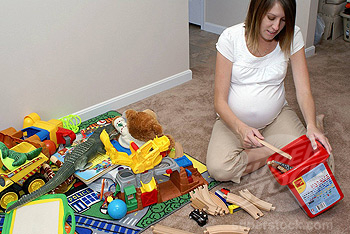
toysWhile a change in physical location can be driven strictly by your emotions, it often is part of an activity.  If I’m picking up the kids’ toys because my mother-in-law is coming over, I’m moving around the living room, but it is in service of the activity of picking up the kids’ toys.

What happens as a result of choosing an activity, no matter how disconnected it may seem from the actual drama of the scene?

  • It makes what happens in the script seem more like real life.
  • Like a change in physical location, it adds visual interest to the audience.  The stage isn’t film, but post-MTV audiences like to watch motion while they listen.  Watching someone do something with purpose is much more interesting than watching someone sit around talking.  Some scripts have scenes that seem to be about people sitting around talking.  When you are cast in a play like that, you must put on your thinking cap and invent things to do.
  • What you choose for an activity says something about who your character is.

Chosen correctly, your activity can also underscore what happens dramatically in the scene.  For the moment, however, let’s leave that responsibility in the director’s lap.

But the grand prize of using an activity onstage?  It puts you in touch with your emotional life without you having to do anything intentionally.   This alone is worth the price of admission!

See Part II here.  See Part III here.