Line Readings, and Why They Don’t Work

dressing windowIn a recent class, Anne asked, “What are line readings?”

A line reading is a pre-determined way of saying a line.  It’s when you plan the intonation you use and the sort of energy and emotion behind it.  It’s a conscious, intellectual choice.  It usually comes from a sense of how the line should sound, what feels right.  And if you have good instincts, your choices in this regard can be very good ones.

Line readings are very much a product of the belief that there is a RIGHT way to do this.  “Can we go back a couple of lines, I said that wrong.”

If you believe there is a RIGHT way to say a line, you will seek it out early and commit to saying the line that way for the rest of your life.  As soon as you find a way that sounds RIGHT, you will stop looking for something better, something more interesting and true to the character.  You may have chosen something good, or even something very good, but you will typically not reach great.

The reason you won’t reach great is because even if the line reading you’ve chosen is exactly “right”, line readings are, by definition, superficial.  They are window dressing.

If you start with what you know is “right”, you lay it on the scene superficially, without undergirding it with emotional need and emotional reality.  It will remain superficial:  an excellent choice with no root structure.  Believe me, the most inexperienced audience will know the difference in seconds.

If the choice is the ”right” choice, you will find it by digging into the character, into what he wants and how he tries to get it, into how he feels about everything that is said and done to him and why he feels that way.  You’ll find it by opening yourself up to what is said and done to him and feeling some real emotion before you respond, naturally and in real-time.   This is why I say you can disregard almost everything in the parentheses in a script; if it’s “right”, you’ll find it on your own, and it will have greater impact when you do.

But if you go for what are essentially externals (inflection, volume, facial reactions, etc.), you don’t really have to search for the emotions, because after all, you’ve got the “final product”, right?  Nothing real has to happen onstage to product line readings.  It’s all artificial.

chinese-noodlesSuperficial actors don’t realize what they are giving up by working this way, so don’t be hard on them (or on yourself, if you’re one of “them”).  It’s very common for untrained actors to do this, and I wish I could say that it is a practice confined to the amateur ranks.  I’ve seen professional performances where this happens, most often in comedies.  An audience may laugh in response to a line reading, but you will never move them, and they will forget the production in short order.  It’s like Chinese food and pancakes:  tastes great, but doesn’t stay with you.

Unfortunately, the people most at risk for making this practice a habit are among the most talented.  Because they have an unerring sense of what is the “right” way to say a line, they can coast.  They can give a very glib, smooth performance that seems to hit all the marks without working very hard.  And the more they do it, the easier it becomes.  They sound great at auditions and in the first few weeks of rehearsals, but their character never grows beyond that.  Their development stalls out halfway through the rehearsal process.  An audience will never really believe them, never really suspend their disbelief in the way that we want them to.

There are worse things.  It’s a shame to pay the money for professional theater and encounter acting like this, but in amateur productions (depending on the quality of the latter), it can sometimes measurably improve the product.

It’s a function, really, of why you want to act.  I haven’t used a golf analogy in a while, but here’s one that’s appropriate.

When a golfer shows up on my lesson tee, I need to find out what his goal is – not just for that lesson, but in general.  What kind of golfer he wants to be will determine how and what I teach him.

People have different reasons for playing golf.  Some do it just to have a reason to spend a few hours with close friends outdoors.  Whether they play well or not doesn’t matter to them.  Some people have a maximum score they can tolerate without getting angry at themselves.  For some, it’s breaking 100 consistently.  For others, it’s bogey golf – high 80s, low 90s.

There are also golfers who want to be the club champ, and are willing to work to get to that point.

Someone who dreams of winning his club championship is going to approach the game very differently from someone who just doesn’t want to embarrass himself when he plays in an occasional golf outing.

All of these reasons are perfectly valid.  As long as the golfer is happy with his score, I don’t care if he’s a good golfer or not.  And I won’t try to make him get better than he wants to be.  My job is just to help him meet his goal, whatever it may be.

Same thing with acting.  If you do it because it’s fun, it gets you out of the house, you get to spend time with other people, and you like performing, then by all means, you should do some acting.  How good you are at it doesn’t matter in the least to me.  As long as you are content with the quality of your own acting and directors keep casting you, feel free to use all the line readings you like.

But if you do want to do some great acting – line readings will never get you there.  That’s all.

To read Where Do Line Readings Come From, Anyway?, go here.  To read So How Do You Avoid Line Readings, go here.
How Do I Know What the Right Acting Choices Are?

There are no right choices.  All right, there are.  There are right choices for this particular cast in this particular production at this particular moment in time.  But honestly, what is RIGHT for this particular cast in this particular production at this particular moment in time may change from night to night.  And that’s not only okay, that’s RIGHT.

But what IS “right” in each case is debatable.  It’s for you, if you’re in that production, to discover.  Not decide.  Discover.

Some actors get terribly worried about whether they are making the “right” choices.  As if this is the SAT exam, and there is some clear, definitive choice to be made.

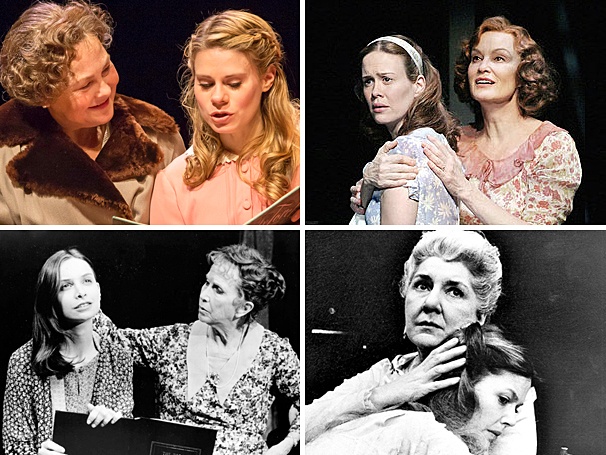
amanda fourHere is a list of actresses who have played Amanda Wingfield in Tennessee Williams’ play, The Glass Menagerie:

Shirley Booth, Julie Harris, Katharine Hepburn, Judith Ivey, Cherry Jones, Jessica Lange, Maureen
Stapleton, Jessica Tandy, Laurette Taylor, Joanne Woodward

Whether you know the play or not – can you imagine all of these disparate women playing the same character in the same way?

Here’s a quote from Meryl Streep:  “Acting is not about being someone different.  It’s finding the similarity in what is apparently different, then finding myself [emphasis added] in there.”

Because YOU are unique, and you are the foundation for the character, your interpretation will be unique.  It will be “right”, whatever it is, if you are working correctly.  And that’s okay.

One doesn’t need to look any further than Shakespeare to realize how many times this has been proven.  Watch multiple versions of Hamlet, Romeo and Juliet, or any of his other plays, and you’ll find a myriad of interpretations of all the main characters.  (Someday I’ll talk about “tone” and how the director’s choices affect your own.)

I recently came across a web post you can read here about The Taming of the Shrew, on how actors change the story.  (Ah!  Storytelling!  That’s a whole other can of worms I’ll open sometime!)  I’m not sure that I’d agree with her interpretation of the 1976 version, but I hope the post makes a clear argument that the videos referred to represent three very different interpretations.

You may like one better than the others, or you may like a fourth option not displayed here.  Personal taste is always at work and perfectly valid.  The point is that there are a variety of logically valid interpretations available to the artist.

I’ve seen Kevin Kline play Hamlet twice.

kline hamletThe first time was in 1986, at the Public Theater in New York City, and he was fabulous.  I thought the whole production was fabulous (the reviews agreed with me about Kline, but not about the rest of the production.)  It was a more humorous version of Hamlet than I had seen before.  Kline’s Hamlet was not the dark brooding Dane I had grown accustomed to.  I loved it.

kline hamlet 3He did the play again in 1990, also at the Public.  The reviews didn’t find much difference between the two productions, other than a stronger supporting cast the second time around.  But I remember the tone of the production being much different – more serious and stately.  But what I really noticed was the difference in Kline’s interpretation.  This Dane brooded more.  Kept his own counsel more.  Was more cynical, less humorous.

I had gone to see the second production hoping, on some level, to see a rerun of the Hamlet I had so loved four years earlier, and saw a very different one instead, despite having the same actor in the leading role.  Both productions were excellent.  Both interpretations by Kline worked.  Very well.

Both were RIGHT.

I’ll leave the last word to Kline, from an interview before a performance of the 1986 Hamlet in the Chicago Tribune.  “’There is no such thing as perfection in the theater,’ he notes, relief apparent in his voice.  ‘You will never get it right because there is no single ‘right.’  With film, there is the lingering illusion [emphasis added] that perfection is possible.’”

To read The Validity of Other Perspectives, go here.  To read About Those Stage Directions, go here.  To read The Half Dozen Rights, go here.  To read Line Readings and Why They Don’t Work, go here.

The Half Dozen Rights

OptionsI hope you’ve had a chance to contemplate my last posts, and at least agree that it is possible that you aren’t always RIGHT; at least, you aren’t always categorically RIGHT.  And that neither is the playwright.

I hope you can also see that if the character you are playing doesn’t occupy space on the same slice of the pie that you do, you might have to reach a little bit to figure out who that character really is and what choices you need to make as an actor to create him believably on stage.  That if you rush to judgment, you might make choices that aren’t the best ones you can make.

But BEST is a very different word from RIGHT.  So let’s stay with RIGHT for a moment or two longer.

I know actors who are convinced that there is a RIGHT way to play a role.  A RIGHT way to say a line.  And it is next to impossible to convince them otherwise.

Some years ago, I was acting in a play, and commented at rehearsal one day that one of the lines another actress delivered was, to my mind, one of the funniest lines in the play.  She was surprised, because she had no idea it was a funny line.  Which explained why she didn’t deliver it in a way that would get a laugh.  But that wouldn’t have mattered if she had understood the character properly.  The humor came out of who her character was, so if she’d been more in tune with her character, the line would have come out correctly and the audience would have laughed.  Automatically.

You don’t have to be a comedian to get laughs in a play.  You just have to know your character well.  (Not that it hurts to understand a little about comic delivery.  A topic for another day.)

Anyway, the actress in question finally begged me to simply tell her the RIGHT way to say the line.  I really hate giving line readings to actors (especially when I’m not the director!), but there comes a point when I will give in if they want it badly enough.  So I gave her a line reading.  She tried using it, although she never got a laugh in doing so.  She didn’t deliver it well, because she didn’t understand what was going on inside of her character.  She was giving a largely superficial performance.

Except for one performance:  One of those happy moments when she accidentally collided with her character, and there was a living, breathing person on stage in the scene that night.  And she said the laugh line perfectly; not at all the way I had suggested, but perfectly.  And the audience roared.  (Unfortunately, she didn’t notice that they laughed, so she learned nothing from the experience and couldn’t repeat it.)

But here’s the real point to the story.  I went home after the rehearsal in which I gave her the line reading.  Had I really given her the RIGHT one?  Or even the BEST one?  And so I ran through various ways of saying it, and realized that I could easily come up with six different ways of saying the line, all of which I was certain would make an audience laugh.  Each reading came from a slightly different understanding of the character at that particular moment.  Each understanding was perfectly valid and workable within the context of the play.  As a director, I wouldn’t argue with any of those six choices.

In other words, there were at least six RIGHTs in that particular situation.

Another example:  I was talking about blocking in class a few weeks ago, and in demonstrating how blocking could work in a particular scene, I realized that there were probably a half dozen ways of moving on a particular line.  Which I would choose as an actor would depend on how I chose to define the character, as well as what the other actor in the scene might do (my movement on that line was, in part, a counter to the other actor.)

As with the example of the laugh line, each of the blocking options I came up with would work.  Obviously, I’d have to make a choice at some point, but which choice I would make would depend on how I ended up interpreting the character and understanding what was going on in that scene for me.  But I could probably make any of them work, if it mattered to the scene.  In other words, if the director really needed me to finish in a particular location, I could find a way to justify that movement.

So again, there were at least six RIGHTs in that particular situation.

I can hear at least one person out there saying, “But which of the six is RIGHT for this production?  I mean, one of them is going to work better than the others, right?”

So now we’re at least moving toward “best” instead of “right”.  But there’s one more thing to say before we can fully do that . . .

To read The Validity of Other Perspectives, go here.  To read About Those Stage Directions, go here.  To read How Do I Know What the Right Acting Choices Are, go here.  To read Line Readings and Why They Don’t Work, go here.

About Those Stage Directions . . .

Gospel-Transformation-Bible-005There are people who feel strongly that the stage directions in the script are The Gospel.  Not just the movements indicated, but the emotional choices for the actor as well (e.g., “angrily”).  I don’t seem to be able to persuade them that these not RIGHT, but they are merely suggestions.  You are under no compunction to follow any of them if you have a better idea.

The people who feel this way credit the playwright with a degree of omniscience that can be misplaced.  Playwrights are human beings, and they make mistakes, just like the rest of us.  Physical movements are often from the original production, not from the playwright, and so don’t warrant slave devotion to them.  The original set used is just one designer’s interpretation of the play, and has nothing to do with the playwright in any case.  And often the physical movement noted is arbitrary.  The play will not be weakened if you stand up two lines earlier or two lines later than the script dictates.  It probably won’t be harmed if you never sit down in the first place.

As for the adverbs playwrights throw in so that you won’t mistake their intention, they simply reflect how the playwright heard it in his head when he wrote it.  It’s not the only way to say the line (see my next post, The Half Dozen Rights, for an expansion on this idea.)

Sometimes these little notes provide clarity where confusion exists, and I’m all for playwrights using them then.  But now that I understand the playwright’s intention, I can say the line however I like – and not necessarily “angrily” – because whatever I end up choosing, it will match the playwright’s intention.  Which I now know.  If I have a more creative choice that is still in line with his intention, I’m going to ignore his specific instruction, and the play will be better for it.

Actor Ray Ficca, playwright Bill Cain, & director Ryan Rilette during a rehearsal for New Book, Round House Theatre, April 2013

Actor Ray Ficca, playwright Bill Cain, & director Ryan Rilette during a rehearsal for New Book, Round House Theatre, April 2013

But sometimes the playwright gets a little carried away with his instructions to the actors.  And you know what?  Sometimes he’s just dead wrong.  I know, I just spoke sacrilege.  But I’ve done plays where I am convinced that the playwright was giving me very bad advice on how to play the role.  I’ve come across stage directions that leave me utterly perplexed as to what he’s talking about.

The lines I say?  Those are sacred, and if I don’t understand what they mean, I better figure it out, and quickly.  But the advice on how to say them, or how to move?  Not so much.  As I said somewhere, if the playwright’s choice is the best one available, you’ll discover it for yourself just by doing the work correctly, and it will be organic when you come across it that way, whereas if you blindly follow the stage directions, you risk it appearing artificial.  So you won’t do any harm most of the time if you ignore them.

I also think it’s important to remember that the playwright is a writer, not an actor.  Now, I’m not saying that all playwrights are terrible actors.  I’m sure there are some who are decent actors.  Maybe even very good ones.  Probably not brilliant, or they’d be actors, first and foremost.  But their stock in trade is putting words on paper.  An actor’s stock in trade is putting the words on their feet.  And sometimes, things look and sound very different in three dimensions than they look on paper.  Sometimes a playwright is simply too close to the work to gain a proper perspective on it.

Theater is a collaborative art.  We each bring something to the table, and the ensemble effort produces the final product.  We actors aren’t there to be marionettes of the playwright.  We are contributing, creative artists.  So when it comes to stage directions, keep what is useful and works.  Use the playwright’s opinions as guidelines.  But don’t turn off your own brain or instinct just because The Playwright Spoke.  He isn’t God.  And he can be wrong.  He didn’t anticipate you playing a role in his play.  If he did, he might have viewed the character differently.  And written entirely different stage directions!

To read The Validity of Other Perspectives, go here.  To read The Half Dozen Rights, go here.  To read How Do I Know What the Right Acting Choices Are, go here.  To read Line Readings and Why They Don’t Work, go here.

The Validity of Other Perspectives (or, You Mean There Actually ARE Other Perspectives?)

I hope you’ll bear with me through the next few posts, because this issue of there being a “right” way to play a role is critical to how you use the first half of your rehearsals.  So it’s worth the time.

Human beings are pre-disposed to thinking that there is a RIGHT.  By definition, the fact that this (whatever “this” may be) is RIGHT, no matter how limited it is, makes anything outside of its limited scope WRONG.

If you’re very young (and perhaps even if you aren’t), you’ll have to take me on faith when I tell you that there is a lot less surety in the world about what is RIGHT and what is WRONG than you probably think there is.  (In twenty years, you’ll probably understand what I’m talking about.  At least, I hope you will.)

Despite the fact that I have an large number of reasons to believe in this uncertainty as being a natural and okay part of existence, I nevertheless fall into the trap of thinking that this, that, or the other thing is RIGHT on a regular basis.  The only thing I have learned, apparently, is to recognize the fall shortly after the fact, so that I can get myself standing again.

Fortunately, rehearsal time allows you the opportunity to backtrack to where you went awry.  To acknowledge that what you were so certain was RIGHT turns out to be largely WRONG, and that you’d better replace it with something else.  Even if you aren’t quite sure yet what to replace it with.  (This is the trial and error that is part of the first half of rehearsals.  Ah, I haven’t gone that far astray, after all!)

You may remember the Kansas example from the post on first-person acting.  I’d like to explain it a little differently now.

SONY DSCImagine all of humanity as occupying a place near the center of a pie.  Carve that pie into a number of slices that corresponds to whatever personality type schema that you’d like to use.  If you use the Enneagram, you’ve got nine slices.  If you use Myers-Briggs, you’ve got 16 slices.

However you slice it, each pie slice represents a general life perspective.  I’m not talking about politics or religion.  It is entirely possible to have completely different politics while occupying the same life perspective space.  (Again, trust me on this one, because I certainly don’t have the space to make the argument.  Go study one of these typing systems in some depth, and you’ll understand what I mean.)

For instance, my Myers Briggs personality type is, among other things, convinced that absolutely everything can be improved.  That colors everything I do.  It’s one of the things that makes me a good teacher; I’m convinced that if I keep trying different ways, I can successfully communicate anything to you.  It’s one of the things that makes me curious and a lifelong student.  In addition, being intensely aware of my own flaws and convinced that everything can be improved, I am the first object of my “I can build a better mousetrap” perspective.  I am my ultimate work-in-progress.

However, not everyone shares this perspective.  Some people just don’t quite see that improving things matters one way or the other.  They aren’t opposed to it; they just don’t see the point in spending the energy on it.  Others take great exception to my perspective.  For them, everything is perfectly fine just the way it is.  And a fourth group of people have a different take, one which says, “I am what I am, and as flawed as I am, I’m never going to change.  Deal with it.”

I hope you’ve noticed that because we’re all standing near the center of the pie, we’re all looking in different directions.  Because we’re looking toward the crust, where our slice is two or three inches wide, we think we’ve got a broad perspective.

The fact that the pie has a circumference of over 28 inches completely eludes us.  As far as we are concerned, our two inches IS the world.  We also assume that everyone else sees the same two inches.  So if they disagree with the party line associated with our slice, they are being purposefully intransigent.  When we’re feeling kindly about them, we’ll just call them stupid.  Or ignorant.

For the most part, these perspectives aren’t things we have a lot of choice about, although once we recognize the limitations of our own perspective, we can start to see why other people’s perspectives make sense to them.  And these different perspectives actually have a very useful function in the world.  I’m a great planner and teacher, but I have no patience for what I see as the tedium of scientific experimentation.  Fortunately, there are personality types who live on other slices of pie who are into science and like their change to come slowly.

The point is that we are inclined to assume, for some peculiar reason, that our slice is RIGHT, and everyone else’s – and remember, everyone else’s constitutes the majority of that dang pie – is WRONG.

But it all depends on where you stand on the pie.  Wherever you are, you think, is RIGHT.  Wherever anyone else is is WRONG.  But they’re standing looking toward their piece of the pie crust, thinking that they are absolutely RIGHT, and you are absolutely WRONG.

So who is RIGHT, and who is WRONG?

To read About Those Stage Directions, go here.  To read The Half Dozen Rights, go here.  To read How Do I Know What the Right Acting Choices Are, go here.  To read Line Readings and Why They Don’t Work, go here.

What Are Play Rehearsals For? Part III

mixing_clay_7-727219“The first phase of rehearsals, for an actor, is for playing.  For exploring.  For daring.  For making mistakes.“

I wrote this line in the last post.  Notice how this differs from Merriam-Webster’s definition of practice:

To do something again and again in order to become better at it.

There IS a point when we want to hone what we are doing onstage.  This happens during the last few weeks of rehearsal.  Once we get there, we can start “practicing” in the Merriam-Webster sense of the word.  It’s a weird alignment of both “practice” and the creative artistic interpretation that I suggested is the second half of the work done by a musician.

Wait a minute!  In my last post, I said the first half of rehearsals are about technique, the second half about being creative.  But now I just said the second half is about practicing.

It is.  About practicing AND being creative at the same time.  But yes, you’re absolutely right.  I’ve moved “practicing” out of the first half entirely, and I’ve replaced it with this thing I’m calling “technique”.

So if “technique” isn’t really “practicing”, but is the actor’s version of what he does in the first half of rehearsals – well, what the heck am I suggesting you do with the first half of rehearsals (more like 65%, actually)?

The first half of the rehearsal period, for an actor, is spent figuring out WHAT to practice. 

In music, in sports, in almost any other activity, you can figure out what to practice pretty easily.  It’s given to you by someone who’s figured it out before you (unless you’re trying to reinvent the wheel, that is).  Your baseball coach gives you drills.  Your piano teacher gives you scales and sheet music.

But for an actor, nothing is predetermined.  You’re given words, but it’s up to you to figure out how to best present them, how to create a character who would speak them.  You go from knowing nothing – 0% — to knowing, say, 75% by the time you reach the end of this exploratory phase.  You pick up the last 25% in the creative/practicing part of rehearsals.

How is this different from what you may be doing now?  Well, I think I said somewhere that the moment you finish reading the script for the first time, you have made dozens of decisions about the play, the characters, how it is going to look, sound, etc.  And if you do that, you are probably starting from something like 40%, not zero.

40% may seem high to you, and in all honesty, it’s a number I’m pulling out of the air based on my gut instinct (which is usually pretty good, by the way).  It sounds high, because certainly there are far more decisions to be made than the dozens I’ve suggested you make on your first reading of the script.

There are.  But the dozens you’ve made initially have, effectively, eliminated a whole bunch of possibilities.  You may only technically be at 10% at this point, but the decisions you’ve made have made the other 30% a foregone conclusion.

To get to a really great performance, you have to permit yourself to be a lump of clay initially.  Something formless and shapeless that you will gradually give definition to, until you have a delicate and distinctive bust to present to the audience.  You don’t want to start rehearsals with a piece of clay that can be clearly identified as a head, no matter how rudimentary.

There is no one to “please” in a rehearsal.  Not even the director.  There is no audience to “perform” for.  So whether you do it “right” in this run-through or not is meaningless.  Let me say that again.  MEANINGLESS.  (I’ll talk about “right” in the next post.)

We seem to have reverted to Problem No. 1, “public”.

It is this need to perform whenever you open your mouth that generally gets in the way of the Open Door Reading.  Actors HATE to break up a long sentence when they’re doing the reading.  They just hate it.  They want everything to “flow” naturally.  They can’t remember the entire sentence, so they say the words they can and immediately dip their heads back into the script without waiting for the three seconds I’ve suggested so they can get the sentence out in a full string.  (Which is why I assigned a specific amount of time to it, and I meant seconds, not beats.  One thousand one, one thousand two, one thousand three.  NOT one two three.)

But who is watching the Open Door Reading who gives a damn whether or not the sentence is completely comprehensible, delivered as smoothly as it will be on opening night?  Who cares if you’ve attached the “right” emotion to it or not?  Who cares if your intensity is what you want it to be in a final performance?  NO ONE.  Let me repeat that.  NO ONE.  That’s not the purpose of the Open Door Reading.  It’s purely a personal exercise for each actor individually and for the two as a creative team.

And so should most everything else be that you do in the first few weeks of rehearsals.

To read Part I, go here.  To read Part II, go here.  To read Staying in the Moment, go here.

What Are Play Rehearsals For? Part II

At last!  Back to our definition of “rehearse”:

          To prepare for the public performance of a play by practicing the performance

If “public” is one of the reasons for our misunderstanding, what’s the other one?

I thought I ought to be sure I understand what “practice” means.  So I looked that up, too.  And I found this:

          To do something again and again in order to become better at it.

And here, I think, is the rest of the problem.  Our common understanding of the word “practice” is, indeed, to “do something over and over again.”

PianistThere are activities in which this is both true and useful.  If you play the piano, you practice over and over to be sure you are hitting the right keys at the right time.  Once you can do that, you can start thinking about artistic interpretation, but first you have to repeat and repeat the fingering.

If you play a sport, you repeat the motions in that sport over and over so that you can fine tune how you throw a ball or swing a bat.  You rehearse the moves in a double play, so that in an actual game, you can execute it flawlessly.

In fact, any physical activity requires repetition – that is, “practice”, as defined above – to get better at it.  In these examples, the physical motion is so integral to the final activity – playing a sonata or a baseball game – that you have to learn the motions through repetition if you’re going to be any good at producing the final product.

In other words, in these activities, you spend the first half of “rehearsals” practicing technique, and the second half being creative.

So far, so good.  I would argue that we should use precisely that same format in preparing a play for performance:  first half is devoted to technique, the second half to being creative.

Notice the change I made there.  I didn’t say “practicing technique”; I merely said “technique”.

There are certainly physical elements to acting, and I’ve written before about the need to “practice” them early and often, just as you do “Moonlight Sonata” and the double play.  Still, the core of acting is emotional, not physical, and to “practice” the emotional through repetition is to take the soul out of it.  It can’t help but become superficial when approached this way.Storyteller

If you doubt me, think about the stories you tell about yourself.  Your “go-to” stories, the ones that are sure to entertain anyone.  You’ve told them so many times that you know just how to tell them to make them a “good story.”  But you also have distanced yourself from the events of the story so much that it is almost as if it happened to someone else.  You are no longer the person it happened to; you’re the story “reader”, as it were.

Also, in these examples, there are certain restrictions to what you do.  If you are a batter, there is only one way for you to swing the bat and be successful regularly.  It may be different from how everyone else bats, but it is your way of doing it well.  Once you discover what your personal mechanics need to be, you practice them over and over, and that makes you a .300 hitter.

If you are playing a sonata, the musical score gives you notes (like the words of a script), and it also gives you rests; that is, it tells you how long notes should last and how long your pauses should be and where they should come.  If you are a jazz musician, you are welcome to disregard these things and put your own spin on it, but if you are a classical musician, you’ve got less wiggle room.  And in any case, a jazz musician needs to know the restrictions of the original work before he can riff on it successfully; riffing is second half work!

What you are given to work with in these other circumstances is slightly different than what you are given as an actor.  You are given words, but as you’ll see in future posts, you’ve got a lot more flexibility with them than you do with Beethoven.

So if we don’t want to “practice” in the way Merriam-Webster defines it, what do we do with the first half of rehearsals?  “Technique” is not a verb, so it doesn’t tell you very much.

No, “technique” is simply the tools you use.  (“Ah, at last, she’s getting back to the original topic!”  Give me enough time, and I’ll always complete the circle.)

The first phase of rehearsals, for an actor, is for playing.  For exploring.  For daring.  For making mistakes.

“Making mistakes!?  I’m going to be standing in front of an audience in 6 weeks, and you’re telling me to make mistakes in rehearsal?  You’ve got to be crazy!”

Crazy like a fox.  I’ll explain why next time.

To read Part I, go here.  To read Part III, go here.  To read A Word About Staying in the Moment, go here.

Learning the Blocking, Part I

How do you learn your blocking?  The same way you learn your lines:  by practicing it over and over.

I am surprised by how many people rely strictly on rehearsal time to learn their blocking.  If your blocking is fairly simple and you make clear notes in your script, this is a perfectly do-able approach.  However, if the blocking is at all complicated or there is simply a good deal of it, it is difficult to get it down quickly if you go about it this way.  And you do want to learn your blocking quickly, because until you have it down, you can’t do much else.

How quickly do you need to learn it?  Let’s say we block the first scene on Monday night.  The next time we run that scene, there are apt to be some moments when an actor is confused about where he is supposed to be, or someone has come up with a better alternative than what was done on Monday.  So the second night we work on the scene, we sort out all of these moments, and we should end that night with a clean run.  And that should be the end to 95% of blocking confusion, and by blocking confusion, I mean the actor who says, “Oops, I was supposed to have crossed to the door four lines ago!” as he dashes to the correct place, or the actor who is surprised to find that he’s supposed to be somewhere other than he is.

actor scriptThis DOESN’T mean that once blocking is completed, it can’t change.  It can.  As you get into rehearsals, you may realize that you can change the blocking to make something funnier or otherwise more effective.  Once you get familiar with the lines, you may realize that the timing is incorrect and the blocking needs to be changed to accommodate this new reality.  As you learn more about your character, you have little epiphanies about what your character will do that you couldn’t have back in the first week of rehearsal when you blocked the show.  To not change the blocking for any of these reasons would be silly, and you should definitely do so.

So yes, that means you have to unlearn what you learned to begin with and replace it with something else.  The nature of the beast, I’m afraid.  The point is that you need to quickly memorize your blocking be doing whatever you’re supposed to be doing at whatever point in the rehearsal process you are.  If you don’t, then your rehearsals stop being about making discoveries about your character and are just about figuring out where you’re supposed to move when.  Just as rehearsals when you haven’t fully memorized your lines but you insist on running the scene without your script are just about you trying to remember your lines.  It’s a waste of everyone’s time and disrespectful of those you are working with.

To read Blocking the Play, go here.  To read Part II, go here.

Blocking the Play

[This is a purely introductory piece on blocking — I have much more useful stuff to say about it down the road.  But I’ve got to start somewhere, and I’m still traveling, so this and the next two posts will fill in the gap until I can get back to my Rehearsing series.]

How you go about this depends at least in part on your director.table reading

There are directors who like to sit around a table with the script, working on relationships and script analysis, until the actors have their lines memorized.  Only then will he allow them on the set.

There are directors who like to begin with blocking, perhaps preceding blocking with a single read-through.

The directors who begin with blocking may come into rehearsals having pre-blocked the entire show, and will tell you where to stand and when to move.

Or they may let you make your own decisions about blocking and suggest changes either in their role as traffic cop or because they think they have a better or more interesting choice they’d like to try.  But first, they want to see where your instincts take you.

blockingIn this last group, there are directors who, once they’ve settled on something that works, will stick with it for the rest of the rehearsal period.  And then there are directors like me, who will continue to tweak the blocking as rehearsals unfold and we learn more about the characters and the play.

And then there is yet another group of directors, who will allow the actors to wander as they will for a few weeks and then put some structure to it.  The wandering is all part of the exploration of the play, and if you explore efficiently, you will have a pretty good sense of what works at the end of this initial period.  But this approach is best used with experienced actors who are all very comfortable with creating their own blocking.

How long blocking takes depends in part on how physical the play is, and of course two different productions of the same play may end up being very different in this regard.  Farces or very episodic plays (The 39 Steps, A Christmas Carol) take the longest time to block.  In a community theater rehearsal of a blocking heavy play, eight to ten pages may be as far as you can go in one night.

A word about the movement in the stage directions of a script:  Sometimes the movements are the playwright’s vision; sometimes they are from the original production.  Either way, you should view them as suggestions and not mandates, especially if your set is configured differently than either the original production’s set or the one the playwright had in his mind’s eye when he was writing (and who knows WHAT that looked like!)  Your job as an actor is to find and use movements that are organic to your own interpretation of the character and the play.  Honor the dialogue given to you by the playwright both in terms of your characterization and your physicality, and the result will be “right” – whatever THAT means!

The only exception to this is when the playwright describes movements that are essential to the plot and not revealed clearly through the dialogue (such as in Frederick Knott’s Wait Until Dark).

To read Learning the Blocking Part I, go here.  To read Part II, go here.

What Are Play Rehearsals For? Part I

One of the greatest myths of acting is one I didn’t include in my earlier post on the topic (which you can read here), and it ties directly into this issue of using the tools:

          Rehearsals are for perfecting a performance to be given in the future.

I thought I’d check out the definition of “rehearse”, just to be accurate.  On the Merriam-Webster website, I found this:

          To prepare for the public performance of a play by practicing the performance

Part of the problem, I think, lies in the word “public.”  It is natural to be concerned about whether or not we’re going to give a performance that people will enjoy.  We want them to applaud, to tell us how wonderful we are.  We certainly don’t want to give a bad performance!

But because you know this public presentation is 6 to 8 weeks away, it is easy and far too tempting to imagine, in our mind’s eye, the performance we want to give and to strive to give it.  To disregard anything that doesn’t match this very premature vision of our character.  Without realizing it, we’re focused on externals, not our character’s soul.  We’re concerned with “looking good” opening night.

21747730We become very “me” focused.  What do I have to say, how should I sound, how should I move, what should I be feeling, how should I respond, etc.   It’s very easy, you know, to prepare a performance without much regard for the other actors in the play:  “Well, if they do their thing, and I do my thing, it should all be all right, shouldn’t it?”

No.  Because your “things” are inextricably interconnected, and can’t exist without each other.  And yet I see a lot of performances where if you lifted one actor out of the production and dropped a completely different one down in his place, at least some of the other performances wouldn’t change at all, and the others probably wouldn’t change much.

Which is never going to get you great theater.

Again, this goes back to the “staying in the moment” issue; lots of people sincerely believe they are reacting to what they are getting from their scene partners, and yet they aren’t.  I can prove it to them in a scene class in short order, but I’d never get them to admit it outside of that.  “Reacting” (I’m still searching for a better word) is incredibly difficult.  Like “staying in the moment”, it’s hard to be sure you’re doing it unless someone catches you in the act of doing it and says, “There!  That’s it!  That was completely in response to what you got from her [the other actor in the scene].”

Without a teacher to keep us honest, we’re all sure that we’re doing it right.  “Oh, yes, you’re raising interesting and valid points, but it doesn’t apply to me, personally.  I’m already doing it.”

So if I tell you that you are probably focused on your end product – that is, the performance – you may find it as difficult to believe as if I tell you that because you aren’t staying in the moment, you aren’t reacting to what you are getting from your scene partner, you’re merely executing a pre-planned agenda (and perhaps an exceedingly well-planned one, at that!)  The difference is that I can easily prove last point; convincing you that you aren’t really exploring and discovering a character, but that you are merely collecting things that fit into your early design is much more difficult.

So I won’t try.

Instead, I’ll just explain what I sincerely believe goes on with all actors in the early stages of their careers and which becomes, for many of them, a way of life that lasts to the end of their careers.  (I do not exempt myself from this group; it’s because I’ve been there, done that, that I think I know what’s going on.)  And I’ll offer you another approach.

You’ve got nothing to lose by trying what I suggest.  If you already know how to do it, you haven’t lost anything.  You’ve gotten a bit more practice at it, and in all likelihood, you’ll understand it a little bit better than you did before.  If you don’t already know how to do it, hopefully you’ll learn something out of the experience.  Or at least plant some seeds that will bear fruit in the future.

The truth is that you wouldn’t be visiting my blog if you didn’t know your acting can improve.  If you didn’t sense that you are falling short of your potential.  Acknowledging that is a very brave act.  So be brave for just a little longer and trust that I may be on to something here and give it a shot.  Because if you ARE falling short of your potential, I guarantee you that staying in the moment, not reacting to your scene partner, and using your rehearsals ineffectively are the reasons why.

To read Staying in the Moment, go here.  To read Part II, go here.  To read Part III, go here.