
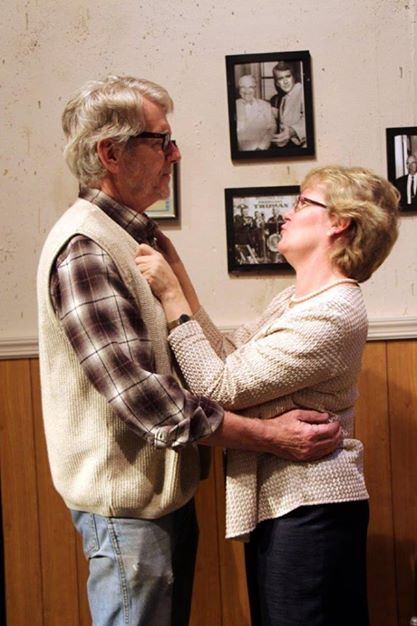
 Now, I can make the opposite argument to the one I’ve been posing in the last four posts. Let’s say that Jorgy and Bea’s relationship was physical from early on, and that they moved in together after Bea’s husband died. Did they try to keep their affair quiet, or at some point did they stop caring what other people thought and carried on without apology?
They don’t strike me as people who would be that insensitive to their spouses, especially given the fact that they chose to not divorce. So if they were sexually involved, it seems likely that they did their best to do it on the sly.
Even if they were very cautious about it, rumors were bound to start. How Bea handled it is one of the defining things about her character. “In a life filled with rumors and gossip and sideways glances,” she tells her daughter in the first act, “I apologized to no one. Don’t expect it of me now. You won’t get it.”
In fact, it doesn’t really matter which route you go in terms of their affair, this line still resonates effectively and says something important about Bea: she does what she thinks is right and feels no need to explain herself or to pacify others. This is also reflected in her second act scene with Garfinkle, when he asks her why she is offering him the $1 million trust fund that is her nest egg. “That’s my affair.”
Alone, either line would say volumes about Bea. Together, they pack an even more powerful punch. When lines reflect the same character choices, pay attention. The playwright is telling you something very important.
Let’s go back to the first four posts, where I argued that Bea and Jorgy aren’t living together. I did this to explain why giving up the trust fund was such a sacrifice. But is that the only way to ramp up the stakes for Bea?
Jorgy objects strenuously to “greenmail”, or paying Garfinkle to go away. How would he feel if Bea gave away the money he invested to protect her? Furious, undoubtedly, and it’s not unheard of for couples to split over something like this, which would be a matter of principle for each of them. Why is she willing to risk his wrath? Because she is afraid they’ll lose, that Jorgy has chosen a path that will be unsuccessful. Even if they lose, Jorgy will be financially secure, and Bea may assume that he’ll forgive her and things will work out in the end, even if they go through a rough patch. But no one looks forward to a rough patch with the one they adore, either.
And let’s face it: $1 million is $1 million. Even if Bea is confident that Jorgy will forgive and support her, it’s a lot of money to give away. It’s financial independence, and as much as she loves him, I think she likes standing on her own two feet, too.
So why is she willing to give it up to ensure the plant remains theirs? The answer is really embedded in the question. She wants to keep the plant open – not for herself, and not for Jorgy, but for the 1,200 men who will be out of work if Garfinkle is successful in his bid to take over (and close down) the plant.
The script provides a nice clue to support this: Bea sets up a retraining facility to help the displaced workers find other jobs. It also offers a reason for her sorrow: the men, used to working with their hands, are not qualified for anything other than McDonald’s or work as night watchmen.
So Bea’s “verb” in this scene is not really “to keep the plant open”, because that doesn’t have emotional impact, and stakes are always related to emotional impact. Let’s rephrase it: To save the jobs of the men working at the plant who have no other viable alternatives for employment.
Once you find the verb, you need to personalize it to make it have real impact. So let’s create three men who are representative of the 1,200 men, all of whom Bea probably knows by name. (Think that’s unrealistic? Even if it is, it’s a good choice to make as an actor – that Bea knows each of them by name, how many kids they have, who has health problems, etc.)
One of the men is Frank, who has worked all his life at the plant and is five years from retirement. He’s retire tomorrow if he could, to move to Florida to be near the grandkids, but he needs those extra five years.
Another is Joe, who has one kid in college and another who is a junior in high school. He and his wife both work, but they are stretched thin when it comes to finding two nickels to rub together. She’s had a series of health problems in the last three years, and that has impacted both her ability to work and added costs for her care.
The third is Mitch, who at 26 is a new homeowner with a baby on the way. It’s been a difficult pregnancy, and his wife is restricted to bed much of the time.
Losing their jobs would create severe financial problems for each of them. Bea can’t bear the thought of that, and is willing to give up her own security and peace at home in order to give it to the men. This choice is supported by the fact that she sets up a job retraining facility at the end of the play.
So at the end of the day, I still can’t tell you, halfway through the run, exactly what choices Jorgy and Bea made about their relationship, but I don’t think it matters. What matters is how I feel about him – he is my best friend, the love of my life, and the thing that has made life worth living. The facts don’t really change any of the emotional choices I need to make in the play.

 Spacious Acting™