How to Make Decisions About Your Character

chrysanthemumBefore I get into how to use trial and error effectively (and why it matters) in the first half of rehearsals, let me answer the questions that have probably flitted through your brain by now, if they haven’t taken up permanent residence:

“But I have to make choices eventually, don’t I?  Ultimately, even if I’m choosing what is ‘best’ rather than what is ‘right’, I have to determine what is ‘best’, right?  So how do I do that?  And when do I do it?  When is it safe to make choices without worrying that I am choosing the wrong ones?”

Truthfully, I’m not sure how many active decisions you need to make if you are working properly.  Try enough different things often enough, and those decisions will start to make themselves.

Let’s say you’re working on Scene 1.  You try it three or four different ways, and they each have their merits.  Should you weigh their merits, debate the pros and cons, and make a choice to use Option C?

Not yet.  No need to, yet.  You’re still in the early days of rehearsal.  There’s still a ton of things to learn about the character.

Characters don’t reveal themselves easily.  If you think they do, then you’ve probably chosen a stereotype.

No, characters reveal themselves over time, over the course of weeks, as you read and reread the play.  As you rehearse each scene again and again.  The more you review the play, either through study or performance, the more it will open itself to you, in the same way that a chrysanthemum moves from a tight bud to a fully open blossom with a hundred petals revealed to you.

As you work on each scene, trying a variety of approaches, a pattern will start to emerge.  You’ll start to see some consistencies in the character from scene to scene.  You’ll start to see how a character trait in one scene is more fully developed in a second scene.  How something that happens later in the play reveals something about your character in an early scene.  That something which was confusing to you is suddenly explained by a line you never took much notice of before.

By remaining open to possibilities for longer than you may be comfortable with (thank you, John Cleese), you will discover that the possibilities that don’t work will simply fall by the wayside.  It’s like letting the chaff blow away in the wind.  Give the wind enough time, it will reveal the wheat to you.  What you will be left with is a focused performance with both adequate consistency and surprise.

Decisions get made for you over time without you having to do much about it, if you’ve explored sufficiently.

To read Can’t I Make Any Decisions?, go here.

Equus, Part III: The First Five Minutes

equus set

The major concern that impacted how my student interpreted the opening monologue in Equus was a need to grab and hold the audience’s attention in the first five minutes of the play.   I agree with the premise in principle.

Should you, as an actor, concern yourself with this?  Honestly, I think it’s the director’s responsibility.  Your responsibility is to make your character a believable person who fairly represents the playwright’s intention.  If you do that and the script is a good one, then the matter of “is the audience going to stay awake for the play” probably won’t arise.  If it does, the director will notice and correct it.

In a quality script, the playwright has eliminated this problem.  Peter Shaffer is one of the best British playwrights of the 20th century.  Equus won a Tony, a Drama Desk, and a Drama Critic’s Award.  It’s very likely that my student was worrying needlessly, but let’s not take anything for granted, and talk about why the script works in this regard.

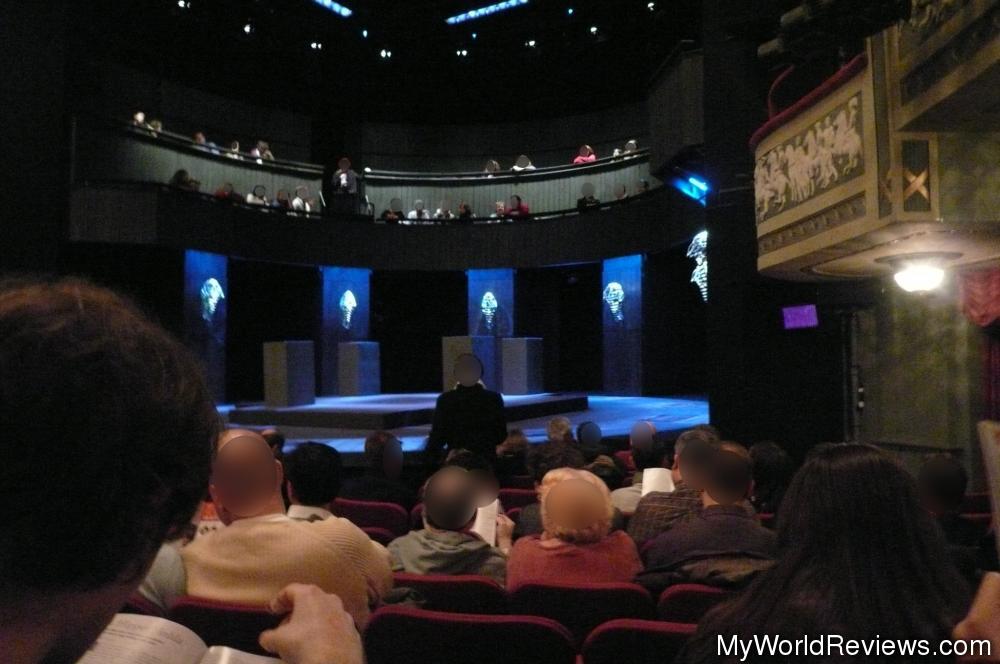
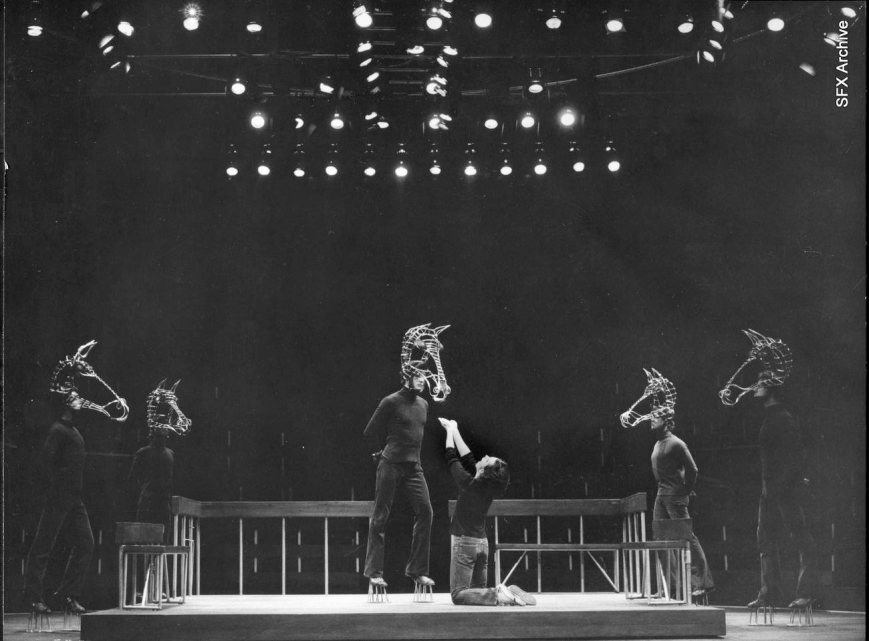
First, Shaffer prefaces the script with some Author’s Notes about the staging.  The photo above is from the recent Broadway revival, and it is loyal to the playwright’s concept in the important ways.  The original Broadway set is below, with the “boxing ring” described by Shaffer.
equus original

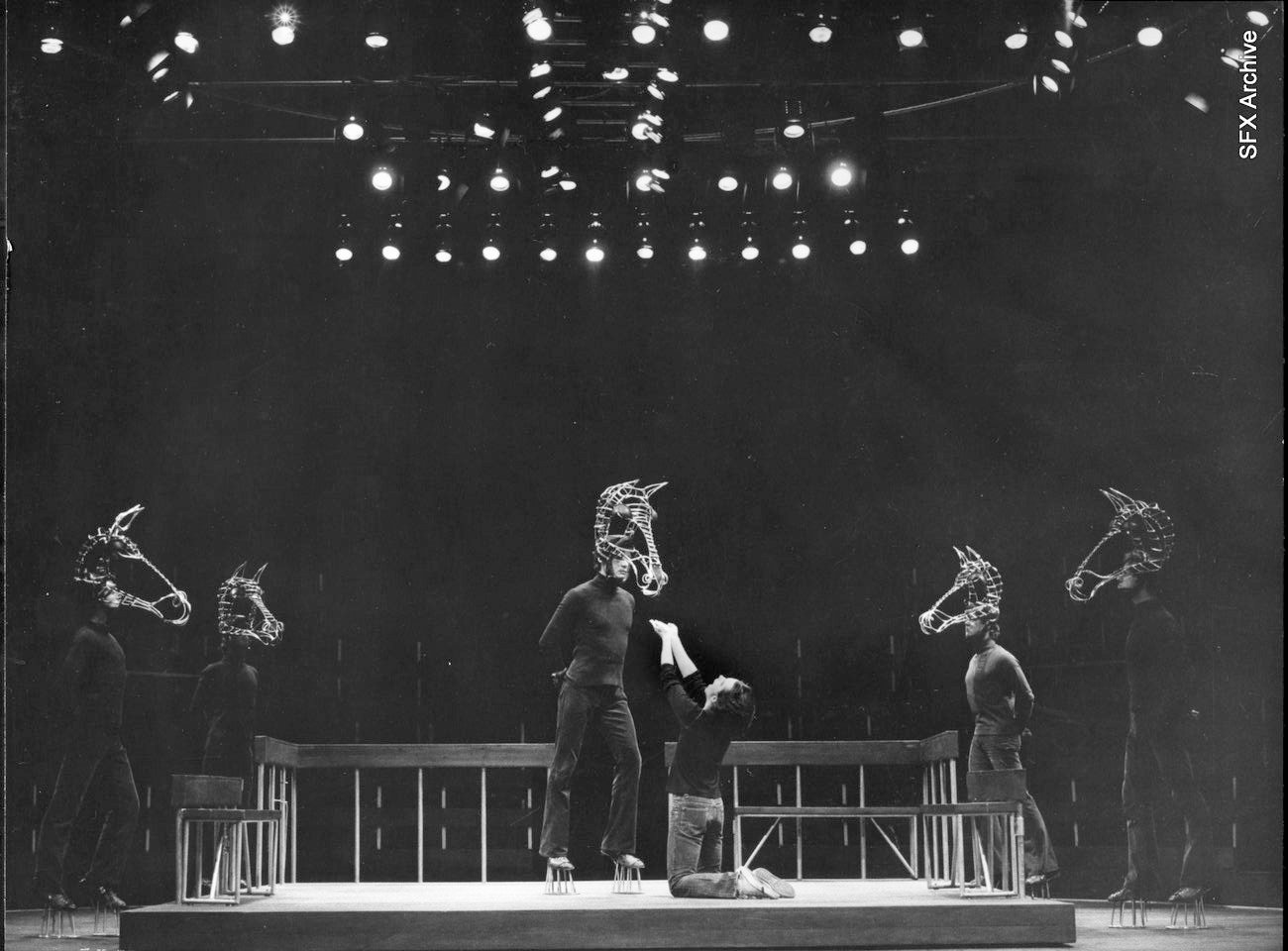
Shaffer asks that the entire cast sit on benches behind the boxing ring throughout the performance and enter the ring for their scenes.  When the horses enter the action, the actors playing them rise from the onstage bench and strap on one of the horse heads that hang around the perimeter.  At the start of the play, Dysart sits to one side and speaks to the audience while Alan and Nugget embrace center stage.

The 1974 photo shows you what Nugget looks like.  This highly theatrical and creative imagining of the horse captures the audience’s attention from the moment the lights come up.  All the actor playing Dysart has to do is not lose the audience’s attention in the three minutes between Nugget’s exit and the revelation that the boy embracing him blinded six horses while tending them in the stable.

Shaffer’s gives Dysart a wonderful opening monologue, one that raises more questions than it answers.  Dysart is clearly a man in pain, at a crossroads we don’t yet understand.  He uses words like “lost” and “intolerable” to describe himself, providing intrigue.  Equus plunges us into suspense on a number of levels almost immediately, and when we learn about the blinding at the five minute mark, we are firmly hooked.

This frees the actor playing Dysart to simply play the truth of this man’s life.  At least, this is where he should start.  A month into rehearsals, once he begins to get a good handle on who Dysart is, the director can evaluate whether the first five minutes is strong enough to grab the audience.  A good actor can make the necessary adjustments in a rehearsal or two.  But in the early days of the production, you want to throw yourself into what your character is feeling.

Does the actor need to go out of his way to make Dysart likable?

There is nothing in the script that makes Dysart unlikable.  You may or may not want to have dinner with him, but audiences empathize with good people in painful circumstances.  Make him a real human being with real feelings and needs, and the odds are very good that he will be likable.

What about intentionally playing the humor of the first half of the monologue to deliberately contrast with the serious tone of the second half, as my student did?

The opening of a play is not just about grabbing and holding the audience’s attention.  It establishes the world of the play as well as its tone (hopefully, your director defines both for you; in scene class, you need to figure that out yourself.)  As an actor, you must be faithful to both and not sacrifice either in the name of making yourself well-liked by the audience.  Humor should be injected when it is appropriate, not for its own sake.

The solemn and almost sexual ritual between Alan and Nugget takes place during the first half of Dysart’s monologue.  Use too much or the wrong sort of humor, and you risk mocking this moment, violating the sacredness of what happens between the boy and horse in the rest of the play.

Equus is an intriguing and moving drama, one that doesn’t end on a hopeful note.  It’s not a laugh fest.  All dramas typically have moments of humor, and I encourage you to find and play all of them in order to give your audience some stress relief, BUT you want to discover the tension of the scene first.  Only then can you determine if there is pressure that must be relieved.

We want to entertain the audience, to get and hold their attention.  But we don’t want to make choices that aren’t in keeping with the play.  That’s where you have to start.  When you focus on “likable” and “how can I grab the audience’s attention”, you’re going for product, not process.

I don’t know if humor is appropriate in that monologue or not.  It’s certainly worth investigating.  However, deciding to play up the humor to make the character likable without first examining the character to see if that choice is appropriate is an arbitrary choice.  You can’t choose unless you have options.  Use your rehearsal time to discover the options.  Then, and only then, can you make the best choices.

To read Equus, Part I: The Three Questions, go here.  To read Equus, Part II: Poetic Language, go here.

Actor’s Etiquette: There’s a Director of This Play, and You Should Listen to Him

9780520267848Directors have a number of responsibilities regarding the production that are different from yours as an actor.  Among them is the responsibility (and right) to determine how to generally interpret the play, which includes his vision for it and the tone the production should strike.

You may not agree with his choices, but you have to make your way to being at peace with them, or the production will suffer.  You can discuss your opinions with him, if you differ in a material way.  You may find you aren’t really far apart; you’re just using different language.  Or you may find he’ll appreciate your input and adjust his vision in some way.

But you may just have very different views, and in that case, he wins.  Ties always go to the director.  This means that it is your job to listen carefully to what he has to say and to try to adjust your own thinking to meet what he is asking for.  Lecturing him on what YOU think is right is only going to create bad feelings.  Take it too far, and the director may wonder if he can ask you to do anything without you putting up a fight.  (I’ve seen this in action.)

Even differences of opinion about small character choices should be dealt with this way.  Yes, you know the character better than the director does.  Eventually.  A good director, if he’s done his homework properly, knows more about your character initially.  My actors start to overtake me in this department somewhere around the halfway mark.

If a director makes a suggestion to you about your character, listen with an open mind.  Trust that he has a reason for it, and that it has something to do with the fact that he is seeing how what you are doing is playing out in the house.

It’s not always easy to do this, I know.  When a director makes a suggestion to me, sometimes I immediately know that he’s right, and all is well.  Sometimes I am in a generally receptive mood and consider it and we have a nice conversation about it.  Sometimes it sounds to me like an idiotic idea, but because I am in a receptive mood, I do my best with it.  If it’s really idiotic, it will probably become apparently in playing it.  If it doesn’t and he still seems attached to the notion, we can now have an honest discussion about its merits and I can politely and reasonably defend my opinion.

And sometimes my worst self emerges and I have a kneejerk reaction that sounds something like this:  “No, my character wouldn’t do that.”

These are words that should never be uttered.  They will, and I’ll probably be one of the actors saying them.  But they shouldn’t be said.

Don’t assume that suggestions from the director are inflexible mandates.  They may be, but they won’t always be.  So go ahead and try what he suggests and see if there is any merit to it.  You’d want the same courtesy if you suggested something; extend it to him.

When my bad self rejects an idea, I always end up considering it later.  “Later” may mean five minutes, and if it does, I make sure I respond to the director before the rehearsal is over, and tell him that I’ll try his idea the next time we do that scene.  Sometimes I think about it overnight, and I’ll talk to him about it at the next rehearsal.  The important thing is that I get back to him about his comment.  Integrating it without acknowledging that is what I am doing isn’t enough.  I need to keep the lines of communication with my director open, and to show him that I respect his input.

Most of the time, I end up realizing that he has a point, and that whatever he is suggesting is more creative and interesting than what I’ve been doing.  It’s easy to get stuck in a rut, and he is throwing me a lifeline.  If I can’t come around to his way of thinking, the time between rehearsals gives me a chance to figure out how to explain my objection to my director, which may open up new possibilities for us.

The director’s “third eye” is critical to a good production.  Trust it.  At the very least, respect it.