Using Scripts in Rehearsal, Part II

As a kid, if I sat next to my father while he read me a story, I always read along silently with him.  When he realized this, he moved to sit facing me while he read.  Now that I was audience only, I received the story much differently.  Using my ears and not my eyes changed the nature of the experience for me.

When you are strictly the listener, you pay attention differently.  Your imagination becomes more active when you aren’t deciphering letters on a page.  When I simply listened to my father read, I converted descriptions into images, and in short order, I had a film going in my head.  When he read “Prince Caspian”, I felt the rocking of the ship and the wind in my hair.

Read the words on the page, however, and it is more of an intellectual exercise.  We can’t fully give ourselves over to the experience with our nose in the book.  Why?

Eye contact.  You need eye contact to connect with other human beings.

eyes1You need other things, too.  You need to shut the output valve (speech, thought, reading) and open the input valve.  You need to listen to what they are saying and how they say it.  To pay attention to what they are communicating to you.  To stop thinking ahead and just receive what they are sending you.

But it starts with eye contact.

Make some serious eye contact with your scene partners, and you open the circuit.  You will find emotions rising up in you of their own volition.  Some might be the emotions you’d expect; some will surprise you.  The important thing is that they show up.  You’ve got real emotion happening on the stage then, not your “idea” of what an emotion looks like.  Remember, the audience knows the difference between the two.  They don’t have to be actors to discern it.  They just need to be human beings.

Your brain will show up for every rehearsal.  You need to make room for the rest of you.  Getting your nose out of the script and looking at your scene partner(s) is essential to achieving that.

Just because you haven’t memorized your lines yet is no reason to bury your face in the script early in rehearsals.  On the contrary, this is the time you want MOST to get in touch with your scene partners.  At this early stage, you have fewer preconceptions and prejudices about the play and your character. You haven’t been through the scene a couple dozen times, so it is still fresh enough to potentially emotionally affect you in surprising ways.  That unfiltered response is what you’re looking for.

When it IS your line to speak, you want to do a modified version of the Open Door reading.  (More on that later.)  When it isn’t your turn to speak, you need to dart your eyes back and forth between your scene partner and your script, looking at the script ONLY to gauge when it is going to be your turn.  (“Her speech takes up five lines; I can look at her for a while.”  Or, as you’re saying your line, “She only has one line after this, so I’ll stay with her for it and then look back down at the script for my line.”)

The script is an aid, not a crutch.  It takes self-discipline to learn to do this.  But it makes all the difference and is worth the effort!

See Part I here.

Using Scripts In Rehearsal, Part I

Actors love to read along in the script, even when it isn’t their line.script

One character may have a monologue that lasts a half page, but in the early rehearsals, every other actor on stage with her will read along in the script for the entire speech as she says her lines.  Never mind that you can listen better when you aren’t reading; if you have a script in your hand, the natural thing to do is to read along silently when it’s not “your turn”.

The problem is that it’s always your turn.

Just because it’s not “your turn” to speak doesn’t mean it’s not your turn.  It’s your turn to listen.  To receive.  To process.  To experience.  To feel.

In real-life conversation, we don’t bow out just because we aren’t talking and tune back in when the other person stops speaking.  We are fully engaged in the conversation, in listening to what is being said and then responding to what we hear.  Okay, we do tune the other person out a bit at points in our conversations, usually when we’ve decided (rightly or wrongly) that we understand what they’re saying,  and we start to think about what we want to say when we manage to interrupt them.  In real life, we aren’t the best listeners.

On stage, you have to become one.

Because it is an artificial situation, where you are trying to stay present to the moment and not leap ahead into a future you already know (because the playwright has given it to you), you have to be a great listener on stage.  You have to lose the habit of preparing what you’re going to say and instead let your speech come out in the moment the playwright has scripted IN RESPONSE to what you have gotten from the other actor.

Let me say that again:  Anything you say must be IN RESPONSE to WHAT YOU ARE GETTING FROM THE OTHER ACTOR.

You have to give your emotions a chance to rise up in you.  Because you aren’t really the character, because you don’t have their history, because the words your “ex-lover” is saying to you don’t have the sort of power they would in real life, you have to make room for the “what if I was” emotions to show up.   Give them space and give your full attention to your circumstances, and they will.  But you can’t do that with your nose in a book.  Emotions are not an intellectual choice you make by deciding what the written words mean.  They are generated in us by what other people – not scripts – say and do.

See Part II here.

Why It’s Difficult to Teach Yourself to Act by Acting in a Play

I’m probably going to be unpopular for saying this.  I am the first to say that there are exceptions to the generalizations that I’m going to make, but I believe that what I am about to argue is true far more often than it is not.

I’m not, incidentally, trying to be critical of any actor on the planet in saying what follows.  On the contrary, I am in complete sympathy with them, but that doesn’t change the reality, I don’t think.

As some of you know, in addition to acting, I teach people to play golf, and I see a lot of analogies between the two.  So here’s why you aren’t going to learn much about acting if all you do is act in productions in which you are cast.

First, because you can’t see what you’re doing.  So you think what you’re doing is working.  And because you’re assuming that it is working, you keep doing it.  Keep doing it, and you might be getting really good at something that doesn’t work.  I’ve had golfers tell me that “they aren’t good enough to come for lessons yet.”  But by the time they get “good enough”, they have grooved some substantial swing errors so well that to undo them without spending a lot of time on the driving range is nigh to impossible.  It’s easier to correct your misconceptions as an actor, but it still takes “range work”.

Second, because you think what you’re doing is the right thing to do.  This is slightly different than the first reason.  The first one is sometimes the product of flying by the seat of your pants.  You’re new to this acting thing, so you get up on stage, you say your lines, your friends and family come to the show and tell you how wonderful you were.  Ergo, it must be working.  So I’ll do more of same the next time!

No, the second reason is based on you making some intentional choices about what you are doing.  This typically happens after you’ve done a show or two, and you have now reached some conclusions as to what this acting thing is about.  Or you are relying on some pretty common assumptions about what acting demands.  Most people operate on faulty assumptions, and don’t realize why following them is going to lead them down a dead end.  Someone else has to point out the flaw in the argument, and you typically won’t find that person at rehearsals.

There are a number of ideas about both golf and acting that I think are “myths”.  That is, they are commonly believed by many people who are still learning to play golf or act, but they are incorrect.  Because so many people repeat them often in friendly conversation, however, they take on credibility simply through repetition.  (See this post on Myths.)  If they weren’t true, so many people wouldn’t be in agreement, would they?  Also in this group are perfectly correct phrases about what to do that people completely misunderstand and so do incorrectly, while being sure they are doing it the correct way!

Third, because you won’t believe that what you’re doing isn’t working until someone can give you a moment where you do it in a way that does work.  Only then can you see the difference between “good” and “better”.  Otherwise, “good” seems great.  But put it next to “better”, and “good” starts to look pretty inadequate.  This is much easier to do on the golf course, where the ball flight immediately tells you what works and what doesn’t, than it is on stage.  An acting teacher can give you that experience, but it takes more time than regular rehearsals permit.

Fourth, because most directors aren’t capable of helping you be a better actor.  This doesn’t mean they are bad directors.  They might be very good directors.  But believe it or not, helping all of the actors in a play to give the best performance they can is really not the number one priority for most directors.  This doesn’t mean they aren’t interested in doing so, but they have a number of responsibilities.  Helping the actors act is only one of them.

But even if they had all the time in the world to devote to your personal performance, most directors aren’t going to be able to help you become better at your craft.  A few of them might be able to help you give a better performance in their play, but most directors aren’t acting teachers.  Even if they are, the short time frame of a rehearsal period doesn’t permit the transfer of technique in a way that you can easily carry to the next play you’re in.  You might learn a thing or two that will stay with you for the rest of your life, but whatever you learn will be a fraction of what you’d learn in another setting.

And lastly, because you have a deadline.  And that’s scary.  You have an opening night looming in front of you, and you will do what golfers do when they try to go out and practice while playing their usual Sunday round.  They hit a bad shot or two, which is what happens when you’re trying to change how you do something, and they panic.  They have a bet on the line, and a responsibility to their partner in that bet.  And so they go with the tried and true.  At least if they lose, they figure, they are dancing with the devil they know.

Fearing that spending time in rehearsals experimenting with your technique may result in your not being ready on opening night, you’ll revert to what is comfortable so as to not risk letting down the rest of your cast.  Or embarrassing yourself on opening night.

I don’t want to minimize the usefulness of watching actors who know what they’re doing do their stuff.  On the contrary, watching them in the context of an acting class, when you can hear the discussion between them and the teacher, can be enormously helpful.  Even watching them in rehearsals when you’re cast in a play with them can be helpful.  But it is difficult to know how they are going about what they’re doing.  You’re apt to identify the symptoms — what it looks like  — rather than the root cause of how they get there — what their process is all about.
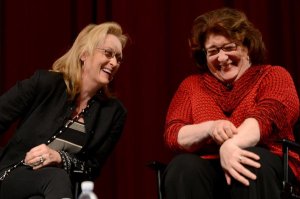
Meryl Streep, Margo MartindaleI watched the promotional show for the film August: Osage County the other day.  Margo Martindale, an actress with an Emmy award and a variety of other award nominations, said that she would give anything to know how Streep prepares before she gets to the set.  If an actress with a 30+ year successful career in theater, film, and television isn’t sure how Streep works, it probably isn’t all that likely that you’ll learn everything you need to know just by watching those who do.  Just sayin’.

I was working with an actor of some experience and talent last week who said to me, “Acting is a lot harder than I realized.”  Yes, it is, but largely that’s a function of our misconceptions about how to go about it and the difficulty of getting good feedback about what we are doing (absent accurate feedback, we have to find people who know what they’re talking about and whose opinions we trust).  Change your misconceptions – that is, replace the myths with a process that works – and get good feedback through a teacher, and you’ll find your acting chops will grow by leaps and bounds.

(My upcoming book will give you some ways to get feedback that will help you make progress without a teacher, but you’ll have to wait for the book to make its appearance.  But while it will help you help yourself, nothing will ever be as speedy as an acting teacher who knows his or her stuff!)


The Open Door Reading — How to Do It

WelcomeI’m going to call this exercise we are doing in class the Open Door Reading.  Meisner calls it the Working Reading, and other teachers may have other descriptions for a similar process.  But I like calling it the Open Door Reading, because I hope it better communicates that we are using the reading simply to open an inner door to emotional possibilities.

First, let me reiterate the practice:

Keep the script in your lap or on the table in front of you.

Look down at the script and gather as many words as you can remember, or perhaps just a short complete phrase.  Don’t read ahead in your script to remind yourself of where the scene is going.  Just gather the words you can remember, and look up at your scene partner.

Take two seconds before you speak to contemplate the words you are about to say.  This doesn’t have to be an active, intentional contemplation.  Just let them sit in your head before you let them out of your mouth.

Say the words to your partner.  Don’t try to force anything on them in terms of how you say them.  If there seems to be a clear intention behind them, go ahead and use it.  If you just say them as ordinary, boring words, with no particular opinion about them, that’s fine, too.  There is no right or wrong about what comes out, as long as it isn’t forced.  If you’re uncertain what to “do” with them on any level, just say them simply.  “Do” something with them only if it feels right and true.

Continue to look at your partner for three seconds after you have finished speaking.  Watch your words “land” on your partner and notice if your partner has any reaction to them.  Notice how you feel about what you’ve just said.  Sometimes what you say will make emotions come up in you.  Sometimes knowing what you’re about to say makes those emotions bubble.  Sometimes nothing will seem to happen.  It doesn’t matter.  Just let whatever happens, happen.

Look down at your script and gather the next bunch of words in your head.  Repeat the above steps, until you have completed your speech.

Once you have reached the end of your speech, continue to look at your partner.  He will eventually figure out that you aren’t going to say anything more.  Let him figure it out in his own time.  He may be processing emotions, so don’t rush him.  He’ll eventually get to his lines.

Don’t look at your script while your partner is talking.  Keep your attention focused on him.  Receive whatever he sends your way:  the words, the way he says them, the way he looks at you.  Receive it with curiosity and openness.  Don’t evaluate it.  Just try to receive it without opinion or judgment.  Don’t modify it in any way.

Let whatever you receive work on you.  Don’t rush it.  Don’t force it.  Don’t raise an eyebrow because you think raising your eyebrow will be very effective in performance (it’s one of the things you noticed when you first read the play, and you know the audience will laugh when you do.)  If your eyebrow raises on its own, that’s fine.  But don’t make it do that.

When you receive whatever your partner is sending you, you may find emotions bubbling up in you that seem inappropriate.  Something tickles your funny bone, but it is ticking the actor’s funny bone, not the character’s.  Or so you think.  That’s okay.  If you feel like laughing, laugh.  Don’t censor what happens because it is “wrong” for the scene.  You’ve got weeks of rehearsal stretching ahead of you, and plenty of time to censor as you need to.  Right now, don’t censor anything.  Let any emotion that rises up in you out, no matter how uncomfortable or embarrassing or “wrong”.

It is difficult, at first, to identify when you are letting emotions flow naturally and when you are intentionally gravitating toward what you instinctively feel is right for the scene.  That’s okay.  Just keep trying to keep your brain from being too active, to not let it share its opinions, and just let your heart talk instead.

Just feel what is happening in you.  Hold the door opening to your feelings, and welcome them to the party.  The good, the bad, and the ugly.

When your partner clearly has no intention of saying anything more, assume that it is your turn.  Look down at your script, and go back to the beginning of this list.  Keep repeating the process until you reach the end of the scene.

See The Hardest Part of Acting here.  See Act Without Expectation here.

The Myths of Acting

Most of us enter the acting life with certain assumptions about what acting is and what we need to do to give a successful performance.  Some of our assumptions are inaccurate, and we need to let go of them in order to make progress in our craft.

Here are some of what I call “the myths of acting”, in no particular order.  Do you recognize any of them?

Myth

  • If I make what I’m doing too “big”, the audience will think I look foolish or stupid.
  • If I don’t make what I’m doing “big” enough, the audience will be bored.
  • My job is to be interesting.  If I don’t entertain the audience, they will be bored and leave.
  • My job is to become a complete character who is, by definition, someone very different from myself.
  • I need to make decisions about who my character is and how he feels as soon as I can, so that I can really explore and develop those aspects of my character through the rest of the rehearsal period.
  • The important thing is to figure out what my character is like:  is he funny or straight-laced, stingy or generous, angry or happy, etc.
  • I need to make logical and clear transitions from one emotion to the next.
  • I need to “play” my character’s feelings.
  • If I don’t get what I need from another actor to make the necessary emotional transitions, then I can’t do the scene well.  The other actor has to give me the right stuff.
  • I’m afraid to really show my emotions, because I’ll either look stupid or be rejected, but the truth is that I don’t really need to feel those things, I just need to convince the audience that I do, and that’s something completely different.
  • My primary job as an actor is to say my lines, and to say them the right way.
  • There is a right way to say each line.
  • The important thing is to get to a finished, polished performance, and everything I do during rehearsals is in service of that.
  • My job is to say my line when it is my turn to speak.  When the other actor has finished talking, it’s my turn.
  • If I take too long a pause in the middle of my line, the audience will lose interest.
  • There is a “right” way to play every character, and I need to find it, or I will fail.

Act Without Expectation

I found this quote from Lao Tzu, the author of the Tào Té Chīng, on a t-shirt at Stratford Shakespeare Festival in Ontario, Canada.  It captures all that we are talking about in terms of feeling your emotions without censoring or judging them, and responding to what you get from your scene partner.

The exercise we did in the last class of 2013 – reading from “sides” – is all about acting without expectation.  All you knew was the name of your character and her relationship with the other character (“friends”).  You knew nothing about the play – what it was about, where the scene was taking place, what had preceded it in time.  You knew nothing about your character – her age, her wants, her background.  All you had were her words, but even those were a surprise to you as the scene went along, because I didn’t let you read them ahead of time!  You had no idea what the other character was going to say to you, because sides only show you your lines.  And so you couldn’t form expectations in advance, although you probably were quite busy making them as the scene progressed!

You began the exercise just trying to say your lines on time, but by the end had begun to listen to your partner speak.  I hope that part of what you got out of the experience was a sense of how much you can learn about a scene from what you get from the other person.  Because you didn’t know what was coming, you had to pay closer attention to what you were getting from her.  Not only did you listen to what she was saying to you, suddenly how she was saying it became more important.

Why does the “how” matter?  Let’s say that you’re walking across the street and someone pushes you from behind, so firmly that you stumble forward several steps before you can steady yourself to turn and see who it was who gave you that shove.  You are probably a little irritated that you’ve been shoved, but you can’t really know how to respond or to whom your anger should be directed until you turn around and evaluate the situation.

If you turn around and see someone you’ve never met grinning with an evil look, because he pushed you just for the hell of it, you’ll feel one way.  But if you see your long lost brother, who was simply trying to get your attention, you’ll feel another way.

If you discover there was an out-of-control skateboarder who came out of nowhere, and the person behind you was just shoving you out of the way, you’ll feel a third way.  But if you see that a brutal fight erupted between two gangs and you were knocked by one of the fighters, you’ll feel a fourth way.

Until you know what you’re getting from the other people on the street, you can’t know how to react.  The emotions that arise in you as a result of that shove don’t come with the shove – they come after the fact, once you are able to put the shove into context.  On stage, how words are said puts them into context, and you must let how they are said “land” on you.  In other words, you must “receive” before you can “react”.  Most untrained actors skip receiving and move directly to reacting.

Of course, it’s easier to wait to get input in real life, when the future is unknown.  On stage, you’re at a disadvantage.  Not only do you know what happens next in the scene, you’ve rehearsed it many times.  You have to train yourself to stop thinking ahead and instead pay attention to what you are ACTUALLY getting from your scene partner – NOT what you got from him the last time you did this scene.

lao tzuWhen you listen not just to the words someone else says, but also to how they are saying it, you have something to react to.  You react to their emotions, their needs, their demands on you.  You empathize or dismiss them; solve or ignore; acquiesce or deny.  But whatever you do, whatever you say and how you say it, it is directly related to what you are getting from the other people in your life, right at that particular moment.

There is more to be said about this, but now is a good time to remember that very helpful guideline when it comes to acting:

Don’t do anything or say anything until a need arises in you to do or say something.  And if that means waiting for that need to arise in you – do!

See The Hardest Part of Acting here.  See The Open Door Reading here.

How to Learn to Play the Verbs

Choosing the verbs is one thing; even if you struggle with it initially, you’ll find it easier the more you do it.  It’s a big change in perspective from playing the emotions you find in adjectives and adverbs, but once you learn to stand in that other position, the verbs will start to come to you more naturally.

Actually PLAYING the verbs is a different challenge.  It is very easy to give the verb lip-service, but fall back into the comfort zone of simply being angry, or whatever emotion seems to dominate the scene.

As with all new activities, you need to isolate it so that you can focus on it.  So take the first beat of your scene or monologue, and work that beat all by itself, focusing strictly on the verb you have chosen for the beat.  Don’t keep going into the next beat, just play the one beat till it ends and stop there.  Since the next beat has a different verb, we want to keep it separate.  Try to blend them before you’ve explored what each verb means, and you’ll muddy the waters.

canto_basic_ms5All you want to do with each beat is to try to get what it is that you want.  Forget everything else.  If you want to persuade someone of something, then do your damnedest to persuade them.  If you want to seduce your scene partner, do.  Don’t worry about “being seductive”.  Just try to get her to kiss you.

Repeat the beat as often as you need to until you are sure that you are as in touch with your need to persuade or seduce the other actor as you can possibly be.  Then set that beat aside and move to the next one.

Rinse and repeat.

NOTE:  Remember, as I noted in my post, “The Hardest Part of Acting”  – it is very difficult to be sure that you are playing the verbs and doing this exercise properly without a teacher observing the work.  I’m explaining the process we are working with in class, but it is only through classwork that you’ll really know when you are doing it correctly.

My own first experience of this process was that it was tedious.  Boring.  Not *FUN*! the way acting is “supposed” to be.  Focusing all of my energy on what was going on in this one beat was incredibly unrewarding.  My scene partner, who was also new to the process, felt similarly underwhelmed, but we were both committed to working the scene as we had been instructed.  So we marked our beats and did the first one.  Four times.  We looked at each other and said, “What do you think?”  “I don’t know.  Shall we move to the next beat?”  “Okay.”

We did the next beat four times.  “All right with you?”  “All right with me.”  “Okay, let’s do the next beat.”  And so on.

At the end of it, we looked at each other.  “What do you think?”  “I don’t know.  Are we doing this right?”  “I have no idea.”

Our next rehearsal, we put the scene together, but still focused intently on each beat’s requirements as we went through them.  At the end of the night, we looked at each other.  “What do you think?  Are we ready?”  “I have no idea.  I mean, we’ve done what she asked, but I don’t know if it’s working.”  “Well, let’s take it to class and have her tell us what we’ve missed.”

So we did.  We played the scene as we’d rehearsed it, focusing on one line at a time, one beat at a time.  It was as incredibly boring and ordinary as it had been in rehearsal.

But we rocked the house.  That scene, because of the way we rehearsed it, remains some of the best acting I’ve ever done.

When you put your focus on what you want – that is, your verb – you put great power into what you’re doing.  This enlivens the scene and makes your scene partner step up her game to meet what you’re doing.  That focus clarifies for the audience what is going on and energizes everyone in the theater.

And a nice little side benefit you’ll get from this exercise is that it helps you to stay in the moment and not anticipate what is coming next!

See Playing the Verbs Part II here.  See Playing the Verbs Part III here.  See Why Playing the Emotions Doesn’t Work here.  See Why Playing the Verbs is (Ultimately) Easier than Acting Emotions here.  See Choosing Verbs here.  See Big Verbs vs. Little Verbs here.

Researching the Role: The Playwright’s Opinion

Writers, quite frankly, don’t know everything about their works.  They know more than you do, at least at the outset, and perhaps even on closing night.  But they don’t know everything.  This means that it is possible that even if they know more in general about their own play, you might know something specific that they have somehow missed.

typingHow can they possibly miss anything about something they have given birth to?  Because there are moments for every writer when his experience is that he is channeling his characters, when they speak without being asked to, when they do unexpected things.  When this happens, you have as good a shot at understanding what is going on for them as the playwright does; more, perhaps, because you haven’t started with the preconceived notions that he may have when he sat down at his desk to write.

Since characters have multiple layers and motivations, everything the playwright thinks about a character may be true, but what you think may also be true.  And sometimes it is entirely possible that the playwright thinks he wrote one thing when in fact he wrote another.  I recently spoke with a novelist about one of his character’s motivation in a particular scene.  His explanation took me entirely by surprise, as I interpreted the events very differently.  His explanation may have been what was in his head when he wrote, but that doesn’t mean it’s what he put down on paper.  If he had, I probably would have received that message on some level.

However, give the playwright credit (at least initially) for knowing what she was trying to do and keep an open mind about her opinions.  Sometimes a playwright will include notes about the play in the playscript, either before or after the script itself.  Don’t ignore these pages simply because there is no dialogue on them.  Make sure you’ve looked at every page in the script so that you’re sure you’ve read whatever the playwright wants to share with you, and do this in the first week of rehearsal.

A week or two into rehearsal, do a little research about the play and previous productions.  Don’t get obsessive about it, but if the playwright has been interviewed by anyone regarding the play, read his responses and give them consideration.  Girl-at-ComputerCheck out reviews of major productions and see if that cast was taken to task for not doing something or praised for being wise enough to do something else.  Yours is a different production; you don’t need to imitate what was successful elsewhere.  But sometimes a review will highlight what is particularly challenging in a play, and it’s a nice reminder of what you need to pay attention to.  All plays have inadvertent “traps”, I’m convinced, and if you don’t know what the “trap” of your play is, you’re apt to fall into it.  If the trap isn’t obvious to you or your director, a reviewer or a playwright may be able to point it out to you.

What do I mean by “trap”?  Well, that’s a topic for another day . . .

See Researching the Role here.

Researching the Role

Not everything in a script is going to be self-evident or otherwise within your knowledge base.  This means you have to do some research.

I am surprised by how many actors don’t do the research necessary for their roles!  They will go into opening night not understanding a word, a line, or a reference.  You need to understand the words and the world of the play, as well as what makes your character who she is.  And that means research.

libraryFortunately, the internet makes this work a lot easier than it used to be.  If you identify at the beginning of rehearsals what you aren’t sure about, you can answer most of your questions in short order, which will help guide how you use your rehearsal time.

So what sort of things should you look into when doing your research?

Word definitions.  This may sound obvious, but I see too many actors saying lines that they do NOT understand and making no attempt to learn what they mean.  If you can’t define a word in ten words or less, look it up.  Don’t assume you know what the word means because of the context in which it’s used.  Look it up so you’re sure you have an accurate understanding.

Sayings.  Sometimes you’ll come across a phrase or imagery that seems peculiar.  These are often common sayings, but being common doesn’t mean that everyone knows them, so don’t feel inadequate if you don’t.  If you do an internet search, you’ll probably find some etymology for it.  If nothing else, ask the rest of the cast.  Sometimes I’ve just been particularly dense about a line, while my fellow actors know exactly what it means and are happy to enlighten me.

Double entendres.  Sometimes words or phrases have two meanings (and the second one isn’t necessarily risqué!)  If a word or phrase can be interpreted two ways, it probably isn’t an accident that it’s in the play.  Consider what insight the second meaning might give you about the play or your character.

Names.  Sometimes the playwright chooses a name that, because of its meaning or its association with a fictional or historical character, sheds some light on the nature or experiences of the character you are playing.  It’s your job to make that connection, because if it exists, someone in the audience will, and they’ll know if something is missing from your characterization.

Place and Time.  If a play takes place in a city, state, or country you haven’t been in, you need to learn something about that locale.  If it happens in an era not your own, you need to learn what the social rules where then, and to understand what the politics and current events of that time were.  Don’t assume that your own experience translates to places and times you don’t know.  Any references to real-life places, people, or events should be explored as well.

Foreign Words.  Occasionally foreign languages appear in a script.  Sometimes the translation is provided, but sometimes it isn’t.  Be sure you know what the words mean and how to pronounce them correctly (or incorrectly, if that’s appropriate to your role).

Occupations and Illnesses.  Don’t assume that because your character is a teacher or a doctor that you know what that means to him.  The odds are that someone has blogged or written a book about his on-the-job experiences.  Teaching at a prestigious boarding school is different from working at an inner city school.  Working in the Emergency Room is different from being a Sports Orthopedic for the NFL.  Unless you share your character’s career, learning something about it will help you to understand both what attracted him to that field and what his daily experiences are like.  The same thing goes for illnesses.  Was your character once an anorexic?  Read up on both the disease and recovery.  Playing the lead in “Whose Life is It, Anyway?”  Study both the right-to-die arguments and what it is like to be a quadriplegic.

Historical Accuracy and Context.  If the play deals with a real historical events or real historical characters in fictional events, you need to do a LOT of research.  The more you read about the life of your character or the circumstances of the play, the better your performance is apt to be.  Believe me, the playwright has done extensive research, but it is impossible for her to include all the background information that informs her choices as a playwright into the text itself.  So crack the books!

Adaptations.  It should probably go without saying that if you are doing a play that is adapted from a book or has sprung on some level from a poem, you should read the source material.  It SHOULD go without saying.  But I’ll say it anyway.

See The Playwright’s Opinion here.

Big Verbs vs. Little Verbs

Big Verbs encompass the whole play and reflect your character’s overall goal, objective, or motivation.  (These are three different terms for the same thing.)  Big Verbs are about what your character wants that he thinks will make him happy.  In a well-written play, it is the thing that he wants most in the world; it is, at that particular moment in time, the single thing he thinks will make him happiest.

Semi-Big Verbs encompass large chunks of the play, such as an act or a scene, and are typically the strategy that your character employs to get what he wants.

Little Verbs cover the individual beats of the play and are the tactics that your character uses to achieve his goal.  They are strategy in action.

blanche duboisLet’s look at Blanche DuBois in A Streetcar Named Desire:  Blanche has lost her job and home and has fled to New Orleans to find sanctuary with her sister.  Her Big Verb, her want, is to find basic security – a roof over her head and food to eat.  Her Semi-Big Verbs are her strategies for getting that:  to charm her brother-in-law into letting her stay; to get her sister to align herself with Blanche’s cause; and to marry Mitch.  These are broad stroke strategies she has to achieve her goal of finding a home.

How she goes about impressing Stanley, co-opting Stella, and marrying Mitch are the Little Verbs, the tactics she uses.  For instance, with Mitch, she flirts, she flatters him, she seduces him, she evades him, she lies to him, she begs him, etc.  Each time she meets with resistance, she changes tactics.  She may change tactics because she is trying to approach him from a variety of angles.  But each Little Verb is what drives each of the smaller beats of the play, all in service of getting Mitch to marry her, which will achieve her goal of finding a home.

If you can put yourself into Blanche’s shoes and believe, for the space of the play, that have lost your job and your home through shameful circumstances, you won’t have to think too much about what you feel in these scenes.  All you have to do is fight like hell to find a way to get a roof over your head.  If Mitch seems like both manna from heaven and your last chance, and you do your best to get him to the altar, the emotions will take care of themselves just fine!

As for Dora in Equus, “to justify slapping Alan” is her Semi-Big Verb for the scene, and all the other verbs for each beat are Little Verbs.  Dora is in conflict with the doctor, who saw her slap Alan and whom she thinks blames her for Alan’s plight, but she is also in conflict with herself.  Her inner guilt makes her swing between attacking the doctor when she doesn’t want to admit her complicity and acknowledging that same complicity in moments when she can no longer deny it.  Inner conflict is a very powerful force on stage.  So the “roadblocks” she runs into that make her change tactics are both what she receives from the doctor while she is speaking (a raised eyebrow, or a stoic refusal to be taken in by her explanations) as well as her own fear of acknowledging that she may have contributed to Alan’s crime by how she raised him.

See Playing the Verbs Part II here.  See Playing the Verbs Part III here.  See Why Playing the Emotions Doesn’t Work here.  See Why Playing the Verbs is (Ultimately) Easier than Acting Emotions here.  See Choosing Verbs here.  See How to Learn to Play the Verbs here.