What Kind of Plays Need Extra Rehearsal TIme? Part I

Once you’ve figured out how many rehearsal hours your play’s length requires, the following issues may warrant adding some time.  How much extra time depends on the actors involved and the demands of the particular play.  Here are some blocking considerations you might want to think about when planning your rehearsal time:

fezziwigFights and Dances.  Be they swordfights, fist fights, wrestling matches, or slapfests, any “fight” needs to be choreographed and rehearsed like a dance.  As for dances, sometimes even straight plays will have a single musical moment requiring coordinated action (e.g. The Fezziwigs’ Christmas Party in A Christmas Carol).  Choreography takes repetition to become seamless and natural; the complexity of the physical action and the coordination of the actors will determine how much extra time is required.

High levels of physical activity.  Physical activity that involves lots of props, like setting a table for a formal dinner for eight, usually requires coordinating the activity with dialogue.  This is like rubbing your belly while patting your head, and so takes a bit of extra time to make it run smoothly.  Reasonably complicated physical activity that doesn’t involve dialogue, such as scene changes made by the actors or complex physical business that either moves the plot forward or else is used for comic relief, usually requires extra time, too.  It requires a memorization of movements that can really only be learned during rehearsals.

Crowd scenes.  Any time you have more than four people on stage, it’s almost a dance to move them around.  Even one scene with six to eight people moving around over the course of six pages can add enough complexity to require extra attention.

Farces.  Because of the number of slamming doors typically found in farces, as well as the need to have exquisitely timed entrances or other physical movements (double-takes, etc.), farces usually take at least one week longer than other plays.  Farces often are longer than two hours in playing time, as well, which also means extra time.

Miming.  Not everyone is good at mime, and even if you have some talent for it, you probably don’t do it much.  Or at least, you probably don’t usually mime whatever motions the play you are in requires.  Some of this is work you’ll need to do at home, but sessions where the actors get feedback on their miming is usually a good idea if you want to really make them completely believable.
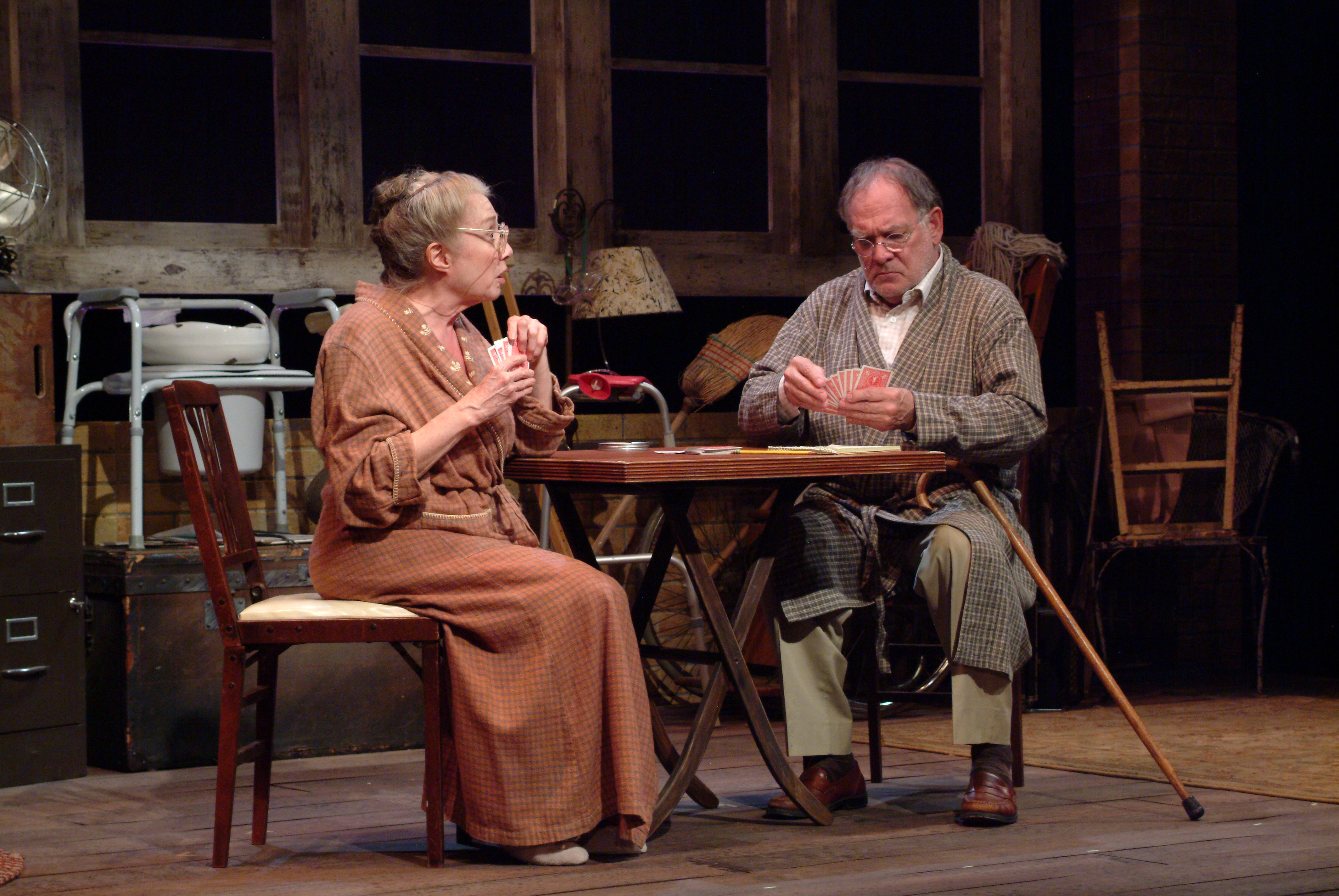
gin gameCard games.  You might not think of a card game as requiring blocking, but it does.  Plays like The Gin Game and Born Yesterday have dialogue that refers to certain things happening in the card games the characters play.  Learning when to draw and discard, when to deal, and when to shuffle your cards around in your hand, all while saying your lines, takes repeated practice to make it happen effortlessly.  The challenge is made all the more difficult because the cards you are looking at aren’t going to be the ones that are actually in the character’s hand.  That is, you may call “Gin” when you don’t actually have “Gin.”

Sleight of hand.  Magic tricks, juggling, and other similar special abilities need extra rehearsal unless the actors cast are already skilled in them.  While the actor responsible will need to practice the skill at home, integrating it into a scene where other things are happening is an extra challenge.

wait until darkThe blind.  If your character is blind, as is Susan in Wait Until Dark, you need extra rehearsal time to learn to move around the set as if you can’t see a thing.  Wait Until Dark and Black Comedy also have scenes where the stage lights are completely extinguished, but the actors have to move around the stage and do very specific actions in the dark despite not being able to see.  It takes extra practice to get so familiar with the floor plan that you can make this sort of scene flow smoothly without hurting yourself.


Do We Have Enough Rehearsal Time?

calendarI’m going to address this simply from the point of view of community theater.  The time needed for college or professional productions probably differs.  I’m also starting with choices that are largely made by the director, but I’ll finish with how it impacts you as an actor.  If you can identify upfront that the director may not have given you enough time to rehearse, you can handle how you rehearse a little differently to overcome this deficit.

In community theater, time is your best friend, but I don’t mean just the number of hours you spend in rehearsal.  Yes, that matters.  But the number of weeks from the first reading to opening night matters as well.

Why?  Because it gives your subconscious time to do its thing.  This is what John Cleese talks about when he says the third requirement for creativity is Time.  Ideally, you want seven weeks of regular rehearsals and one week of technical rehearsals.  Let’s say it takes you five weeks to get off book.  That gives you one week to REALLY get off book; that is, to reach the point where the words come out without you having to think about them.  It gives you one more week to do the fine-tuning that can only happen once you are REALLY off book.  And it gives you the eighth week to adjust to technical issues.

If the entire cast can get off book in four weeks and you’ve got a compelling reason to not use an eight week period, then for an “ordinary show” (see below), you can shorten the rehearsal period to seven weeks.  However, it’s my experience that at least some of the cast will still be on-book in that fifth week.  But the theory here is that you should put the script down no later than three weeks before opening night in order to benefit from what I will call the “subconscious effect.”

Has there ever been a community theater production you’ve been part of that seemed to be noticeably better on the second weekend of performances?  If so, you’re looking at the “subconscious effect”.  Once you get off book and are “fine-tuning” your performance, your subconscious gets very busy and does work on your role that you aren’t aware of.  Even if all you do in the week after opening is look at your script three times and have one pick-up rehearsal, your subconscious is still working and getting more comfortable with your choices.  Magical stuff happens when you give it this time to work.  So if you can give it that extra week before opening night, you’ll get better buzz to help fill the house on the second weekend!

As for the number of hours you need, my general rule of thumb is that a production with no special needs that will run for 2 hours including one 15-minute intermission requires 54 hours of rehearsal time prior to Tech Week.  To get the most out of this time, you need rehearsals that last at least 2½ hours long, three or four times a week.  (Rehearse them more often than that, and they have no time to work on their part at home as well as do their laundry.)

If the play is longer or shorter than two hours, you can adjust the total rehearsal time up or down.  But length is not the only consideration in choosing the number of hours for rehearsal.  Special considerations can increase the amount of time you need to work outside of rehearsals as well.

What do I mean by special considerations?  I’ll talk about them next time . . .

Actor’s Etiquette: Tech Rehearsals

tea-etiquette-v2We hate them, but they are a necessary evil.

They are tedious.  They start late.  Everything stops while they fix a problem.  Couldn’t they have figured this out ahead of time?

It doesn’t matter.  It is what it is.  Take a deep breath and be patient.  Everyone is frustrated.  Stay attentive to what is being said by the director or the technical crew, so you can help them.  Don’t get so involved in conversations with other actors that you lose sight of why you’re here.  Be as helpful as you can by getting into position when they need you to be somewhere, and by running something as many times as they need to to get it right.

You’ve had a lot of rehearsals to get it right.  The crew gets one, and there are all kinds of other reasons you aren’t privy to that the Tech isn’t going smoothly.  Don’t roll your eyes or lose your temper.  It will all be over soon.  And don’t worry that you can’t do any decent acting at this rehearsal.  It’s not for you, it’s for them.  You can act in the dress rehearsal.

This doesn’t mean you shouldn’t try your best.  No, you may not be able to sink into the character in this rehearsal, but the crew needs to understand the general timing and events of the show so they can match their cues to them.  Be sure you give them what they need.

The Stage Director as Film Editor

The stage director has a number of functions.

  • She chooses the tone of the play and makes sure that every aspect of the production supports that tone.
  • She identifies what she thinks the playwright is trying to say, and makes sure that all the actors’ choices are consistent with that point of view.
  • She is in charge of the mise en scene, and in that role plays traffic cop.
  • She is the Big Picture artist of the production.  Actors are little picture people.  She controls the scope and feel of the evening.  We are responsible for the moment-to-moment details.

film editorIn other words, she’s a film editor for the stage.

Having a strong sense of the big picture is an essential ingredient in a quality director.  The ability to attend to detail is an asset, but it isn’t critical.  You can be a very good director if you have people around you to handle the details.

The reverse is true for actors.  The more you can work with the minutiae of what happens in a single moment (giving oneself over to it without overthinking it, that is), the better your work is apt to be.  If you can also see the big picture, so that you can tailor your work to intentionally enhance the grand scheme and ease the director’s burden a little bit, then your performance is apt to scale some impressive heights.  But it isn’t necessary, because the director is your film editor.

Unlike a film editor, who works after all the filming has been completed, the stage director does her editing throughout the rehearsal process.  That means that you, as the actor, need to provide her with quantity of film to select from.  Take after take.  And each take should be a little different.  Each take should offer something slightly (or majorly) different to the director.  Your job is to provide choices.

Now, truthfully, you’ll do a lot of the editing yourself.  You’ll try stuff in rehearsal and realize this works and that doesn’t, and select accordingly.  But there will be times, as in The Rainmaker scene I’ve cited, where you may try two materially different approaches, and both seem to work on some level.  What to do?  Which to choose?  How do I know what’s right???????

You don’t have to.  The director will.

Isn’t this a beautiful system?  You don’t have to worry about it.  The obvious choices?  Go ahead and make them.  The ones that panic you so much that you think you have to make them early and often?  Let the director shoulder that responsibility.  That’s what she’s there for.

And this frees you up to try everything you can think of.  Because a good director will give you immediate and solid feedback about what works and what doesn’t.  Good feedback, I believe I said, speeds the learning process.  So you don’t have to worry that you won’t get it all done in time.  You will.

Actor’s Etiquette: Notes

Decorum-Dress-Etiquette-BookNotes are what the director gives the actors once run-throughs begin.  He takes written notes during the run-through and comments on the actors’ performances either after the run-through or at the beginning of the next rehearsal.

The purpose of notes is twofold.  First, it allows you to run scenes or acts without interruption.  Second, it is intended to be an efficient way of communicating what is necessary.  Once you get to run-throughs, there is usually less time for the director to talk because so much time has been spent actually rehearsing.  So the idea is:  convey the information and get the hell out of Dodge.

If your director gives notes at the end of the night (which is usually more profitable, since you’re more apt to remember what he’s talking about than you will at the next rehearsal), remember that everyone is tired and wants to go home.  This means that it’s not the time to get into a long discussion about anything.  Listen to the director, acknowledge what he is telling you, answer his questions briefly and clearly, ask questions succinctly if you are confused.

And leave it at that.  If you have a bone to pick, do it after the rehearsal has ended and people are free to head to their cars.

As I’ve talked about elsewhere, bones are best picked after you’ve had the chance to sleep on it.  It’s late.  You may feel differently in the morning.  And believe me, the director is tired, too.

It’s usually a good idea to write the notes down and review them before the next rehearsal.  No matter how good your memory is, it’s easy to forget a note, because (wait for it!) it’s late and you’re tired.

Notes usually involve fine-tuning issues, things you may need to think about before the next rehearsal, but which are easily fixed.  Notes about problem areas will probably be run several times in rehearsals, but if not, don’t be afraid to ask that some general rehearsal time be spent on them.

If you get the same note repeatedly, it means this:  “You aren’t paying attention to what I’m telling/asking you, because I keep having to say it.  It would be nice if you’d actually do something about the problem before we open.”  The first time it’s repeated (because you forgot it since you didn’t write it down), the actors will forgive you.  But after that, they are all thinking to themselves, “Would you just do it already, so we don’t have to listen to this note again, because (wait for it!) it’s late and we’re tired and we want to go home.”

Exploring the Subtext

rainmaker 2Let’s say that I try the scene from The Rainmaker the way Nash wrote it.  I try it with the alternatives that I’ve suggested, and at the end of the day, apart from the step File takes toward Lizzie, which I think makes no sense at all, I end up using Nash’s choices.

Doesn’t that justify just using Nash’s choices from the beginning?  Should I waste time trying things that ultimately aren’t going to work, that are going to be tossed aside?

First off, I don’t know at the time that I am exploring my options in the scene that I’m going to end up using Nash’s choices.  It’s just as possible that I will use my own.  The only way that I can be confident that his choices are the right ones is if I explore and dispense with any other possibilities.  The confidence I gain is worth the effort.

Second, I get a good deal out of exploring the options that I ultimately don’t use.  It’s called exploring the subtext.

Because we are often unable or unwilling (often out of fear) to be honest with each other, creating the confusion and conflict of good drama, the unspoken thoughts and feelings which make up the subtext are important elements for an actor.  To create a really rich performance, you have to know what the subtext is and play it accurately.

You don’t do that by saying “File and Lizzie have been in love forever, but File keeps resisting it.”  You do it by immersing yourself in the longing you have for the other person, the desire to touch them.  Once you’ve pumped up that desire to its max, you can now layer resistance on to it and the electricity in the scene skyrockets.  Without the intimate understanding of what the love File and Lizzie have for each other really feels like, you can’t know what it is you are resisting.  The audience needs to see not just the resisting, they need to see the love, too.  If you don’t show the audience the love, then all they see is resistance, and they don’t know how to interpret it.  Do they hate each other?  Love each other?  Or are they indifferent?  If you aren’t actively resisting something, it’s apt to come out somewhere in the middle, and that looks a lot like indifference.

It’s the push me/pull you relationship of the love and the “I can’t give in to this” (File) or “I can’t let him know how much I care” (Lizzie) that is dramatically interesting.  Play one without the other, and you’re missing half of the symphony.

So however you choose to stage this scene, you need to explore both elements, text and subtext.  By experimenting with the levels (how much love, how much resistance), you discover the most interesting and powerful way to play the scene.

In other words, when there is clear subtext in a scene – when your feelings are not aligned with what you say – your performance will ALWAYS be best served if you take at least one rehearsal of the scene and play the subtext as clearly as possible (even if it appears to categorically contradict particular lines you speak).

Oh, and the negative “can’ts” up above?  It’s okay to start with them as long as you translate them into positive verbs, as in “I must resist loving Lizzie” and “I must hide my love from File”.

The Stage Directions You Should Pay Attention To

There is, of course, an exception to every rule.  So there are stage directions that I wouldn’t think about ignoring.

godot3_p1250709Samuel Beckett’s plays are a good example.  Waiting for Godot specifies a single tree in a barren landscape.  To populate the set with some scrub brush as well would be to damage Beckett’s intention.

To have Hamm stand or Clov sit in Endgame would similarly harm the play.

In Equus and in Christopher Schario’s A Christmas Carol, the playwright calls for the actors to be on stage at all times, seated on benches at the sides when they are not part of the action.  This is a choice that should be honored in the production.

Thornton Wilder makes no such request for Our Town, but productions of his play have been staged this way, and I don’t see it as problematic.

Schario’s play calls for a fiddler on stage, who plays music at various points throughout the night.  When I directed the play, there was no fiddler available.  We turned four of the actors into a singing quartet who fulfilled Schario’s intention faithfully, I think.  However, striking the musical component entirely would have lessened the play.

Our townNoel Coward’s estate insists that his plays be staged with complete fidelity to the stage directions, including the smoking.  I’m not sure that every cigarette in Coward’s oeuvre must stand lest his plays be harmed.  (A red pen to some of his dialogue would strengthen the plays, but alas, we must draw the line there.)

Full realistic sets for Our Town would completely contradict the playwright’s purpose; however, if you indicated the gardens with something other than arched trellises, I doubt an audience would be disturbed.

In other words, examine the stage directions, playwright’s notes, and dialogue for the playwright’s intention.  Honor the intention.  If you succeed in this goal, then whatever you do will be all right.

Actor’s Etiquette: Be Punctual

mannersYou have a limited amount of rehearsal time, and no one really knows if it’s going to be enough or not.  Don’t waste any of it.  Get to rehearsal early enough that you can take off your coat, change to your rehearsal shoes, get out your script, turn off your cell phone, and gather your bearings.  If you need to eat when you get to the theater, get there early enough that you’ve finished swallowing by the time rehearsal is to start.

If everyone arrives at the time the director has called for rehearsal to begin, the odds are very good that ten minutes will be wasted while everyone greets everyone else and gets their act together.  It is courteous to get that out of the way PRIOR to the called time.  If you don’t, then whoever IS ready to begin at that time has to wait for you.

Tech week is always difficult.  If you can be early, that’s often a good idea, because sorting out technical issues always takes more time than you think.  The earlier you get there, the earlier you can go home.

On performance nights, know when the stage manager has called you for and be there on time.  No one wants to worry about whether or not you’ve had car trouble.

If for any reason you are going to be AT ALL LATE for ANY rehearsal or performance, call and let someone know as soon as you know, so that they can deal with your lateness appropriately.

If the schedule has been changed and you are no longer expected at rehearsal, confirm that with your director or stage manager.  Some shows don’t really have a schedule, and what is being dealt with at future rehearsals is so fluid that it is easy for actors to get confused about when they are needed.  So check and double-check about when you are required to be there!

Actor’s Etiquette: Be Polite

ws_etiquette_ALL_340x280Be respectful of other points of view.  Expressing your own is fine if you don’t make the other person feel wrong.  If you think you have, apologize.

Don’t yell, and if you do, apologize.

Don’t argue with the director.  Discussion is fine.  Argument isn’t.  If you do, apologize.

Don’t criticize other actors, on or off stage.  If you do, apologize.

Be nice to the technical crew.  They work hard, and they aren’t your servants.  They don’t get much appreciation.  Say thank you.  A lot.

Directors are almost as unappreciated as the technical crew, and they’ve been busting their butt since long before you got involved.  Let them know how much they really meant to the success of the show.

Say thank you to your fellow actors, too.  They are part of the reason why you look good on stage.

Be cheerful, even if you’ve had a bad day.  Put it aside for the time you’re at the theater.

Remember that you have to live with these people for a period of months, and they have to live with you.  Keep all your relationships at the theater healthy and happy!

I Don’t Know If I’m Supposed to Be Submissive or Aggressive in This Scene

Agnes_of_God_GozoAt first blush, you might think that the actress who said this hasn’t got a clue about her character.  I mean, these are polar opposites, right?  They can’t possibly both be right in the same scene.

Actually, her instincts are correct.  The scene is from Agnes of God, pages 23 to 25.  It’s a scene between Agnes and the Mother Superior, two years before Agnes’ pregnancy.  Agnes has stopped eating, because she believes saintliness requires her to be skinny, and she wants to suffer as the saints do.  The Mother Superior is worried about her health and wants her to eat.  Agnes is bound by her vows to obey the Mother Superior, who is also a surrogate mother to her.  But she also feels that she has been instructed by God to lose weight, that unless she does so, he will be angry with her.  She won’t let the Mother Superior overrule God’s instructions.

The actress playing Agnes sensed that she has moments of strength and weakness in the scene, but had trouble sorting out when to use which.  Despite the fact that she had only been working with me about a month at the time, with no prior acting experience, she had learned enough that when I replied by saying, “Submissive or aggressive?  I think you’re on the right track, the only problem is that th . . .”

“They’re adjectives,” she finished for me, shaking her head, vexed at falling into the trap again.

Listen, it’s okay to come up with adjectives and emotions when you are first talking about a scene.  That’s what we respond to as human beings.  The problem comes when we can’t move past them and we use them as the primary guidance for how we play the scene.  No matter how good your instincts are, unless you can build into those emotions by discovering the character’s history and what they want most, playing the emotions will be general and superficial.  You need to clearly understand why THIS particular character is [insert adjective] at THIS particular moment in her life.

So once you’ve identified the emotions or the adjectives that seem appropriate to you, simply translate them into verbs.  As I’ve mentioned before, you do this by asking, “Why would I be submissive?”  The answer?  “Because I’m a nun, and I have to do whatever my Mother Superior says.”  The verb?  To obey.

“Why would I be aggressive?”  “Because she is trying to make me do something that I know is wrong, that God would hate.  I can’t let her force me to eat.”  The verb?  When I asked the actress to tell me what the scene was mostly about for her, she named her verb in response to the idea of being aggressive:  To escape.

These are two strong verbs in opposition.  “To obey” implies, on some level, “to stay”, which is the direct opposite of “to escape.”

When you can find contradictory motivations like these, scenes can become electric as you go back and forth between two opposing needs in one person.  On the one hand, I have to obey her, on the other hand, I have to resist her power and do what I know is right.  The conflict is no longer just between Agnes and the Mother Superior, it is also within Agnes herself.  The tension of what is going on onstage just tripled.