Stage Movement, Part III

We use movement where you change physical location on stage for a number of reasons, but the biggest one is to provide visual interest to the audience.  There are other benefits:

  • Moving distracts your left brain so your right brain can do its job.
  • Moving underscores what is happening dramatically and emotionally in the scene.

But mostly, we’re giving the audience more to pay attention to.  It’s a storytelling technique.  If we use pauses in our speech to help build tension and interest (what’s she going to say next?), we use physical movement for a similar reason (where’s he going and what’s he going to do when he gets there?)

Physical movement of this kind is, in some ways, unnatural.  We are creatures of habit, we are.  We sit in the same chair, tread well-worn paths in the carpeting, eat the same thing for breakfast , frequent the same places week after week.  Most of us aren’t explorers; we’re observers.

I think this is part of why we’re reluctant to move much on stage.  We don’t give ourselves permission to be that free in our real lives, why should we behave any differently on stage?  But everything on stage should be a little bigger than life – even Laura in The Glass Menagerie.  Remember, this isn’t film, and you aren’t getting your close-up.  What you do has to be big enough to carry over the footlights and to the rear of the house.
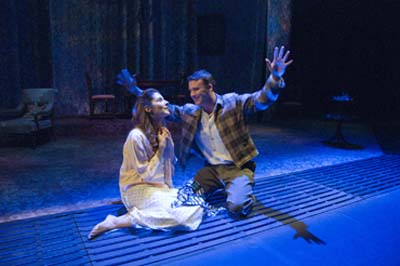
glass menagerieSo you’ve got two things to fight against.  One is your own disinclination to stray out of whatever you consider to be your comfort zone.  Inertia, in other words.  The other is your fear of the unknown.  What’s it like over on the other side of the stage?  Is there a trapdoor I’ll fall through?  Will I find my way back if I go over there?

I know, this sounds silly.  And it is.  But it is also, truthfully, part of why you won’t go over there.  And like most fears, the closer you look at it, the more you realize that you’re afraid of – nothing, really.  Roaming all over the stage gives you a wonderful feeling of freedom.

So leave a trail of breadcrumbs if you need to.  But find reasons to use as much of the stage as you can as often as you can.  Not every role will permit you to do this – Laura, for instance is emotionally constrained and her physicality should reflect this (but in a bigger than life way).  But when your roles do allow it, it makes for theater that’s really interesting to watch!

See Part I here.  See Part II here.

Stage Movement, Part II

There is something oddly unnatural about being onstage when it comes to movement.  Is it our awareness of the audience and our need to “cheat” to make certain things easier to see?  How do we address the audience’s need to see what happens while making our activities on stage look natural?

One thing I’ve learned as a golfer is that you need to break technique into the smallest pieces possible.  It’s the only way to get good at them.  Trying to do multiple things at once and get good at them simultaneously is nearly impossible.  Oh, heck, let’s just call it completely impossible.

That’s why when I give you an exercise, I ask you to only pay attention to one thing at a time.  When it comes to working on your physical life, I want you to worry less about the lines and the emotion and more about the physical.  I don’t care if your monologues aren’t as emotionally successful next week.  I care about whether or not you can walk and talk at the same time.

Let’s break the physical element into two pieces:  movement that involves changing location (walking, crossing your legs, sitting down) and movement that involves using your hands to do something (pack a suitcase, drink some coffee, peel a banana).  And let’s explore those two things separately.

Your assignment for next week is to do your monologue while changing location as much as possible.  You have the whole script to put the monologue into context now; use that for your emotional life, but disregard the constraints that the script places on you physically.   We’re not staging the play, so we don’t care if we do it “right”.  We’re using the monologue as a learning tool, that’s all.

walkingChoose surroundings that give you the greatest opportunity to move around.  If there isn’t an emotional impetus to move you, choose ANY activity, no matter how inane (like moving the cups) that will give you a reason to use as much of the stage as possible.  You don’t have to keep moving if you have an emotional reason to stay still.  Just don’t stay still after the moment has passed, and don’t be self-indulgent about those moments, even if that is the right choice emotionally.

We’re looking for balance between the physical and emotional, but err in favor of movement for the purpose of this exercise.  You can always scale back if you go overboard; but if you don’t go far enough, you’ll never get there.  (The golf analogy:  you have to get it to the hole to have a shot at it going in the hole.)

See Part I here.  See Part III here.

Words ≠ Communication

The meaning of words is a very small part of how we communicate.

Albert Mehrabian, a UCLA psychology professor in the 1960s, posited that only 7% of what we communicate comes through the words themselves.  About 38% comes from other verbal clues (intonation, volume, etc.), and the rest from body language.  Obviously, language itself may be more important in some conversations than others.  If you don’t pay attention to the words in a math or science class, you may not pass the test!

However, ordinary conversation – what we use on stage – probably follows this breakdown, at least closely enough.  Whatever the numbers really are, we need to pay considerable attention to how we use our voices and our bodies if we are going to convey the story’s meaning most effectively.

In real life, we do this naturally.  Our emotions automatically result in paralinguistic choices (the verbal stuff not related to the meaning of the words) that convey our emotions.  And that which we have trouble expressing in words, we express through our bodies.  Again, without much thought about those choices.

I may not be able to find words that tell you just how much I care about you, but looking in your eyes and stroking your shoulder underscores the words, “I love you.”  If I’m having trouble getting you to understand something, I probably am not going to say, “Boy, am I frustrated that you are being so obtuse!”, but I might turn and walk away while throwing my hands up in the air, as if that will somehow signal the gods to send me the magic words I can’t find myself.

The two examples I’ve just given you are pretty common ways of expressing those emotions.  But they are hardly the only ones.soup  I might say “I love you” by putting a bowl of soup in front of you and sitting down to attentively watch you eat it.  I might deal with my frustration by taking a deep breath and looking down at the ground while I gather myself, and then force myself to speak very slowly and calmly to explain myself.

Who your character is helps to determine the choices you should make as an actor, although you’ll find that your characters will often surprise you with choices you thought were inappropriate.  The point of this post is that if you’re just going to trust the words to do the job for you, you’re throwing away opportunities to develop a richer characterization.

Most actors I work with understand that they need to use some verbal inflection, but don’t explore the full range of their voices and the meaning that can add.  And most don’t use physical movement to any real degree to convey meaning.  Movement onstage becomes practical:  I need to answer the phone, because my next lines are part of a phone conversation; I need to pick up the gift because I need to take it offstage with me when I exit; I need to sit on the couch because the script says so.

So we’re going to intentionally explore these tools in class, so that you can learn how to bring them to bear in the next play you do!

The Actor’s Job – More Than You Think

Acting is about action.  We forget this sometimes.  Playwrights can only provide the basic structure of the play:  the plot and the dialogue.  Don’t get me wrong – without the playwright, the actor has nothing to do, and the playwright’s contribution is paramount.  Thank goodness we have some good playwrights!

But without the actor, they are just words on a page.  To bring life to those words, we actors need to add not only the emotional life, but physical action.  Saying our character’s lines is actually third in the list of responsibilities.  After all, silent films were very successful for many years, and only the words that couldn’t be conveyed any other way ever showed up on the screencards.

Our job, whether we are in films or on stage, remains the same:  add the emotions and the action.  Hence, our logo:

21724617This is tougher than it sounds.  As both John and Nora have found, human beings are afraid of our emotions and distance ourselves from them as much as possible.  Actors, on the other hand, need to plunge into them.  That’s pretty terrifying.

That’s why we used the memory exercise.  It’s a way of introducing yourself to your own emotions and to make friends with them.  If you keep exploring your own feelings through distant, unimportant memories (because those are quite important enough, and much safer), you’ll become more comfortable with letting them show up on stage, too.

As for action – well, most actors focus on the words and resist moving.  I’m not quite sure why that is, but it’s pretty universal.  Only a minority of actors are inclined to move instinctively early in their careers.  If no one has encouraged you to explore stage action in any depth, you can do twenty shows and still be confining yourself to a space the size of a telephone booth.  (Remember those?)

But action is one of the most important and valuable tools an actor has.  Action is inextricably linked to your emotions, but if you’re not accustomed to using it, the exercises we’ve been doing – by creating “business” with your activity and learning to use the space available to you on stage by walking on your “unimportant” lines – are designed to draw your attention to the role both business and movement play in your acting.

We’ve made some arbitrary choices in using them – but going to the extremes is a way of focusing on what you otherwise avoid.  Once we get into actual scene work, you’ll find the link between action and emotion that make both easier to do.