Trusting Your Subconscious

How I swing the golf club isn’t going to be exactly the way you do.  Our golf swings are as unique as our personalities.  But good golf swings all have certain things in common.  You can’t break the laws of physics and have success.

When I break the golf swing into little pieces so I can learn to do it better, I can clearly identify what works and what doesn’t work, using these natural laws.  I can then practice what works over and over.

Acting is different.  This is a new play, and I don’t have a clear destination.  What I did in the last play doesn’t apply.  I am starting from scratch and have to figure out what works in this play, with this cast.  Acting is a creative, subjective art, and we make our way to a final performance bit by bit.

So how do you decide what works in a role, which “bits” to keep and which to discard?

The best way is to let your subconscious decide for you.  As I’ve said, it is much better equipped to synthesize everything into a cohesive performance than your conscious brain is.

This doesn’t mean that you won’t make some conscious decisions throughout rehearsals.  You will.  But if you refuse to set them in stone until your subconscious lets you know what conclusions it’s come to, you’ll give a more integrated and complete performance.

So how do we keep our conscious brains from doing what they love to do:  make decisions left, right, and center?

It’s an act of self-discipline, for starters.  You have to learn to intentionally sit on the fence for a while, to refuse the temptation to hop down on one side or another.  To hold open the possibility that something is different than what you expect it to be.  That your subconscious may have a different opinion.Straddle Fence

It’s a product of actively seeking opposites, and developing a willingness to experiment.

It’s a function of inputting data into the computer (your subconscious), and trusting that it will do its calculations and spit out the right answer.  I can assure you that it will.  Learning to act is, in part, a matter of learning to stop manipulating your subconscious and to trust it instead.

I tell my golfers that their subconscious knows how to play golf, and that if they could only shut down their conscious brains, they’d all play great.  And it’s true.  Your subconscious will compensate for your swing flaws as much as it can, because it knows what you’re doing wrong.  It’s fascinating to watch.

The same thing applies to acting.  Your subconscious will find your character much faster than your conscious brain will.  And time is, after all, of the essence.  A rehearsal period is finite.

Ah, but I hear you say, “You are asking me to trust this blindly, to not only try these things in class, but to try them when I’m in a play.  But what if they don’t work?  I’ll make a fool of myself on opening night!”

No, you won’t.  And I’ll explain why I am so confident of this in the next post.

To read The Subconscious Effect, go here.  To read Good Process = Great Performances, go here.

The “Subconscious Effect”, or Why You Can’t Do Any Acting Until You’re Off Book

Have you ever been part of a theater production that seemed to be noticeably better on the second weekend of performances?  Have you personally experienced moments in the last couple of weeks of rehearsal, or during performances, when you did something, said something, in a completely different way than you ever had before?  And it surprised you, but it worked?

Not only did it work, but it was so much better than anything you could have dreamt up if you’d tried!  It was a “gift of the acting gods”, who kindly sent you a little epiphany.

If so, you’re looking at what I call the “subconscious effect”.

Your subconscious is not only in the business of making you happy; it is in the business of synthesizing disparate things into a “whole”.  Your conscious can’t do this very well, because you can only hold so many things in your head at once.  Even if you’re a great multi-tasker, you’ve got your limits, and creating a believable and interesting character on stage surpasses them.

the-subconscious-mindSo your subconscious plays a very large role in what you do on stage.  Yes, your conscious brain has a function during acting, too.  Among other things, it notices when something unusual happens that needs to be acknowledged (like when your earring falls on the floor.)  It notices when the audience’s laughter has crested, and you can deliver your next line.  And it saves the day when someone forgets their lines.

But most of the heavy-lifting in performance is done by your subconscious.  Learning how to act is, in part, figuring out how to keep your conscious brain from interfering with your subconscious.

In the first weeks of rehearsal, your conscious brain is fairly active.  It’s putting data into the computer.  Your subconscious is participating, too, but it’s difficult for it to be involved continuously in this phase.  That’s okay.  The more you do this, the more you’ll learn how to make room for it.  But right now, don’t worry if you notice that you’re “thinking” more than you’re “not thinking”.  (You will find that the tools I’m introducing you to help you to “not think” in a constructive way.)

As long as you have a script in your hand, your conscious brain is more active than you want it to be.  Both the physical presence of a script in your hand, which you won’t be carrying in performance and is therefore unnatural and distracting, and the ability (or need) to read lines rather than speak them from memory impede what your subconscious can do.  You are too aware of the mechanics and the underlying unreality of what you are doing – that is, that you are pretending to be someone else – to do any real acting.

You can lay a great foundation for real acting in these early weeks of rehearsal.  Absolutely!  And that’s what you should be using this time for.  But don’t for a minute think that you’re doing anything worthy of an audience at this stage.

Once you get off book, your subconscious gets very busy and does work on your role that you aren’t aware of.  This is where good acting comes from.  Once your subconscious has the freedom to work, because your conscious brain has started to cede to it, the character finally starts to seem like a real person.  And it’s because this happens that people think that Learning Process #2 is sufficient.  They understand that the subconscious is working in some mysterious way.  But think how much more your subconscious can do for you if you give it more quality data using Process #3!

To read Trusting Your Subconscious, go here.  To read Good Process = Great Performances, go here.

Good Lord!

I try to keep my blog posts short and consumable, which is why I sometimes end up with multi-parters.  Sometimes topics are longer than a single post, and so I try to break them into the smallest bits possible, to stick to my self-assigned word count and thereby hold your attention.

But I know that I am pushing my readers’ patience on this one.  I started with this very practical, “How the heck do I use the tools effectively?”, and I’ve gone conceptual on you, talking about learning processes for three posts, and now I’m about to move into the subconscious for three posts:

  • The Subconscious Effect, or Why You Can’t Do Any Acting Until You’re Off Book (read here)
  • Trusting Your Subconscious (read here)
  • Good Process = Great Performances (read here)

But if you are reluctant to trust what I’m telling you, to actually try doing what I suggest when you are under the gun, facing an opening night that your entire family will be attending, then understanding what is in these posts will help you to trust.  None of us knows our own subconscious, except indirectly, so it can be difficult to trust both its power and capabilities.  As I’m writing these posts, I realize that these tools are all in service of helping you to quiet your conscious brain when it is making too much noise, using your conscious brain in ways that will actually benefit you (but which you probably aren’t doing right now), and giving your subconscious more latitude than you usually do.

And from that comes great acting.  No matter who you are.

Figuring out how to use your subconscious on your own takes time.  I want to put you on a shortcut.  I want to introduce you to your subconscious early in your development, so that you can recognize when it’s around.  Because it will make an immediate, noticeable difference in what you do on stage.  Who wants to slog through the usual slow learning process when you can be fast-tracked?

So please trust that I will get back to the practical as soon as I can, and at least skim these theoretical posts.  Because they help to explain the process in their own way — just not in my usual hands-on fashion!

The Learning Process, Part III (The Fastest Route)

When it comes to acting, there are two levels of learning.  One is learning technique – the tools we are talking about.  But once you’ve learned technique, the learning process doesn’t stop in the way that it did when you learned to drive.  Each time you do a play, you have to learn the play.  Rehearsals are all about learning.  So understanding the learning process and how you can use it to your benefit matters.

Given that we have a short time frame for rehearsals, we want to move as much knowledge about the play and our character as we can into our subconscious as fast as possible.  The better we get at this, the more layered and interesting our performances will be.

So what’s the fastest way to learn?  Intentional focus.

The best way to learn to do something well is by breaking it into its smallest parts and getting really good at each of those parts without regard to any of the other parts.Puzzle Piece

Let me say that again, because it’s really important:  If you can give up attachment to how you do all those other things, and just pay attention to how you do this one particular small piece of the big puzzle, you’ll get really good at this one particular small piece of the puzzle, and in surprisingly short order, too.

Let’s look back at the Process #2 example.  If we stop worrying about all the other things we do “wrong”, and just pay attention to the speed of our backswing, we can figure out what is going on in our backswing and what corrections we need to make.  If we stop worrying about what the ball is doing – the final product – we can focus on making the backswing the correct speed, and by repeating it often enough, we can groove the speed so well that it becomes part of our subconscious behavior, and we can turn our attention to something else.

Confuse our subconscious by trying to do too many things at once and not doing any of them well, and it takes a while to learn.  Isolate the pieces that we are trying to learn so we are giving our subconscious clear information about our expectations, and we can learn much more quickly.  Get the process right, and the final product will take care of itself.

Acting isn’t golf.  We aren’t trying to create a perfect, repeatable swing every time.  We’re trying to create a character who lives and breathes in ways that may be unique every night.  But as actors, we are as prone to focusing on final product – our performance on opening night – as a golfer is.  It is just as true for us that process is what matters, and that good process results in great performances.  This is what we call “staying in the moment.”  (More on that another time.)

Okay.  I’m now going to wind my way back to the matter of acting tools.  I’m going to talk a little about the role your subconscious plays in your acting, because it will help you to commit to using the tools.  And then I’ll talk about the practical aspect of how you put the tools together.

See Part I here, and Part II here.

The Learning Process, Part II (The Usual Route)

The second way to learn is to actively try to get better.  We gain a little bit of knowledge, enough to get a feel for the complexity of what it is that we are trying to do.  If I’m learning to play golf, at this point I understand that I have to learn to rotate my arms in a particular way, to push the club away from me rather than lifting it, to deal with weight shift, maintaining spine angle, keeping my head behind the ball, not rushing my backswing, following all the way through, finishing high . . .

“Sheesh!  That’s a lot to pay attention to, but okay – I want to learn this game, and learn it quickly!  So I make a swing.  And I have this feeling that I swung too quickly, and I know I did the weight shift wrong, and I hit behind the ball, so I must have done something else wrong, and I don’t know if I finished correctly or not.  Did I get all the way through?  And look what the ball did!  It never got higher than ten feet off the ground, and it’s over in the bushes, I don’t know if I can even find it over there.Print

“Let me swing again, I’ll do it better this time.  Oops!  I lost my balance that time, and I’m not sure what happened in the second half of the swing, but the club was doing some really weird things, and I could really tell that I rose up that time.  And the ball popped up and went left, but it came down just as quickly.”

How much learning do you think is going on here?

You can eventually sort everything out using this approach, but it’s a little time-consuming.  You gradually figure out what matters and what doesn’t.  Take a new physical activity, for instance.  You don’t know what muscles are required to get the job done initially.  But as you go along, your subconscious figures out what muscles don’t need to participate, and it shuts them down.

As long as you are actively paying attention to what happens (unlike the golfer in the previous example), the wheat and the chaff get separated over time.  You may go down some wrong paths, but you figure that out before you get too far, and you come back to the fork in the road and follow the other route.

But a certain amount of what happens in this learning process is serendipity.  Your subconscious is looking out for you and it does its best to make you happy.  Sometimes the best it can do it to try to save you from yourself, but given enough time, your subconscious will often figure out how to do something better.  What it can’t do, using this process, is figure out how to be great.

Why?  Because the rehearsal process is short.  Whether you use a two or six or eight week rehearsal period, it’s a finite length of time.  With each play, you’re starting the learning process at zero, but you don’t have the leisure to learn at your own pace.  No one is going to delay opening night so that you can improve your performance.

I guess you can figure out that my personal preference is Learning Process #3 . . .

To read Part I, go here.  For Part III, go here.

The Learning Process, Part I (The Path of Least Resistance)

So how do we develop good acting technique?

Let me digress just a bit and talk about the learning process.

In a previous post, I talked about your conscious brain being a Commodore 64 computer, while your subconscious brain, by comparison, is 1,000 times better than the most sophisticated computer and software presently available.  Let’s take that a little further and say that your conscious brain is like the computer’s RAM, while your subconscious is all the files you have saved.

Your conscious brain is the threshold over which knowledge passes into your head.  While you’re learning something, your conscious brain seems to do most of the work.  Once you’ve learned it, it is largely resident in your subconscious brain, from which it can be called forth when needed.

As actors, we want to move knowledge into our subconscious as much as possible, so that our subconscious can play a very big role in what we do on stage.  Yes, our conscious brain will be active during a performance, too, but great acting requires that your subconscious participates.  A lot.

There are three basic ways that we can teach our subconscious.  I’ll explain how they impact acting, and you can choose which route you’d like to take.

First, understand that your subconscious doesn’t have a value system.  It’s your conscious brain that decides ice cream is good, while sorbet is bad.  (My husband’s opinion; I love sorbet.)

Your subconscious does understand frequency, however.  Do the same thing over and over, and your subconscious will learn to do that thing very well.  Why?  Because it equates frequency with desire, and your subconscious wants you to be happy.  It wants you to succeed, and its job is to help you do that.

So it does its best to learn whatever it thinks you want to do, and to learn to do it better.  To learn to do as much of it as possible without troubling your conscious brain, freeing your conscious brain up to find world peace or the best price on a hotel.  A lot of your day is spent doing things on autopilot, thanks to your subconscious.  And isn’t that a good thing!  Remember how you had to pay full attention when you were learning to drive?  Now you can have a conversation when you drive without having an accident.

Self-taught golfers eventually come for lessons.  They have tried to imitate what they see others do, but they don’t know enough about the golf swing in the early stages to make the right choices.  They can’t see what they look like when they swing.  They imagine they look like Tiger Woods, when in fact they look like Charles Barkley.  (If you’ve never seen Barkley play golf, take my word for it, it’s not pretty.)

They have swing flaws that they have grooved over the years through repetition, and they come to me to undo years of learning in one lesson.  Which is extremely difficult to do.  Their flawed motion is firmly embedded in their subconscious, and it is only with great conscious discipline that they can change that.

cartoon manHow does this approach to learning affect an actor?  You make choices early in the rehearsal process, what seem to be the “obvious” choices about how to say your lines.  You have a “vision” of what you want the final performance to look like, and so you rush to put those pieces of the puzzle together and trust that everything else will fit in, over time.  Once you’ve got a few weeks under your belt, you’ll be comfortable with the material, and then you can really start to explore it.

“Getting comfortable” typically means run-throughs.  Let’s run that scene again!  And again!  And when I’m home rehearsing and memorizing my lines, I’m going to read them over and over.  And I’ll probably do a little bit of “acting” as I memorize them.  So I’m not just memorizing the words, I’m memorizing my surprise when you tell me you eloped with someone you met last week.

Before you know it, you’ve memorized a “primitive” performance, one without nuance or a real understanding of the character (which only comes with time.  You just met this character, after all.)  You’re well on your way to a performance that is superficial, with no real emotional core to it.  If you’re talented, you can shine this baby up, but you will never be able to give it a soul.  You can’t peel back the exterior you’ve created to add the foundation halfway through the rehearsal process, because adding the foundation is going to change the exterior.  At this point, you’re committed to the exterior.  You have grooved that swing.

Early run-throughs – repeating the scene without having a reasonably good idea of what you are trying to achieve in doing so – are the death-knell for great acting.

To read Part II, go here.  To read Part III, go here.

What Do I Do With These Acting Tools? Part II

If we have a strategy, a process, a way of going about things that is intentional on some level, the odds are very good that we will perform whatever activity we’re doing as efficiently and effectively as possible.

Let’s say you’re cooking.  Maybe you’re making Yorkshire pudding.  Maybe you’re baking bread.  Or an apple pie.  Whatever you’re making, you need some skills.  The first time you sift flour, you probably make a bit of a mess (or if you’re my husband, a lot of a mess).  You’re a little uncoordinated, or you sift far more than you need.

When you measure the flour, how do you do that without losing the benefits of sifting?  How do you make sure the salt is evenly spread through it?  How do you knead the bread correctly?  Or roll the pie dough?

knead-bread-dough-by-hand-when-baking.1280x600These are all techniques.  You don’t do them particularly well the first time out.  The more you do them, the more you understand them.  You learn what order to do things in.  What has to be done, and what can be skipped.  What makes the tastiest bread, the flakiest pie crust.  And you also learn how to do it as quickly as possible.  The better you are at technique, the better the product and the faster the process.

Which is why, for instance, I can do the Open Door Reading Process so quickly now that you wouldn’t even know I’m doing it.  But when I first did it, it was as tedious and sporadically useful as it is for anyone who’s doing for the first time.

Tools are about technique.  They are about making you proficient at how you go about acting, so that it is less of a guessing game.  And because you are more proficient, you can get further along in the process by the time you get to opening night.  What used to take you five weeks, now takes you only three.  So now you have time to spare to really fine tune your performance, and to come up with some unexpected and creative choices.

Without technique, it is unlikely that you’ll have time for that.  And it is also unlikely that you’ll be able to turn in a consistently believable performance.  You’ll toggle between “true” and “false” all night long.

Which is perfectly fine if you’re okay with that.  It really is.  If you’re working in community theater, and you’re doing it for love and to share time with other people who enjoy putting on plays, then the imperfections in your performance may not matter to you.  But if they do, or you hope to act professionally, read on . . .   Be warned, though, I’m going to take a little (necessary) detour and talk about the Learning Process for a few posts.  It’s directly related to this topic, so don’t skip it, but it will help me avoid having an eight part series . . .

To see Part I, go here.  To see The Learning Process, Part I, go here.  To see The Learning Process, Part II, go here.

What Do I Do With These Acting Tools? Part I

I think there are multiple posts on this topic, but I’m still finding my way to them.  So if this first post is unsatisfying on some level, do stay tuned.  I promise to wrap it into a nice little package eventually.  I try to keep posts reasonably short and focused, and write longer ones only when it absolutely unavoidable.

Every once in a while, I have the opportunity to ask an actor how he goes about creating a role.

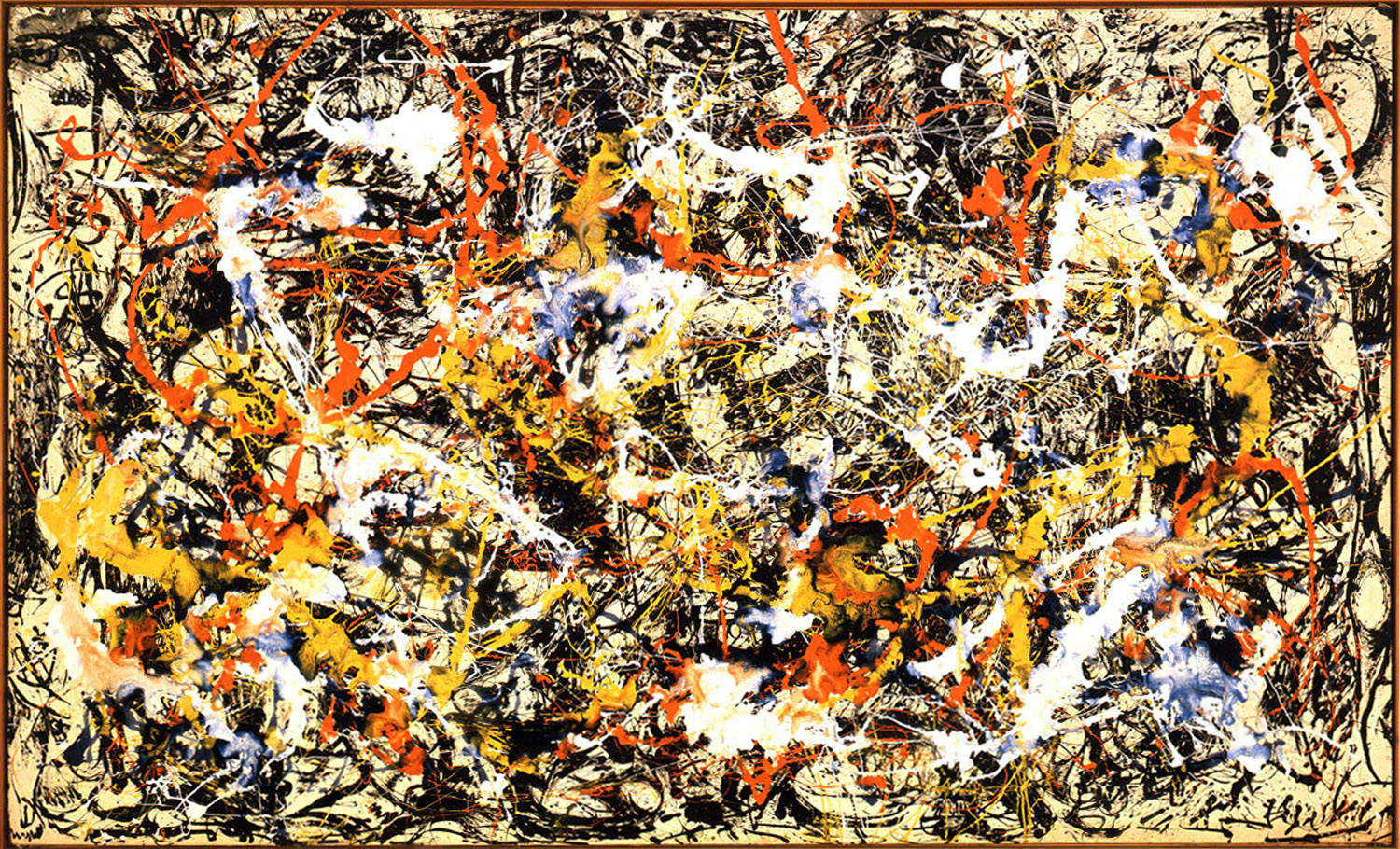
pollockMy favorite local actor answered it with characteristic honesty:  “I have no idea what my rehearsal process is.”  In fact, he does, but he’ll describe it in the simplest terms, and he tries to not overthink it.  Which is not at all a bad way to go about it, especially if you have a certain amount of talent, and he does.  But his “simplest terms” are the best distillation of what acting really is.  Not everyone can distill it to a few points as truly as he does.  Actually, I’d argue that most people can’t.

More often, what I hear is something along these lines:  “I just try to figure out who this character is, over the course of rehearsals, and to play that.”

Well, duh.  But it’s not a particularly informative description, is it?  And it reminds me of when I was a kid.  Every once in a while, I’d use a word, and Dad would ask me to define it.  And I would eventually say, “Oh, I know what it means, I just can’t put it into words!”  At which point, Dad would diplomatically suggest that if I couldn’t put it into words, perhaps I wasn’t as clear on what it meant as I thought I was.  Point to Dad.

Personally, I’m a very instinctive actress, so I understand the difficulty in describing one’s acting process.  I can probably be reasonably clear about my own if you have more than a minute to spare, but it’s nothing I can distill into a single paragraph that you can adopt for yourself.  (Obviously, or I wouldn’t have a blog.)

But since I know the quality of the product of these actors who are “just trying to figure out who this character is”, I have the feeling that the nature of their work consists in reading the script a lot or else just trusting that if you rehearse it over and over, you’ll have sufficient little epiphanies to patch together into one stellar performance.  That because it is an artistic endeavor, once just hangs around and waits for the acting gods to strike you favorably.  But hey – we aren’t all Jackson Pollock.  And even Meryl Street and Denzel Washington got master’s degrees in acting.

There is a limit to what you can achieve by simply “immersing yourself in the play.”  (Another ineffective description I’ve heard.)  Yes, there is a lot of subconscious work involved in acting.  I am the last person to encourage you to think too much on stage.  On the contrary – I’d like you to think less on stage.  But I know that to do so, you need some specific, practical tools to at least help you discover what the acting “issues” are.  That you are likely operating on some very false premises that you are convinced are absolutely true.  And that a certain amount of conscious thought at the right moments can be useful – as long as you don’t think too much.

This is where the tools come in.  But I’ve reached the end of Part I . . .

To read Part II, go here.

Acting Beats, Part III

This is sort of cheating, because it isn’t actually a new post, to speak of.  Well, I may have a new post on the subject later this week, once I’ve had a chance to mull things over a bit.  But this post is mostly just a detour sign.

I happened to check the blog’s stats this morning, to see which posts have been visited the most.  And the two posts on Acting Beats are right up there.  Not a surprise.  I know a lot of actors either don’t really know what the term means, although they’ve heard it used, because I have actors who aren’t new to acting ask me what it means.  But even if you at least sort of understand the meaning of “Beat” in the context of acting, I think a lot of people are confused as to why we even care where a beat starts and ends, or what it covers.  And so beats become an English Lit discussion more than being a practical tool that you can use to improve your performance.

So I’ve tried, in some small way, to cover this issue in the various posts on both beats and verbs.  And my verb posts have gotten a bit of attention, too, but since actors don’t throw around the word “verb” quite as much as they do the word “beat” (although perhaps they should), I’m not sure that everyone realizes the two are connected.  And so people who want to read about Acting Beats find Parts I and II, but don’t necessarily find what is really Part III:  my post on “Why Playing Verbs is (Ultimately) Easier than Acting Emotions.”

So if you haven’t read that post yet — which assigns verbs to the example used in Part II, and has a few other things to say about the matter as well — you can read it by clicking here.

Thoughts About the Open Door Reading

Open DoorIt’s difficult to do initially.  It’s uncomfortable.  It’s unnatural.  We don’t listen particularly well in real life.  As soon as someone starts to talk, we start forming our response.  We’re only half paying attention to them.  We’re busy figuring out what to say and looking for a pause we can enter to speak our opinion.

The Open Door Reading, however, encourages you to pay attention to your partner.  If you resist the temptation to look at your script (so that you’ll be “ready” when it’s “your turn”), you have nothing to do but pay attention to what your scene partner is sending you.  After all, you haven’t memorized your lines yet, so you can’t prepare them if you aren’t looking at the script.  Since you don’t have the freedom to improvise a response, you just have to wait until you can look at the script.  So you might as well use that time to notice what your partner is doing and saying and to let it affect you.

Taking time is an essential part of the equation.  If you shortcut any of the steps I listed in the post on how to do the Open Door Reading, you will not experience what the exercise can do for you.  Only by allowing silence and trying to not fill it intentionally will you create space that emotion can flow into.  Only by allowing silence can you begin to receive what you are getting from your scene partner rather than putting up walls and anticipating what you are going to get.

And once it is time for you to talk, if you resist the temptation to look at your speech in its entirety, to notice its arc and to prepare for the powerful line at the end by setting up the lines at the beginning in the “right” way, you’ll give more attention to words and phrases that you otherwise might dismiss as being unimportant, instead of being open to the possibility that they are, in fact, important in unexpected ways.

Our instinct to make the scene “flow”, and to make it understandable to anyone listening is fairly strong, so it requires a good deal of self-discipline initially to stick to the plodding process as I described it here.  Because it is plodding.  Stilted.  Boring.  Occasionally hard to follow.  Tedious.  Long.  But since at this point, you don’t HAVE an audience that cares about it flowing or being understandable, you can ignore your instinct and use the exercise to discover what it has to teach you about this particular play.

Because that’s the point.  The exercise is only about what you, the actor, gets out of it.  It’s not for the director or an audience.  There are no rights or wrongs in terms of what shows up for you.  It’s simply information.  Data for you to consider down the road in rehearsals.  To use or not use, as you see fit.  But like a statistician, you need to collect all the available data before you start evaluating it.

Hopefully, you will have moments in the Open Door Reading when emotions show up with unexpected force, and frighten or surprise or delight you.  Equally hopefully, these moments will convince you that there might be something to this process.

Most people need a teacher watching them the first few times they use the Open Door Reading technique.  Without that, most actors will cheat.  Not intentionally.  They just don’t realize that they aren’t being faithful to the process.  A teacher can help you get the most out of the experience, which in turn helps you to recognize when you’re doing it properly down the road, with another scene from another play!