The Half Dozen Rights

OptionsI hope you’ve had a chance to contemplate my last posts, and at least agree that it is possible that you aren’t always RIGHT; at least, you aren’t always categorically RIGHT.  And that neither is the playwright.

I hope you can also see that if the character you are playing doesn’t occupy space on the same slice of the pie that you do, you might have to reach a little bit to figure out who that character really is and what choices you need to make as an actor to create him believably on stage.  That if you rush to judgment, you might make choices that aren’t the best ones you can make.

But BEST is a very different word from RIGHT.  So let’s stay with RIGHT for a moment or two longer.

I know actors who are convinced that there is a RIGHT way to play a role.  A RIGHT way to say a line.  And it is next to impossible to convince them otherwise.

Some years ago, I was acting in a play, and commented at rehearsal one day that one of the lines another actress delivered was, to my mind, one of the funniest lines in the play.  She was surprised, because she had no idea it was a funny line.  Which explained why she didn’t deliver it in a way that would get a laugh.  But that wouldn’t have mattered if she had understood the character properly.  The humor came out of who her character was, so if she’d been more in tune with her character, the line would have come out correctly and the audience would have laughed.  Automatically.

You don’t have to be a comedian to get laughs in a play.  You just have to know your character well.  (Not that it hurts to understand a little about comic delivery.  A topic for another day.)

Anyway, the actress in question finally begged me to simply tell her the RIGHT way to say the line.  I really hate giving line readings to actors (especially when I’m not the director!), but there comes a point when I will give in if they want it badly enough.  So I gave her a line reading.  She tried using it, although she never got a laugh in doing so.  She didn’t deliver it well, because she didn’t understand what was going on inside of her character.  She was giving a largely superficial performance.

Except for one performance:  One of those happy moments when she accidentally collided with her character, and there was a living, breathing person on stage in the scene that night.  And she said the laugh line perfectly; not at all the way I had suggested, but perfectly.  And the audience roared.  (Unfortunately, she didn’t notice that they laughed, so she learned nothing from the experience and couldn’t repeat it.)

But here’s the real point to the story.  I went home after the rehearsal in which I gave her the line reading.  Had I really given her the RIGHT one?  Or even the BEST one?  And so I ran through various ways of saying it, and realized that I could easily come up with six different ways of saying the line, all of which I was certain would make an audience laugh.  Each reading came from a slightly different understanding of the character at that particular moment.  Each understanding was perfectly valid and workable within the context of the play.  As a director, I wouldn’t argue with any of those six choices.

In other words, there were at least six RIGHTs in that particular situation.

Another example:  I was talking about blocking in class a few weeks ago, and in demonstrating how blocking could work in a particular scene, I realized that there were probably a half dozen ways of moving on a particular line.  Which I would choose as an actor would depend on how I chose to define the character, as well as what the other actor in the scene might do (my movement on that line was, in part, a counter to the other actor.)

As with the example of the laugh line, each of the blocking options I came up with would work.  Obviously, I’d have to make a choice at some point, but which choice I would make would depend on how I ended up interpreting the character and understanding what was going on in that scene for me.  But I could probably make any of them work, if it mattered to the scene.  In other words, if the director really needed me to finish in a particular location, I could find a way to justify that movement.

So again, there were at least six RIGHTs in that particular situation.

I can hear at least one person out there saying, “But which of the six is RIGHT for this production?  I mean, one of them is going to work better than the others, right?”

So now we’re at least moving toward “best” instead of “right”.  But there’s one more thing to say before we can fully do that . . .

To read The Validity of Other Perspectives, go here.  To read About Those Stage Directions, go here.  To read How Do I Know What the Right Acting Choices Are, go here.  To read Line Readings and Why They Don’t Work, go here.

About Those Stage Directions . . .

Gospel-Transformation-Bible-005There are people who feel strongly that the stage directions in the script are The Gospel.  Not just the movements indicated, but the emotional choices for the actor as well (e.g., “angrily”).  I don’t seem to be able to persuade them that these not RIGHT, but they are merely suggestions.  You are under no compunction to follow any of them if you have a better idea.

The people who feel this way credit the playwright with a degree of omniscience that can be misplaced.  Playwrights are human beings, and they make mistakes, just like the rest of us.  Physical movements are often from the original production, not from the playwright, and so don’t warrant slave devotion to them.  The original set used is just one designer’s interpretation of the play, and has nothing to do with the playwright in any case.  And often the physical movement noted is arbitrary.  The play will not be weakened if you stand up two lines earlier or two lines later than the script dictates.  It probably won’t be harmed if you never sit down in the first place.

As for the adverbs playwrights throw in so that you won’t mistake their intention, they simply reflect how the playwright heard it in his head when he wrote it.  It’s not the only way to say the line (see my next post, The Half Dozen Rights, for an expansion on this idea.)

Sometimes these little notes provide clarity where confusion exists, and I’m all for playwrights using them then.  But now that I understand the playwright’s intention, I can say the line however I like – and not necessarily “angrily” – because whatever I end up choosing, it will match the playwright’s intention.  Which I now know.  If I have a more creative choice that is still in line with his intention, I’m going to ignore his specific instruction, and the play will be better for it.

Actor Ray Ficca, playwright Bill Cain, & director Ryan Rilette during a rehearsal for New Book, Round House Theatre, April 2013

Actor Ray Ficca, playwright Bill Cain, & director Ryan Rilette during a rehearsal for New Book, Round House Theatre, April 2013

But sometimes the playwright gets a little carried away with his instructions to the actors.  And you know what?  Sometimes he’s just dead wrong.  I know, I just spoke sacrilege.  But I’ve done plays where I am convinced that the playwright was giving me very bad advice on how to play the role.  I’ve come across stage directions that leave me utterly perplexed as to what he’s talking about.

The lines I say?  Those are sacred, and if I don’t understand what they mean, I better figure it out, and quickly.  But the advice on how to say them, or how to move?  Not so much.  As I said somewhere, if the playwright’s choice is the best one available, you’ll discover it for yourself just by doing the work correctly, and it will be organic when you come across it that way, whereas if you blindly follow the stage directions, you risk it appearing artificial.  So you won’t do any harm most of the time if you ignore them.

I also think it’s important to remember that the playwright is a writer, not an actor.  Now, I’m not saying that all playwrights are terrible actors.  I’m sure there are some who are decent actors.  Maybe even very good ones.  Probably not brilliant, or they’d be actors, first and foremost.  But their stock in trade is putting words on paper.  An actor’s stock in trade is putting the words on their feet.  And sometimes, things look and sound very different in three dimensions than they look on paper.  Sometimes a playwright is simply too close to the work to gain a proper perspective on it.

Theater is a collaborative art.  We each bring something to the table, and the ensemble effort produces the final product.  We actors aren’t there to be marionettes of the playwright.  We are contributing, creative artists.  So when it comes to stage directions, keep what is useful and works.  Use the playwright’s opinions as guidelines.  But don’t turn off your own brain or instinct just because The Playwright Spoke.  He isn’t God.  And he can be wrong.  He didn’t anticipate you playing a role in his play.  If he did, he might have viewed the character differently.  And written entirely different stage directions!

To read The Validity of Other Perspectives, go here.  To read The Half Dozen Rights, go here.  To read How Do I Know What the Right Acting Choices Are, go here.  To read Line Readings and Why They Don’t Work, go here.

What’s in a Name? Part II

Just as you need to pay attention to the title of the play, you need to look at the character’s names as well.  Most names have “meanings” that can be found in a book of baby names (these lists are also available on line now.)  For instance, “Thomas” will always be associated with the “Doubting Thomas” of the New Testament.  A playwright may not be referencing this connection if he names a character “Thomas”, but then again, he might.  It’s worth examining the meaning of your character’s name, just to be sure you aren’t missing anything.

Amadeus.  As I talked about last time, Amadeus translates, literally, to “He Loves God.”  As crude as Mozart can be, he must also have moments where his love of and communion with God are clear.

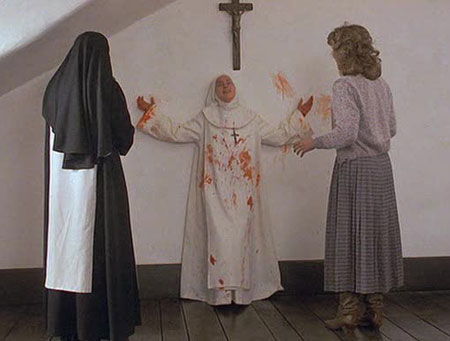
AgnesOfGod-BIGAgnes of God.  St. Agnes chose martyrdom at the age of 14 to giving up her virginity.  There are obvious correlations between her story and the Agnes in Peilmeier’s play.  But for those who don’t know anything about St. Agnes, the appellation “of God” helps to make Agnes’ purity clear to the audience.  If you play Agnes, you need to make purity part of her character; if you play one of the other characters in the play, you need to be aware of Agnes’ purity.  The names of the other two characters, Martha and Miriam Ruth, have Old and New Testament connections worth exploring:  Martha and Mary (a derivative of Miriam) are sisters in the New Testament, and Miriam appears in Exodus while the Book of Ruth is the only book named after a woman.

Doubt.  St. Aloysius is the Catholic patron saint of youth.  For Sister Aloysius to take his name, it says something about what matters to her and how she conducts her life.

The Little Foxes.  Regina is Latin for “Queen.”  Hellman’s choice of this name for her leading character probably speaks to both her bearing and her self-image.

Bright_Ideas_pestoBright Ideas.  Eric Coble’s black comedy is based on Shakespeare’s Macbeth.  Not only should you read Macbeth to understand all the references and correlations, the character’s names in Bright Ideas gives you clues as to who serves what function.  The leads, however, are not named after Lord and Lady Macbeth; their names reference other historical characters, and provide additional meaning to those roles.

Enchanted April.  Three of the characters in this play have names that may give some indication of their character’s nature:  Rose, Mrs. Graves, and Michael Wilding.  This naming convention is often used in comedies written prior to 1900, such as Sheridan’s The School for Scandal (e.g., Lady Sneerwell and Lord Backbite).Frankie & Johnny

Frankie and Johnny in the Clair du Lune.  “Frankie and Johnny” is an old ballad.  The correlation between the story of the ballad and the characters in Terrence McNally’s play may not be readily evident, but it is too famous a song for the choice of their names to be merely coincidence.  You need to figure out what McNally is telling you about the characters and their relationship.

No Man’s Land.  All of the characters in Pinter’s play are named after cricket players.  The obvious question is, “Why?”

Distant Fires.  Kevin Heelan’s play has three black men (Raymond, Foos, and Thomas) and three white men (Angel, Beauty, and General).  The first obvious question is, “What sort of name is Foos?”  Check the Urban Dictionary, there’s a variety of reasons why Heelan might have chosen this name for this particular character.  The second obvious question is, “Why are all the white men known by nicknames, and why do those nicknames reflect such definitive, one-dimensional concepts?”

The Wisdom of Eve.  No one names a character “Eve” by accident!  It’s up to you to figure out what the playwright is trying to tell you by referencing the couple from the Garden of Eden.

To read Part I, go here.

What’s In a Name? Part I

[I am traveling and seem to have left the rest of the series of posts I’m writing on rehearsing at home!  So I’m going to post on some unrelated topics until I get back home to the drive that has them.]

Sometimes a play’s title describes what happens in the play, but holds no mystery beyond that.  Many of Harold Pinter’s plays are named after an event, character, or place in the play (The Birthday Party; The Caretaker; The Room).  The Philadelphia Story is about journalists trying to write an article about a wedding that is taking place in Philadelphia.  The Gin Game is a play about two people in a senior citizens’ home who play gin rummy together.  Dial M for Murder is a clever reference to the letters on a telephone’s keypad, and follows a long tradition of using wordplay when naming murder mysteries, but has little deeper meaning.

But sometimes the title reflects the playwright’s theme or thoughts about the play or a character.  Let’s look at some play titles to see how this can work and why it matters to you as an actor:

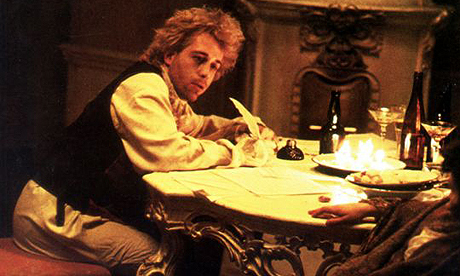
Amadeus276Amadeus.  This play is about Wolfgang Amadeus Mozart and another composer of his era, Antonio Salieri.  Salieri is the protagonist, but the play is named after Mozart, a choice which reflects the plotline.  But Peter Shaffer doesn’t call the play “Mozart”.  Instead, he uses the composer’s middle name.  It’s worth asking, “Why?”  If you look at the Latin meaning of the name, “He loves God”, you probably have your answer.  But don’t stop there.  Why does Shaffer want to draw your attention to this, and how should the production as a whole reflect this knowledge?  If you are playing either Mozart or Salieri, how does this focus affect your performance?

lauraThe Glass Menagerie.  One of the characters in Tennessee Williams’ play has a collection of glass figurines, all of which are animals.  But is this the only reason for the title?  Laura is not the main character of the play; why should it be named after her collection?  Perhaps it refers to her family, or to humanity in general.  The unicorn clearly is symbolic; whom does it represent?  And why does Williams choose for the animals to be made of glass rather than wood?  Is the fragility or transparency of glass important?  Are all of the characters fragile, in some way – not just Laura?  If you decide this is what Williams intended, it will undoubtedly change how you play your character.  If you don’t observe this about the title, your Amanda or Jim may be a hardier person than if you do.

Bell, Book and Candle.  The title of this romantic comedy about witches refers to a method of excommunication for one who has committed a particularly grievous sin.  Those last three words need to inform how the leading character feels about her actions as well as the loss of magical powers.

Betrayal.  Harold Pinter’s play about an affair that reveals itself in reverse chronological order is obviously about betrayal.  An adulterous wife has an affair with her husband’s best friend, after all!  But the title reminds us to not get lost in the details of the romance, and to remember that it is, first and foremost, about how we betray those we care about.  At some point in the rehearsal process, you should look at each scene in this light, so that you keep this element front and center.

foxesThe Little Foxes.  In naming this play, Lillian Hellman references a biblical passage from Song of Solomon, which reads, “Take us the foxes, the little foxes, that spoil the vines:  for our vines have tender grapes.”  Perhaps she uses the adjective “little” to make the reference clearer, or perhaps she is saying something about her characters by using it.  The Hubbard family is obviously devious and greedy, but exploring this quote in its fullest (what or who are the vines and the grapes?) and letting it inform your character’s actions will enrich the production.

Rabbit Hole.  Lewis Carroll’s book, “Alice, Through the Looking Glass” turned “rabbit hole” into a metaphor for adventure into the unknown.  Understanding its use in that book gives you food for thought when performing this play.  Does just one person go down the rabbit hole, or do several people make that journey?  What is falling into the hole like for your character?  What can you, as an actor, do to give the audience a sense of that particular experience?

Master Harold and the Boys.  On the surface, the title of Athol Fugard’s play is simply naming the characters, but it does much more.  It presages the end of the play, warning you in advance that no matter what transpires between Hally and Sam, the young boy is the “master” and the adult males are, in this society, merely “boys”.  As an actor, you want that relationship to be an undercurrent throughout the play.

crucibleThe Crucible.  A crucible is a container which has a higher melting point than whatever is inside it.  Think of steel or glass being melted before being re-formed into something else.  John Proctor clearly is in a crucible, but perhaps most of the other characters in the play are as well.  If you are in Arthur Miller’s extraordinary play, what is your character’s melting point?  Are you transformed into something better or worse than what you were originally?  And how do you feel about that transformation?

To read Part II, go here.

What Are Play Rehearsals For? Part I

One of the greatest myths of acting is one I didn’t include in my earlier post on the topic (which you can read here), and it ties directly into this issue of using the tools:

          Rehearsals are for perfecting a performance to be given in the future.

I thought I’d check out the definition of “rehearse”, just to be accurate.  On the Merriam-Webster website, I found this:

          To prepare for the public performance of a play by practicing the performance

Part of the problem, I think, lies in the word “public.”  It is natural to be concerned about whether or not we’re going to give a performance that people will enjoy.  We want them to applaud, to tell us how wonderful we are.  We certainly don’t want to give a bad performance!

But because you know this public presentation is 6 to 8 weeks away, it is easy and far too tempting to imagine, in our mind’s eye, the performance we want to give and to strive to give it.  To disregard anything that doesn’t match this very premature vision of our character.  Without realizing it, we’re focused on externals, not our character’s soul.  We’re concerned with “looking good” opening night.

21747730We become very “me” focused.  What do I have to say, how should I sound, how should I move, what should I be feeling, how should I respond, etc.   It’s very easy, you know, to prepare a performance without much regard for the other actors in the play:  “Well, if they do their thing, and I do my thing, it should all be all right, shouldn’t it?”

No.  Because your “things” are inextricably interconnected, and can’t exist without each other.  And yet I see a lot of performances where if you lifted one actor out of the production and dropped a completely different one down in his place, at least some of the other performances wouldn’t change at all, and the others probably wouldn’t change much.

Which is never going to get you great theater.

Again, this goes back to the “staying in the moment” issue; lots of people sincerely believe they are reacting to what they are getting from their scene partners, and yet they aren’t.  I can prove it to them in a scene class in short order, but I’d never get them to admit it outside of that.  “Reacting” (I’m still searching for a better word) is incredibly difficult.  Like “staying in the moment”, it’s hard to be sure you’re doing it unless someone catches you in the act of doing it and says, “There!  That’s it!  That was completely in response to what you got from her [the other actor in the scene].”

Without a teacher to keep us honest, we’re all sure that we’re doing it right.  “Oh, yes, you’re raising interesting and valid points, but it doesn’t apply to me, personally.  I’m already doing it.”

So if I tell you that you are probably focused on your end product – that is, the performance – you may find it as difficult to believe as if I tell you that because you aren’t staying in the moment, you aren’t reacting to what you are getting from your scene partner, you’re merely executing a pre-planned agenda (and perhaps an exceedingly well-planned one, at that!)  The difference is that I can easily prove last point; convincing you that you aren’t really exploring and discovering a character, but that you are merely collecting things that fit into your early design is much more difficult.

So I won’t try.

Instead, I’ll just explain what I sincerely believe goes on with all actors in the early stages of their careers and which becomes, for many of them, a way of life that lasts to the end of their careers.  (I do not exempt myself from this group; it’s because I’ve been there, done that, that I think I know what’s going on.)  And I’ll offer you another approach.

You’ve got nothing to lose by trying what I suggest.  If you already know how to do it, you haven’t lost anything.  You’ve gotten a bit more practice at it, and in all likelihood, you’ll understand it a little bit better than you did before.  If you don’t already know how to do it, hopefully you’ll learn something out of the experience.  Or at least plant some seeds that will bear fruit in the future.

The truth is that you wouldn’t be visiting my blog if you didn’t know your acting can improve.  If you didn’t sense that you are falling short of your potential.  Acknowledging that is a very brave act.  So be brave for just a little longer and trust that I may be on to something here and give it a shot.  Because if you ARE falling short of your potential, I guarantee you that staying in the moment, not reacting to your scene partner, and using your rehearsals ineffectively are the reasons why.

To read Staying in the Moment, go here.  To read Part II, go here.  To read Part III, go here.

Directors Use Adjectives, Actors Use Verbs

(A slight detour from the tools’ posts, which are still a work-in-progress…)

HELLO in eight different languagesLet’s say you’re still making this transition, trying to learn how to avoid thinking in terms of angry, innocent, deceitful.  You’ve studied the script, you’ve marked your beats, you’ve found your verbs, and by God, you really are trying to play them for all they’re worth!

Then you’re at rehearsal one night, and the director says to you, “You used to be angrier in this scene.”  Or, “Could you be a little more confused when she asks you that?”  Or, “I think the scene would work better if you were more excited when she comes home.”

It’s almost like offering an alcoholic a cocktail, only with much less serious repercussions.  But there’s a strong temptation to comply.  You want to please your director, and he must know better than you do, that’s why he’s in charge!  You may not even realize that he’s putting you back on Adjective Road, so eager are you to “get it right.”

But there is something worth noting:  your director has a different job to do than you do, and adjectives/adverbs are part of the language he is apt to speak.  He may not even be aware of this adjective/verb thing.  He’s going to continue to use adjectives, and you know what?  That’s just fine.

Because you can translate them into verbs.Translate Computer Key In Blue Showing Online Translator

Why does he use adjectives and adverbs if they aren’t part of a good actor’s language?  Because he’s not an actor.  Because it’s a quick way to communicate what he wants; verbs take longer to find.  Because even though it’s live theater, his view is almost cinematic, and so he is dealing on some level with images, sounds, emotions.  Large brush strokes.  And because he naively thinks that he is getting to the heart of the matter and being helpful.

So if he asks you for anger, or confusion, or excitement, he’s not really telling you how to do your job.  He’s just telling you what he wants to experience viscerally.  He may not even know what he means, exactly; but he’ll know it when he sees it from you.

It’s not his job to learn an actor’s verbs; it’s your job to translate his instructions into terms that are meaningful for you.

So maybe “angry” becomes, “I want to make you accept me as I am!”  Maybe “confused” becomes, “I want to understand how this happened.”  Maybe “excited” becomes, “I want to get married tomorrow, not next week!”

You may need to take a minute in rehearsal to make this translation, which goes something like this:

“Angry?  Angry.  Why would I be angry in this part of the scene?  What is it that I want that I’m not getting, and why does not getting it upset me so?  How can I raise my stakes in this scene, so that not getting what I want really pisses me off?”

When you have a verb you can actively play that will help you produce anger, you can move forward with the rehearsal.  But if you allow yourself to revert to using adjectives just to please your director now, that choice will have a negative impact on your performance, and that won’t please your director later.  You’re just postponing that difficult discussion for another day down the road, when he realizes that you aren’t making the progress with the scene that he had hoped for.  And believe me, he’s not going to realize that he hamstrung you back at the rehearsal where he asked you to play angry.

Take the time you need to make the translation and then to consider how this adjustment might affect the scene.  Then play the scene again, with the adjustment.

I’ve never met a director who objects when an actor asks for a minute or two to make an adjustment.  Don’t feel that you can’t ask for time.  In the long run, you are helping the production and saving it time.  Trust that.

To read Big Verbs vs. Little Verbs, go here.  To read Why Playing Verbs is (Ultimately) Easier Than Acting Emotions, go here.

Researching the Role: The Playwright’s Opinion

Writers, quite frankly, don’t know everything about their works.  They know more than you do, at least at the outset, and perhaps even on closing night.  But they don’t know everything.  This means that it is possible that even if they know more in general about their own play, you might know something specific that they have somehow missed.

typingHow can they possibly miss anything about something they have given birth to?  Because there are moments for every writer when his experience is that he is channeling his characters, when they speak without being asked to, when they do unexpected things.  When this happens, you have as good a shot at understanding what is going on for them as the playwright does; more, perhaps, because you haven’t started with the preconceived notions that he may have when he sat down at his desk to write.

Since characters have multiple layers and motivations, everything the playwright thinks about a character may be true, but what you think may also be true.  And sometimes it is entirely possible that the playwright thinks he wrote one thing when in fact he wrote another.  I recently spoke with a novelist about one of his character’s motivation in a particular scene.  His explanation took me entirely by surprise, as I interpreted the events very differently.  His explanation may have been what was in his head when he wrote, but that doesn’t mean it’s what he put down on paper.  If he had, I probably would have received that message on some level.

However, give the playwright credit (at least initially) for knowing what she was trying to do and keep an open mind about her opinions.  Sometimes a playwright will include notes about the play in the playscript, either before or after the script itself.  Don’t ignore these pages simply because there is no dialogue on them.  Make sure you’ve looked at every page in the script so that you’re sure you’ve read whatever the playwright wants to share with you, and do this in the first week of rehearsal.

A week or two into rehearsal, do a little research about the play and previous productions.  Don’t get obsessive about it, but if the playwright has been interviewed by anyone regarding the play, read his responses and give them consideration.  Girl-at-ComputerCheck out reviews of major productions and see if that cast was taken to task for not doing something or praised for being wise enough to do something else.  Yours is a different production; you don’t need to imitate what was successful elsewhere.  But sometimes a review will highlight what is particularly challenging in a play, and it’s a nice reminder of what you need to pay attention to.  All plays have inadvertent “traps”, I’m convinced, and if you don’t know what the “trap” of your play is, you’re apt to fall into it.  If the trap isn’t obvious to you or your director, a reviewer or a playwright may be able to point it out to you.

What do I mean by “trap”?  Well, that’s a topic for another day . . .

See Researching the Role here.

Researching the Role

Not everything in a script is going to be self-evident or otherwise within your knowledge base.  This means you have to do some research.

I am surprised by how many actors don’t do the research necessary for their roles!  They will go into opening night not understanding a word, a line, or a reference.  You need to understand the words and the world of the play, as well as what makes your character who she is.  And that means research.

libraryFortunately, the internet makes this work a lot easier than it used to be.  If you identify at the beginning of rehearsals what you aren’t sure about, you can answer most of your questions in short order, which will help guide how you use your rehearsal time.

So what sort of things should you look into when doing your research?

Word definitions.  This may sound obvious, but I see too many actors saying lines that they do NOT understand and making no attempt to learn what they mean.  If you can’t define a word in ten words or less, look it up.  Don’t assume you know what the word means because of the context in which it’s used.  Look it up so you’re sure you have an accurate understanding.

Sayings.  Sometimes you’ll come across a phrase or imagery that seems peculiar.  These are often common sayings, but being common doesn’t mean that everyone knows them, so don’t feel inadequate if you don’t.  If you do an internet search, you’ll probably find some etymology for it.  If nothing else, ask the rest of the cast.  Sometimes I’ve just been particularly dense about a line, while my fellow actors know exactly what it means and are happy to enlighten me.

Double entendres.  Sometimes words or phrases have two meanings (and the second one isn’t necessarily risqué!)  If a word or phrase can be interpreted two ways, it probably isn’t an accident that it’s in the play.  Consider what insight the second meaning might give you about the play or your character.

Names.  Sometimes the playwright chooses a name that, because of its meaning or its association with a fictional or historical character, sheds some light on the nature or experiences of the character you are playing.  It’s your job to make that connection, because if it exists, someone in the audience will, and they’ll know if something is missing from your characterization.

Place and Time.  If a play takes place in a city, state, or country you haven’t been in, you need to learn something about that locale.  If it happens in an era not your own, you need to learn what the social rules where then, and to understand what the politics and current events of that time were.  Don’t assume that your own experience translates to places and times you don’t know.  Any references to real-life places, people, or events should be explored as well.

Foreign Words.  Occasionally foreign languages appear in a script.  Sometimes the translation is provided, but sometimes it isn’t.  Be sure you know what the words mean and how to pronounce them correctly (or incorrectly, if that’s appropriate to your role).

Occupations and Illnesses.  Don’t assume that because your character is a teacher or a doctor that you know what that means to him.  The odds are that someone has blogged or written a book about his on-the-job experiences.  Teaching at a prestigious boarding school is different from working at an inner city school.  Working in the Emergency Room is different from being a Sports Orthopedic for the NFL.  Unless you share your character’s career, learning something about it will help you to understand both what attracted him to that field and what his daily experiences are like.  The same thing goes for illnesses.  Was your character once an anorexic?  Read up on both the disease and recovery.  Playing the lead in “Whose Life is It, Anyway?”  Study both the right-to-die arguments and what it is like to be a quadriplegic.

Historical Accuracy and Context.  If the play deals with a real historical events or real historical characters in fictional events, you need to do a LOT of research.  The more you read about the life of your character or the circumstances of the play, the better your performance is apt to be.  Believe me, the playwright has done extensive research, but it is impossible for her to include all the background information that informs her choices as a playwright into the text itself.  So crack the books!

Adaptations.  It should probably go without saying that if you are doing a play that is adapted from a book or has sprung on some level from a poem, you should read the source material.  It SHOULD go without saying.  But I’ll say it anyway.

See The Playwright’s Opinion here.

How Action Enhances the Play

Most physical action used in plays is not indicated in the script.

Yes, sometimes there are stage directions that appear in parentheses.  Some scripts have more of this than others.  These days, playwrights steer away from including any stage directions unless they are absolutely necessary to understanding what is going on in a scene.  For instance, if a character says “Here”, and then pulls a packet of unmarked bills from his jacket pocket, and the other character says “Thanks”, you’d have no reason to know that it’s a bribe and not a throat lozenge unless the playwright tells you.  But directions such as “sits” or “stands” are rare in today’s scripts.  The playwright understands that it often doesn’t matter exactly when the sitting or standing happens, and that if it does, a good actor will be able to figure it out without assistance.

But even in older scripts where stage directions are sprinkled in here and there (and sometimes these are not the playwright’s opinions but merely the stage manager’s recording of what was done in the original production, which you should not consider to be sacrosanct), there is much that isn’t included.  It’s your job as an actor to add physical movement that underscores, enhances, or adds to the fun of the play.

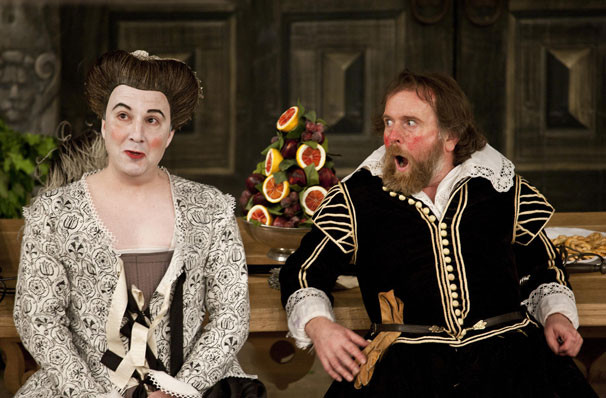
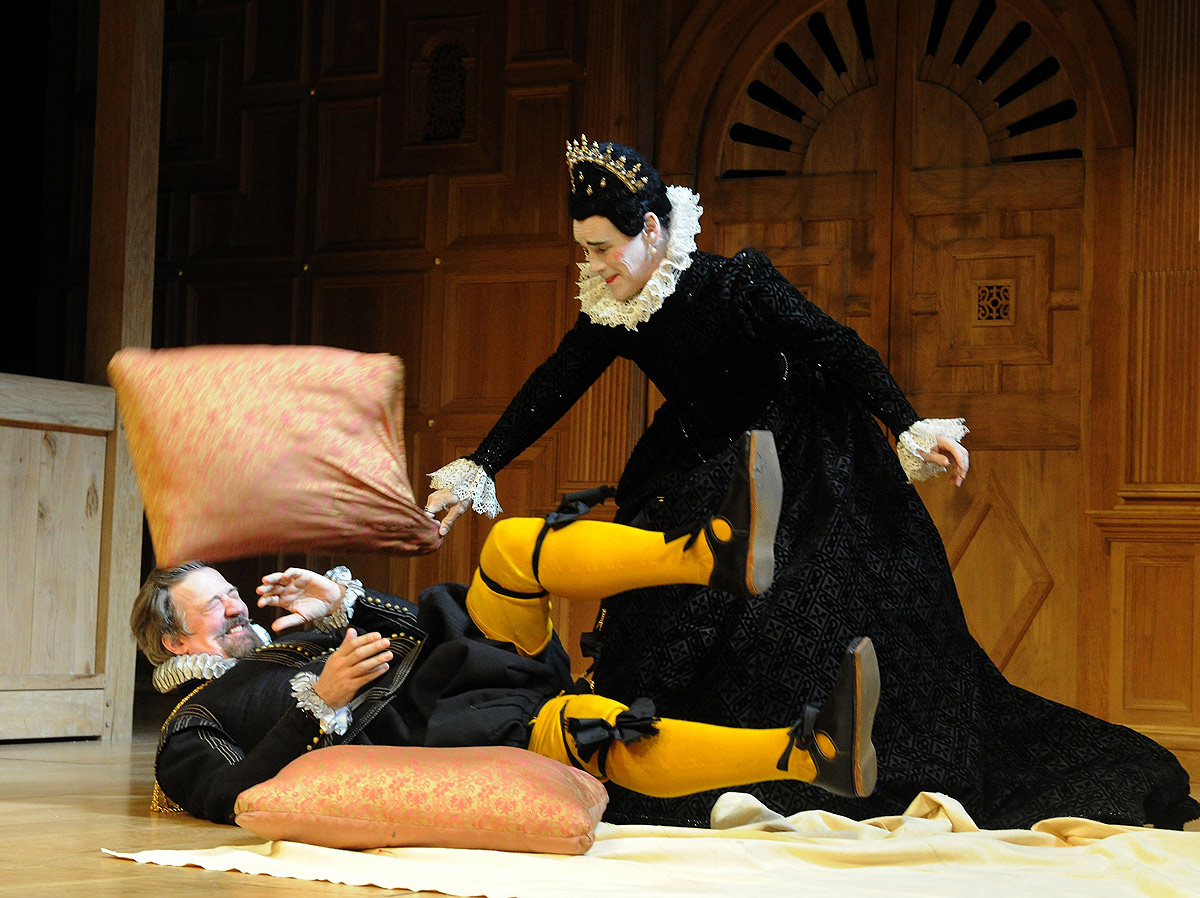
If you’ve ever read a Shakespeare play, you’ll know that aside from entrances and exits, there isn’t much recorded in the script in terms of movement.  Watch a good production, however, and you’ll find lots of action, especially in the comedies.  I just saw the London production of Twelfe Night with Mark Rylance and a host of exquisite actors at the Belasco Theatre in New York, and it was full of marvelous physical bits that made us all laugh.  Here’s a few photos to give you an idea of what is possible when you let your imagination loose and express yourself through more than words (you can also check out Youtube for the American Conservatory Theatre’s commedia del’arte production of The Taming of the Shrew — links in the right column — for some very physical Shakespeare!):

TN4

TN3

Twelfe Night

TN6

TN1

Playwrights are literary (and how this affects acting beats and performance)

A good playwright doesn’t just know how to develop a plot, maximize conflict, and create interesting characters.  All these things help plays to be successful, but playwrights aren’t merely practical creatures.  They (the good ones, anyway) also know how to use literary devices to their best advantage on stage.

The kinds of literary devices I’m about to talk about help to focus the audience’s attention on what is important, as well as to make what is happening as clear as possible.

Here is the monologue from Agnes of God that Davina is working on, along with the Beat marks she is presently using.  They are slightly different than the ones she started with, because it became clear that the literary choices of the playwright help to determine the Beat divisions.agnes1

Dr.  Livingstone:  How dare you march into my office and tell me how to run my affairs – how dare you think that I’m in a position to be badgered or bullied or whatever you’re trying to do.  Who the hell do you think you are?  /  You walk in here expecting applause for the way you’ve treated this child.  /  She has a right to know!  That there is a world out there filled with people who don’t believe in God and who are not any worse off than you!  People who go through their entire lives without bending their knees once – to anybody!  And people who still fall in love, and make babies, and occasionally are very happy.  She has a right to know that.  /  But you, and your order, and your Church have kept her ignorant, because ignorance is next to virginity, right?  Poverty, chastity, and ignorance, that’s what you live by.

What are the literary devices John Peilmeier uses in this monologue? 

REPETITION.  Repetition means at least two of something.  It’s typically used to emphasize something, and Peilmeier uses it (forgive me) repeatedly in this monologue.  Two examples:  “how dare you” and “She has a right to know.”

GOOD THINGS COME IN THREES.  We talked about lists of threes in comedies, that three is the necessary number for a joke to be funny when it involves a list of some sort.  It doesn’t just apply to jokes, however.  When a writer wants to emphasize a point, he often builds to it by using a list of three.  Such lists can be used in a number of ways, but typically they escalate upwards emotionally, as in big, bigger, biggest.  (Choose to use them differently if you like, but be sure that you recognize that there are three related items which need to be delivered with some sort of variety in order to be effective.)

This monologue has a number of lists:

  • How dare you/how dare you/who the hell – forget that the third element doesn’t begin with “how dare you”, it is nevertheless the climax to this list of three.
  • Badgered/bullied/whatever you’re trying to do
  • People who/people who/people who
  • You/your order/your Church (and notice how each element is tied to the Mother Superior)
  • Ignorant/ignorance/ignorance
  • Poverty/chastity/ignorance (notice that “ignorance” is part of two separate lists)

FRAMING.  Framing is when the repetition begins and ends a thought.  “She has a right to know” is used to frame a list.  Just in case you forget where she started, why she made the list, Peilmeier reminds you by hammering it home with the closing frame.

A less obvious frame is in the last two sentences.  It is an implied frame, because it begins with “you, your order, and your Church” and ends with “that’s what you live by”, which is another way of saying the list that begins this section.  Just in case you forget that Dr. Livingstone is directly accusing the Mother Superior, the phrase “that’s what you live by” brings you back to where she started.

Peilmeier uses these devices to make sure you get his major points.  Words in a play can fly by, and you don’t know which words are the most important ones unless the actor and/or playwright help to underline them for you.  Peilmeier presents the actress with some great tools in this monologue; your job is to use them to their best advantage.  Don’t swallow any of the repeated words, and make sure your audience knows you are giving them a list.  The need to give them some variety in delivery will also help you explore the emotional underpinnings to your character at this moment.

With regard to choosing the beats when you find literary devices like this, make sure you include them in one beat.  Lists, frames, and repeated words typically belong in the same beat.