Good Process = Great Performances

"for colored girls who have considered suicide when the rainbow is enuf" (From Page to Stage)

“for colored girls who have considered suicide when the rainbow is enuf” (From Page to Stage)

I direct community theater plays.  I’ve worked with actors with natural talent and actors with little natural talent, with lots of experience or none at all.  Actors with different learning styles and ways of processing information.  Of these, perhaps three gave indications through how they worked that they knew something about what they were doing.  Everyone else was flying by the seat of their pants.

My directing style reflects the fact that I am a teacher by nature.  A few moments in rehearsal are clearly instructive, but mostly, I introduce technique without specifically saying, “Okay, this is something you want to use in every play you do.”  I hope that my actors will realize the benefits of what they are doing and carry some small portion of that experience forward into other plays.  I am sowing seeds, as it were.

"When Men Are Scarce" (Caribbean Community Theatre)

“When Men Are Scarce” (Caribbean Community Theatre)

I ask my actors to work in ways that use the tools without actually identifying them as tools.  I help them to work in healthy, organic, productive ways that they’ve never used before.  I help them to work in the way well-trained actors do, and every time they veer off course, I push them back on.

I don’t do the work; they do.  I just make sure they are working correctly.  Good process = great results.

My rehearsals are hard work.  I have high expectations and encourage them to strive for greatness.  And to a man (and woman), they do.

"A Christmas Carol" (From Page to Stage)

“A Christmas Carol” (From Page to Stage)

It’s a different way of working, and it’s uncomfortable for them.  I run scenes as much as I can, but less than most community theater directors do.  I work the beats.  I work moments.  I dig for motivations.  I demand great physicality.  As you’ll see when I talk about blocking, I keep my actors moving.

Actors have so much to learn in the course of my rehearsals that when they think about opening night, I can see the panic in their eyes.  After five weeks, they have no confidence that this thing is going to come together in time.  Everything still seems like a haphazard work-in-progress.  They can’t make many conscious decisions, because I keep changing things just enough that they are always a little off-balance.  “Where’s the run-throughs that are my security blanket?!?”

Once we start with run-throughs every night, I still have this annoying habit of stopping mid-scene and addressing issues that I deem too critical to wait for notes.  Over the next couple of weeks, the interruptions become fewer, and the notes start addressing tiny details instead of major issues.  As we approach tech week, we are fine-tuning at a level the actors have never done before.  And now, the actors are beginning to think that we just might pull this off.
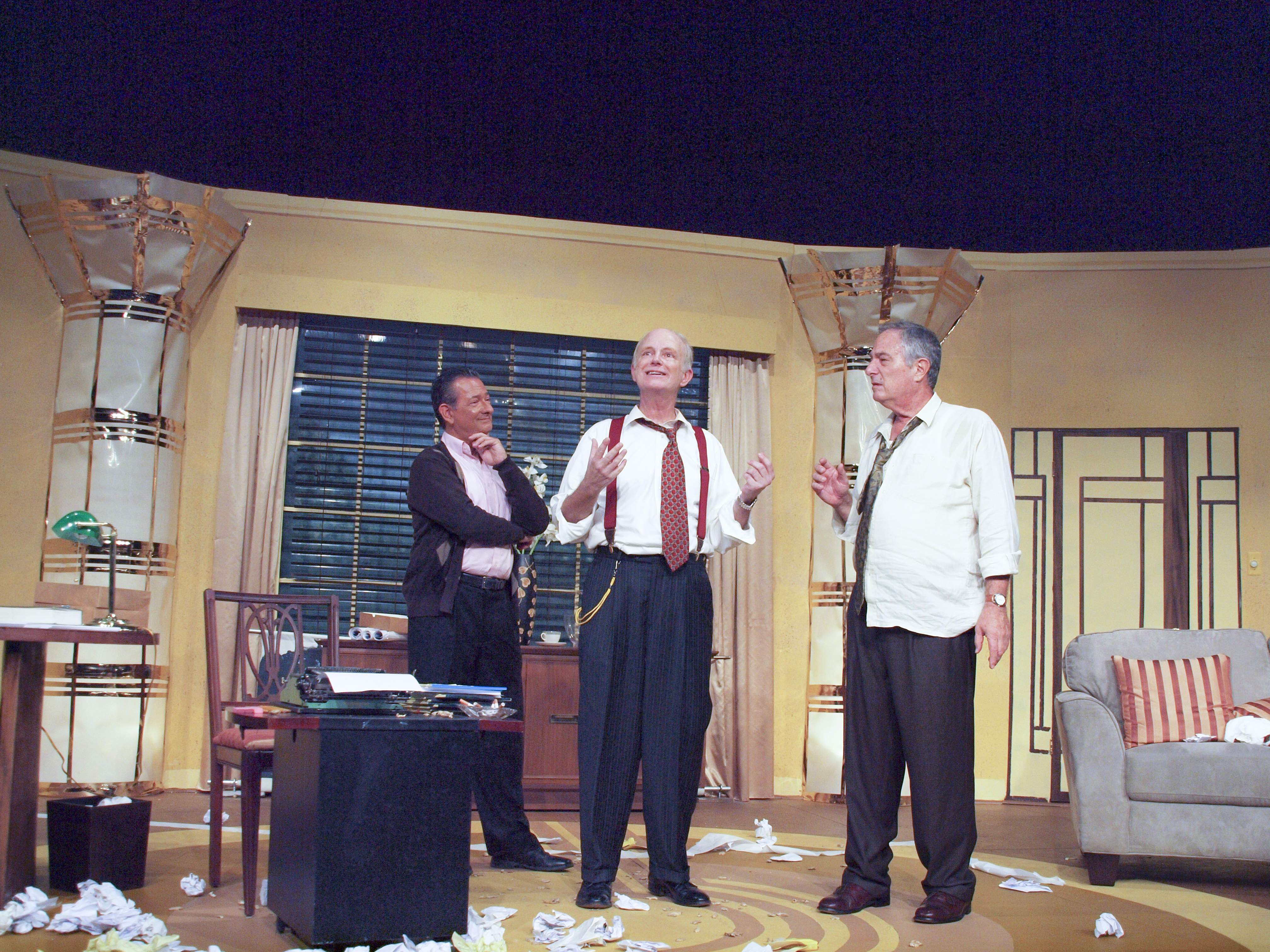
"Moonlight and Magnolias" (Caribbean Community Theatre)

“Moonlight and Magnolias” (Caribbean Community Theatre)

And two nights before we open, they kill it.  They absolutely kill it.  And they know it.  They have brought this play to a place they never dreamt of.  They have each gone well beyond what they thought they were capable of.

It happens every time.  No matter who is in the cast, or how little experience they have.  Good process = great performances.  And you can do it without me there to guide you.  I promise.

To read Trusting Your Subconscious, go here.  To read The Subconscious Effect, go here.

What Do I Do With These Acting Tools? Part II

If we have a strategy, a process, a way of going about things that is intentional on some level, the odds are very good that we will perform whatever activity we’re doing as efficiently and effectively as possible.

Let’s say you’re cooking.  Maybe you’re making Yorkshire pudding.  Maybe you’re baking bread.  Or an apple pie.  Whatever you’re making, you need some skills.  The first time you sift flour, you probably make a bit of a mess (or if you’re my husband, a lot of a mess).  You’re a little uncoordinated, or you sift far more than you need.

When you measure the flour, how do you do that without losing the benefits of sifting?  How do you make sure the salt is evenly spread through it?  How do you knead the bread correctly?  Or roll the pie dough?

knead-bread-dough-by-hand-when-baking.1280x600These are all techniques.  You don’t do them particularly well the first time out.  The more you do them, the more you understand them.  You learn what order to do things in.  What has to be done, and what can be skipped.  What makes the tastiest bread, the flakiest pie crust.  And you also learn how to do it as quickly as possible.  The better you are at technique, the better the product and the faster the process.

Which is why, for instance, I can do the Open Door Reading Process so quickly now that you wouldn’t even know I’m doing it.  But when I first did it, it was as tedious and sporadically useful as it is for anyone who’s doing for the first time.

Tools are about technique.  They are about making you proficient at how you go about acting, so that it is less of a guessing game.  And because you are more proficient, you can get further along in the process by the time you get to opening night.  What used to take you five weeks, now takes you only three.  So now you have time to spare to really fine tune your performance, and to come up with some unexpected and creative choices.

Without technique, it is unlikely that you’ll have time for that.  And it is also unlikely that you’ll be able to turn in a consistently believable performance.  You’ll toggle between “true” and “false” all night long.

Which is perfectly fine if you’re okay with that.  It really is.  If you’re working in community theater, and you’re doing it for love and to share time with other people who enjoy putting on plays, then the imperfections in your performance may not matter to you.  But if they do, or you hope to act professionally, read on . . .   Be warned, though, I’m going to take a little (necessary) detour and talk about the Learning Process for a few posts.  It’s directly related to this topic, so don’t skip it, but it will help me avoid having an eight part series . . .

To see Part I, go here.  To see The Learning Process, Part I, go here.  To see The Learning Process, Part II, go here.

What Do I Do With These Acting Tools? Part I

I think there are multiple posts on this topic, but I’m still finding my way to them.  So if this first post is unsatisfying on some level, do stay tuned.  I promise to wrap it into a nice little package eventually.  I try to keep posts reasonably short and focused, and write longer ones only when it absolutely unavoidable.

Every once in a while, I have the opportunity to ask an actor how he goes about creating a role.

pollockMy favorite local actor answered it with characteristic honesty:  “I have no idea what my rehearsal process is.”  In fact, he does, but he’ll describe it in the simplest terms, and he tries to not overthink it.  Which is not at all a bad way to go about it, especially if you have a certain amount of talent, and he does.  But his “simplest terms” are the best distillation of what acting really is.  Not everyone can distill it to a few points as truly as he does.  Actually, I’d argue that most people can’t.

More often, what I hear is something along these lines:  “I just try to figure out who this character is, over the course of rehearsals, and to play that.”

Well, duh.  But it’s not a particularly informative description, is it?  And it reminds me of when I was a kid.  Every once in a while, I’d use a word, and Dad would ask me to define it.  And I would eventually say, “Oh, I know what it means, I just can’t put it into words!”  At which point, Dad would diplomatically suggest that if I couldn’t put it into words, perhaps I wasn’t as clear on what it meant as I thought I was.  Point to Dad.

Personally, I’m a very instinctive actress, so I understand the difficulty in describing one’s acting process.  I can probably be reasonably clear about my own if you have more than a minute to spare, but it’s nothing I can distill into a single paragraph that you can adopt for yourself.  (Obviously, or I wouldn’t have a blog.)

But since I know the quality of the product of these actors who are “just trying to figure out who this character is”, I have the feeling that the nature of their work consists in reading the script a lot or else just trusting that if you rehearse it over and over, you’ll have sufficient little epiphanies to patch together into one stellar performance.  That because it is an artistic endeavor, once just hangs around and waits for the acting gods to strike you favorably.  But hey – we aren’t all Jackson Pollock.  And even Meryl Street and Denzel Washington got master’s degrees in acting.

There is a limit to what you can achieve by simply “immersing yourself in the play.”  (Another ineffective description I’ve heard.)  Yes, there is a lot of subconscious work involved in acting.  I am the last person to encourage you to think too much on stage.  On the contrary – I’d like you to think less on stage.  But I know that to do so, you need some specific, practical tools to at least help you discover what the acting “issues” are.  That you are likely operating on some very false premises that you are convinced are absolutely true.  And that a certain amount of conscious thought at the right moments can be useful – as long as you don’t think too much.

This is where the tools come in.  But I’ve reached the end of Part I . . .

To read Part II, go here.

Using Scripts in Rehearsal, Part II

As a kid, if I sat next to my father while he read me a story, I always read along silently with him.  When he realized this, he moved to sit facing me while he read.  Now that I was audience only, I received the story much differently.  Using my ears and not my eyes changed the nature of the experience for me.

When you are strictly the listener, you pay attention differently.  Your imagination becomes more active when you aren’t deciphering letters on a page.  When I simply listened to my father read, I converted descriptions into images, and in short order, I had a film going in my head.  When he read “Prince Caspian”, I felt the rocking of the ship and the wind in my hair.

Read the words on the page, however, and it is more of an intellectual exercise.  We can’t fully give ourselves over to the experience with our nose in the book.  Why?

Eye contact.  You need eye contact to connect with other human beings.

eyes1You need other things, too.  You need to shut the output valve (speech, thought, reading) and open the input valve.  You need to listen to what they are saying and how they say it.  To pay attention to what they are communicating to you.  To stop thinking ahead and just receive what they are sending you.

But it starts with eye contact.

Make some serious eye contact with your scene partners, and you open the circuit.  You will find emotions rising up in you of their own volition.  Some might be the emotions you’d expect; some will surprise you.  The important thing is that they show up.  You’ve got real emotion happening on the stage then, not your “idea” of what an emotion looks like.  Remember, the audience knows the difference between the two.  They don’t have to be actors to discern it.  They just need to be human beings.

Your brain will show up for every rehearsal.  You need to make room for the rest of you.  Getting your nose out of the script and looking at your scene partner(s) is essential to achieving that.

Just because you haven’t memorized your lines yet is no reason to bury your face in the script early in rehearsals.  On the contrary, this is the time you want MOST to get in touch with your scene partners.  At this early stage, you have fewer preconceptions and prejudices about the play and your character. You haven’t been through the scene a couple dozen times, so it is still fresh enough to potentially emotionally affect you in surprising ways.  That unfiltered response is what you’re looking for.

When it IS your line to speak, you want to do a modified version of the Open Door reading.  (More on that later.)  When it isn’t your turn to speak, you need to dart your eyes back and forth between your scene partner and your script, looking at the script ONLY to gauge when it is going to be your turn.  (“Her speech takes up five lines; I can look at her for a while.”  Or, as you’re saying your line, “She only has one line after this, so I’ll stay with her for it and then look back down at the script for my line.”)

The script is an aid, not a crutch.  It takes self-discipline to learn to do this.  But it makes all the difference and is worth the effort!

See Part I here.

Using Scripts In Rehearsal, Part I

Actors love to read along in the script, even when it isn’t their line.script

One character may have a monologue that lasts a half page, but in the early rehearsals, every other actor on stage with her will read along in the script for the entire speech as she says her lines.  Never mind that you can listen better when you aren’t reading; if you have a script in your hand, the natural thing to do is to read along silently when it’s not “your turn”.

The problem is that it’s always your turn.

Just because it’s not “your turn” to speak doesn’t mean it’s not your turn.  It’s your turn to listen.  To receive.  To process.  To experience.  To feel.

In real-life conversation, we don’t bow out just because we aren’t talking and tune back in when the other person stops speaking.  We are fully engaged in the conversation, in listening to what is being said and then responding to what we hear.  Okay, we do tune the other person out a bit at points in our conversations, usually when we’ve decided (rightly or wrongly) that we understand what they’re saying,  and we start to think about what we want to say when we manage to interrupt them.  In real life, we aren’t the best listeners.

On stage, you have to become one.

Because it is an artificial situation, where you are trying to stay present to the moment and not leap ahead into a future you already know (because the playwright has given it to you), you have to be a great listener on stage.  You have to lose the habit of preparing what you’re going to say and instead let your speech come out in the moment the playwright has scripted IN RESPONSE to what you have gotten from the other actor.

Let me say that again:  Anything you say must be IN RESPONSE to WHAT YOU ARE GETTING FROM THE OTHER ACTOR.

You have to give your emotions a chance to rise up in you.  Because you aren’t really the character, because you don’t have their history, because the words your “ex-lover” is saying to you don’t have the sort of power they would in real life, you have to make room for the “what if I was” emotions to show up.   Give them space and give your full attention to your circumstances, and they will.  But you can’t do that with your nose in a book.  Emotions are not an intellectual choice you make by deciding what the written words mean.  They are generated in us by what other people – not scripts – say and do.

See Part II here.

On Censoring (and why you shouldn’t!)

The moment I read a script, I’ve made dozens of decisions about a character.  Who she is.  How she speaks.  How she moves.  How this or that line probably should be said.  What sort of movement is required.  What I want.  Etc.  You do, too.  We can’t help it.

Human beings are always judging and evaluating new information placed before us.  We like to categorize things.  When you meet someone, you immediately start “identifying” who it is.  What are some of the favorite questions we like to ask new people?  Where are you from?  Do you have brothers and sisters?  Where do you work?  What do you do for a living?  Are you married?  Where did you go to school?woman_clipboard

And we assess the other person’s appearance immediately, too.  Are they attractive?  Do they dress neatly or sloppily?  Do they care about their appearance?  Do they have good taste in clothes (according to our lights, that is).  Are they color blind?  Do they need a haircut?  Is that blond real or bottled?  Are they athletic or bookish?  Funny or annoying?

We aren’t always right about our assessments of people.  Ever know someone who makes snap judgments about people, pronouncing someone to be a “jerk”, only to tell you months later, after he’s gotten to know the guy, what a “good guy” he’s turned out to be?  Or who praises someone to the hilt after a single meeting, only to discover later that it was all a show and that he’s done someone wrong?  If you don’t, then look in the mirror, because the odds are that you’ve misjudged someone along the way.  But knowing that doesn’t stop us from making quick judgments about those we meet.

Real people have the opportunity to change your mind about them.  But characters in a play aren’t as forceful.  They won’t resist your labels, at least not loudly enough to get your attention.

What seems obvious on the first read-through often IS part of the scene, and part of the character.  But it is only one part.  Human beings are much more complicated than the broad strokes we sometimes settle for as actors, without even realizing that is what we are doing.

In fact, human beings are not just complicated, but they are also often contradictory, and their behavior and dialogue reflect that.  When you are inclined to say, in response to a director’s suggestion, “But my character wouldn’t do that,” you are often censoring it on the basis that the director’s suggestion is blue, but you’re creating a character based on oranges and reds.  What if, instead, you chose to go for a rainbow?  Or instead of a quartet, for a symphony?  When you do this, you not only surprise the audience, but you make the play richer and more layered.  And you create characters who, by virtue of their very contrariness, seem like very real human beings.

Acting is Exploring, Not Deciding

Forgive the length of this post, I couldn’t find a way to split it in two!

Your subconscious is the most amazingly sophisticated computer.  I almost wrote “known to man”, except that we cannot, with our conscious brains, begin to appreciate all that our subconscious can do.

I say “can” do, because our conscious brain is apt to interfere with the process.  We think far too much and do ourselves a disservice by doing so.  If, instead, we would listen for the words our subconscious whispers to us, we’d all be better off.  Learning to do something well is in large part a product of learning to shut up and listen.

Remember the old adage about computers, “Garbage in, garbage out”?  When we use our conscious brains too much, we tend to put garbage into the computer.  I’ll explain why it’s garbage another time, but garbage confuses the subconscious, which doesn’t know what to do with it.  The garbage doesn’t fit with what’s true, but the fact that you’ve entered this data makes your subconscious try to work with it, to fit the square peg into the round hole.  Because here’s the funny thing about your subconscious:

It doesn’t have a value system.

Binary codeIt’s like Binary Code computer language.  It knows 0s and 1s, but it doesn’t have an opinion as to which is better.  It just knows they are different.  It understands frequency, however.  Here’s my golf analogy:  If you hit a ball in the water the last time you played, you’ll worry that you’ll do it again during your next round.  So you’ll think things like, “Just don’t hit it in the water.”  “Just get it over the water, I don’t care where it ends up.”  “Oh my God, I hit it in the water last time, I don’t want to do that again.”

Your subconscious doesn’t understand the word “don’t”.  Instead, it homes in on the word “water”.  “Oh,” says your subconscious, “he keeps talking about the water.  That must be where he wants his ball.”  And Bingo! That’s where your ball goes.

On the other hand, if you simply present ideas to your subconscious without stressing one over another, your subconscious is free to choose what works best, and it is smart enough to do precisely that.

It is easy to rush to make choices as an actor.  After all, you have a finite rehearsal period in which to put a play together to show the public.  No one wants to make a fool of themselves, so making choices early makes us feel that we’ll be able to practice those choices often enough to make them look good.  This theory is fine as long as the choices are good ones, but they often aren’t.  It’s impossible to understand your character in the first few weeks of rehearsal.  And even if the choices are good, making them early often precludes choosing a better one later.

Rehearsals are instead best used as explorations into what is possible.  In experimenting, we often come across things that don’t work, but those “mistakes” often lead us to things that do.  The creative process starts, I’m afraid, with a lot of garbage, but the garbage is the warm-up.  Your work at the end of the night is always better than the work at the beginning, isn’t it?

Once your creative juices get warmed up, they start to produce quality stuff you can keep.  Do enough exploring and, after a few weeks, the pattern starts to emerge, a pattern that is impossible to see with any clarity before then.

This is an uncomfortable approach at first.  It’s easy to get scared by an opening night that seems to loom larger with each passing day.  Making choices makes us feel secure, but if you can have the courage to trust the process and explore every conceivable option throughout the first half of your rehearsal process without making choices, you will find that a great performance will be the natural result, and that it will come together fairly effortlessly in the last few weeks of rehearsal.

I’ve seen this happen time and again.  I make my actors a nervous wreck when I direct, because I refuse to let them settle into complacency early on.  I am continually pushing and asking questions and trying new things through Week 5 (assuming an eight-week rehearsal period).  They are sure, I think, that this thing will NEVER come together!  Can’t we please have more run-throughs?  (Run-throughs are an actor’s greatest security blanket.)  But the work starts bearing fruit after Week 5, and the payoff in performance is self-evident.

By delaying choosing, you turn the decision-making process over to your subconscious, which is better qualified for the job.  You will also find that you don’t have many choices to make after all, that it has made them for you.  All you need to do is run with them!

Acting is NOT a Linear Process

Most complex activities are not linear in nature.  Whether you are good at painting, cooking, or playing a sport, you gradually developed your expertise.  For instance, I am currently learning to do yoga.  Sometimes I pay attention to the positions I am trying to achieve, to make sure my form is good; sometimes I concentrate on making sure my abs are employed throughout.  Sometimes I pay attention to whether I’m inhaling and exhaling in the right places.

non linearWhen I pay attention to one aspect, I am NOT paying much attention to the others.  It’s impossible to focus on more than one thing at a time.  Whatever I focus on is probably what I feel is my weakest link at this moment.  By jumping back and forth between the aspects, I’m building expertise in all of them “at the same time”, just not simultaneously.  I keep a certain amount of parity in all areas by not developing my skill in one aspect to the exclusion of the others.

It is difficult to become great at one aspect if you don’t improve the others at the same time.  Because the aspects work together to create a single whole, you need to develop them all gradually and not leave one behind.  Imagine putting on a pair of jeans and getting your left leg in all the way up to your crotch before starting on the other leg.  You’ll find the jeans have to come down to at least your knee in order to get your right toe in the pants.

Because each new part in a play is a fresh learning experience, hopscotching from one approach to a role to another is just part of the creative process.  As long as you hit all the squares at some point and revisit them as necessary during the rehearsal process, the exact order you follow probably isn’t critical.

I start with my emotional response to the text, probably because that’s where I started when I read plays at eight years old.  That was my entrée into the life of a play, because most of my theater experience at the time was confined to reading the script, apart from an occasional school production.  Opening myself to the possible emotions my character feels is still my starting point.

Because the way I move on stage is driven largely by the emotions I feel, blocking comes after this initial emotional investigation, never before.  It doesn’t necessarily come second, though.  If I get a script before rehearsals start, I may mark the beats in my script.  I may look for the verbs for each beat, or I may just look for my verb for the entire play.  I may examine the language to see what it can tell me.  I may look for the arc of my character, or for the ebbs and flows of the play.  I may study the relationships between the characters.

All of the tools I’m introducing you to are tools you can use in whatever order suits you best, or suits a particular play best, and are probably best revisited periodically throughout rehearsals.  As long as you expose your subconscious to the opportunities these techniques provide you, the order doesn’t really matter, because your subconscious is clever enough to use them properly, no matter what order you choose.  But that’s a story for another day . . .

Memorizing Your Lines, Part I

You can’t do any real acting until you memorize your lines.

You can lay a great foundation for real acting while you’re still on book.  You can experiment with options while you’re still on book.  You can explore your character plenty.  You can pay attention to what your fellow actors are doing and try to receive it and see how what they are doing may impact your own choices.Book

The one thing you can’t do until you’re off book is act.

Why?  Because your subconscious is what does the acting, and it can’t function when your left brain is working on remembering lines.  When your left brain is that kind of active, you subconscious just can’t be heard.

Here are the five stages of memorizing your lines:

  1. You start to know bits and pieces of the scene.  But you’ve still got big gaps of lines you can’t remember.
  2. You kind of know the whole scene, but it’s work to remember it.  We can see the wheels turning every time it’s your turn to speak.
  3. The wheels are no longer obvious, but you’ve got certain lines you’ve got a mental block on, and when you hit them, the wheels go into overdrive.
  4. The mental blocks have disappeared.  Technically, you’ve got the scene completely memorized.  But in truth, one-quarter to one-half of your attention is focused on the lines and whether or not you remember the next one.  You remember every single one; it’s just that you are conscious of the fact that you are remembering them.   Conscious isn’t good in acting.
  5. You can recite your lines without pausing.  They have become second nature, and fall out of your mouth with you having to think about them.

The gap between stages 4 and 5 is probably at least one week.  I memorize lines easily and quickly, but I can tell the difference between when I am first officially “off book” and how I can work a week later.  (So can the audience.)  Assume that you’ll have at least one week of “acclimation”.

This period of “acclimation” and the fact that you can’t do any quality acting until you are off book are my two biggest arguments for beginning to memorize your lines the day you get your script.  Before your first rehearsal, before you’ve finished blocking.  The earlier you have your lines memorized, the better your performance will be.  Guaranteed.

See Part II here.  See Word Choice, Memorization, and Script Analysis Part I here.  See Word Choice, Memorization and Script Analysis Part II here.

Justifying the Text, Part III

The examples I’ve given you for justifying the text are the obvious ones.  If I start to cry, it’s not that hard to figure out that it’s because you slapped me, or humiliated me, or told me you’re leaving me for another woman.

What about the less dramatic moments in a scene?  Do I need to pay too much attention to your response to me then?  Or should I just worry about my own responses?

Many actors do just that, while simultaneously acknowledging the importance of their scene partner in their choices.  “So-and-so made me mad when she said that, and that’s why I . . .”  “But I think my character wouldn’t respond that way.  I mean, she said such-and-such to me . . .”

Clearly, we think the choices we make about our own lines are at least partly driven by what we’re getting from others, and yet we forget that they feel the same way.  That to really close all the loops in a play, we need to look at our role from the other characters’ viewpoints.  To make sure that everything works together flawlessly.  If there is a puzzle piece that you can’t fit into the picture, you’ve missed the boat somewhere and need to start over.

magnifying glassA play is a large mystery for the actor to solve.  In a well-written play, all of the clues you need to solve the mystery are provided by the playwright.  They might be hidden from view, but they are there to be discovered.  Playwrights do not provide red herrings, nor do they spring new information on you in the last scene before Jessica Fletcher identifies the murderer, without which you could not have figured out whodunit.

Many of those clues about your character are in the other characters’ lines.

Here’s the golf analogy.  An amateur plays a hole from tee to green.  How do I land the ball safely in the fairway?  How do I get the ball on the green from the fairway?  How do I get the ball in the hole once it’s on the green?

A professional golfer plays the hole backwards, from green to tee.  Where do I want to land the ball on the green to have the easiest putt?  Where do I want to hit the ball from the fairway to give myself the best chance of putting the ball on that spot on the green?  What club do I need to hit, and how do I shape my shot, to get the ball to that spot on the fairway?

So yes, you should read each scene from your character’s point of view.  But you should also read each scene from the other character’s point of view.  How are they responding to your character, and what does that tell you about the kind of person your character is and about what is emotionally going on for your character right now?

See Part I here.  See Part II here.