
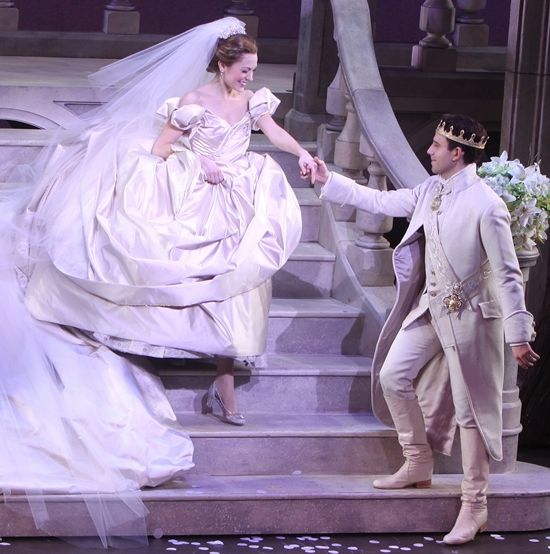
The inspiration for my play, Happily Ever After, came about because I started thinking about the fact that all fairy tales end with the wedding, and so kids who grow up reading them know how to aspire for a wedding, but have no real understanding of what happens next or how to navigate the next 50 years. The emphasis on courtship over marriage has probably led many couples into a morass, pre-marital counseling notwithstanding. I had no idea where I was going to go with it, but that was what put my seat in the chair. What followed wound up being more layered and philosophical than I had anticipated, or even than I knew prior to attending the rehearsal of it.
While watching the rehearsal, I put on my director’s hat, contemplating how I would deal with the issues the director was facing if I was in his shoes. As a result, I had to analyze my own play in a way that I hadn’t done, and so I learned some interesting things about it!
It was in analyzing the play that I finally figured out why I was uncomfortable with the changes made to the stage directions that end the play. It turned out that the changes left the audience with two messages that were both in direct contradiction to what I had been trying to say over the course of the play.
Surprising that movement could have such a dramatic effect, huh?
Without reading the play, you may not fully understand why this is, but I’ll give it a stab anyway.
Here’s the original stage directions (remember, this is the continuation of the fairy tale — in this case, Cinderella). I should say that the dialogue that precedes the stage directions makes it clear that, in the privacy of their bedchambers, the Prince invites her to dance.
(She brightens at this, and moves into his arms at a safe distance. They start to waltz, and one of them — it doesn’t matter who — starts to hum. Da-de-da. It doesn’t matter whether the one humming can carry a tune. It may even be better if they can’t. Now they are both humming. They may even laugh at how bad they are, which only emboldens them to sing louder. As the song goes on, they gradually move closer together. And eventually, they are kissing. Not the chaste sort of kiss as at the beginning of the play, but the happily-ever-after sort of kiss.)
Now, here’s the changed version:
(She brightens at this, and moves into his arms at a safe distance as an orchestra begins to play. They waltz a few steps. She stumbles and nearly falls, but he catches her. She looks up at him, and there is a spark. She grabs his head and pulls him to her, planting a firm kiss on his mouth. He sweeps her into his arms and carries her into the bedroom.)
Without knowing anything about the play, there are five distinct differences between these two descriptions:
- In the original, there is no orchestra, or else it is too faint to be heard, and that is why they start humming. In the revision, we clearly hear the full orchestra.
- In the original, there is a shared experience which has nothing to do with kissing or sex (humming while they dance, in a silly sort of moment between two people who barely know each other but are going to be spending their lives together). In the revision, this is replaced by her stumbling as they waltz.
- In the original, the kiss is a gradual melding as they begin to relax together. In the revision, there is sudden switch that goes off in her head that provokes the kiss.
- In the original, the kiss is mutual. In the revision, she clearly kisses him.
- In the original, there is a blackout on the kiss. In the revision, he whisks her off of her feet and takes her into the bedroom.
Without having the entire play to view it in context, #1 can fairly easily be dismissed as not being critical.
The other four may be critical. First off, the original seems to emphasize the romantic over the passionate. Sexual desire is clearly at play in the revision.
Secondly, the original has the shared moment of non-romantic, non-sexual silliness, and the revision doesn’t have a comparable moment.
So what can we take away from this?
Before changing stage directions at the beginning or end of a scene or play, you need to carefully study them in the context of what the playwright was trying to accomplish or is trying to say. Opening moments set a tone, and closing moments — especially at the end of a play — are the playwright’s final word on the subject. You want to make sure that you are, up to the end, telling the playwright’s story, and not your own. Also, when the stage directions are more than the minimal (he doffs his hat and exits), they are effectively substituting for dialogue and so probably deserve a similar fealty, at least in terms of intention.
Understanding the playwright’s intention is critical in changing stage directions that are more than simply practical (she sits down; he pours a drink; they turn out the lights and exit upstairs). If the director had kept the sexual overtones out of it and found a comparable non-sexual moment to replace the humming and laughter, I might have been disappointed (or not, if he found a better way of accomplishing it than what I wrote), but I wouldn’t be uncomfortable with it. He would clearly have gotten the point of what I was trying to say and simply found an alternative way to say the same thing.
I could have written the “la-di-da” into the dialogue, and probably will so that future directors will understand that it is a non-negotiable element of the play.
So here’s my argument for why the changes reversed the intended meaning of the play:
I associate the sexual desire and attraction between a new couple with the fairy tale story; while critical to beginning a happy ending, it is insufficient in and of itself. Love and friendship are the more important elements. By removing the humming, you remove the friendship; by dispensing with the gradual, mutual kiss, you remove the love; and in its stead, you’ve got passionate desire on both sides (her kiss, his carting her off to the bed). A misplaced emphasis on sex has ruined many a marriage, and that was part of why I wrote the play. When you end on that note, you are saying, “This is a fine way to go about it.”
The director said he chose to have her initiate the kiss because she had been avoiding it up until that point. That’s fine, but if I wanted that 180 degree turn, I would have written it that way. Making her the aggressor makes her a very different girl (and him a very different man). Before you make a 180 degree change, you need to be sure the script supports it.
He also said, “she stumbles and he catches her before she falls, as he will for the rest of their lives”, and it’s a sweet, if traditional concept. However, it plays into the old-fashioned myth of the fairy tale — the white knight who will come along and save the damsel in distress and make everything perfect forever — that I had spent ten minutes unraveling and arguing was not going to produce a healthy marriage.
So change the stage directions if you have a really good reason to (I’m still not sure why they decided to change mine), but if you must, please make sure that you are being fully faithful to supporting the playwright’s intention and theme.

 Spacious Acting™