
About Those Stage Directions . . .

Gospel-Transformation-Bible-005There are people who feel strongly that the stage directions in the script are The Gospel.  Not just the movements indicated, but the emotional choices for the actor as well (e.g., “angrily”).  I don’t seem to be able to persuade them that these not RIGHT, but they are merely suggestions.  You are under no compunction to follow any of them if you have a better idea.

The people who feel this way credit the playwright with a degree of omniscience that can be misplaced.  Playwrights are human beings, and they make mistakes, just like the rest of us.  Physical movements are often from the original production, not from the playwright, and so don’t warrant slave devotion to them.  The original set used is just one designer’s interpretation of the play, and has nothing to do with the playwright in any case.  And often the physical movement noted is arbitrary.  The play will not be weakened if you stand up two lines earlier or two lines later than the script dictates.  It probably won’t be harmed if you never sit down in the first place.

As for the adverbs playwrights throw in so that you won’t mistake their intention, they simply reflect how the playwright heard it in his head when he wrote it.  It’s not the only way to say the line (see my next post, The Half Dozen Rights, for an expansion on this idea.)

Sometimes these little notes provide clarity where confusion exists, and I’m all for playwrights using them then.  But now that I understand the playwright’s intention, I can say the line however I like – and not necessarily “angrily” – because whatever I end up choosing, it will match the playwright’s intention.  Which I now know.  If I have a more creative choice that is still in line with his intention, I’m going to ignore his specific instruction, and the play will be better for it.

Actor Ray Ficca, playwright Bill Cain, & director Ryan Rilette during a rehearsal for New Book, Round House Theatre, April 2013

Actor Ray Ficca, playwright Bill Cain, & director Ryan Rilette during a rehearsal for New Book, Round House Theatre, April 2013

But sometimes the playwright gets a little carried away with his instructions to the actors.  And you know what?  Sometimes he’s just dead wrong.  I know, I just spoke sacrilege.  But I’ve done plays where I am convinced that the playwright was giving me very bad advice on how to play the role.  I’ve come across stage directions that leave me utterly perplexed as to what he’s talking about.

The lines I say?  Those are sacred, and if I don’t understand what they mean, I better figure it out, and quickly.  But the advice on how to say them, or how to move?  Not so much.  As I said somewhere, if the playwright’s choice is the best one available, you’ll discover it for yourself just by doing the work correctly, and it will be organic when you come across it that way, whereas if you blindly follow the stage directions, you risk it appearing artificial.  So you won’t do any harm most of the time if you ignore them.

I also think it’s important to remember that the playwright is a writer, not an actor.  Now, I’m not saying that all playwrights are terrible actors.  I’m sure there are some who are decent actors.  Maybe even very good ones.  Probably not brilliant, or they’d be actors, first and foremost.  But their stock in trade is putting words on paper.  An actor’s stock in trade is putting the words on their feet.  And sometimes, things look and sound very different in three dimensions than they look on paper.  Sometimes a playwright is simply too close to the work to gain a proper perspective on it.

Theater is a collaborative art.  We each bring something to the table, and the ensemble effort produces the final product.  We actors aren’t there to be marionettes of the playwright.  We are contributing, creative artists.  So when it comes to stage directions, keep what is useful and works.  Use the playwright’s opinions as guidelines.  But don’t turn off your own brain or instinct just because The Playwright Spoke.  He isn’t God.  And he can be wrong.  He didn’t anticipate you playing a role in his play.  If he did, he might have viewed the character differently.  And written entirely different stage directions!

To read The Validity of Other Perspectives, go here.  To read The Half Dozen Rights, go here.  To read How Do I Know What the Right Acting Choices Are, go here.  To read Line Readings and Why They Don’t Work, go here.

The Validity of Other Perspectives (or, You Mean There Actually ARE Other Perspectives?)

I hope you’ll bear with me through the next few posts, because this issue of there being a “right” way to play a role is critical to how you use the first half of your rehearsals.  So it’s worth the time.

Human beings are pre-disposed to thinking that there is a RIGHT.  By definition, the fact that this (whatever “this” may be) is RIGHT, no matter how limited it is, makes anything outside of its limited scope WRONG.

If you’re very young (and perhaps even if you aren’t), you’ll have to take me on faith when I tell you that there is a lot less surety in the world about what is RIGHT and what is WRONG than you probably think there is.  (In twenty years, you’ll probably understand what I’m talking about.  At least, I hope you will.)

Despite the fact that I have an large number of reasons to believe in this uncertainty as being a natural and okay part of existence, I nevertheless fall into the trap of thinking that this, that, or the other thing is RIGHT on a regular basis.  The only thing I have learned, apparently, is to recognize the fall shortly after the fact, so that I can get myself standing again.

Fortunately, rehearsal time allows you the opportunity to backtrack to where you went awry.  To acknowledge that what you were so certain was RIGHT turns out to be largely WRONG, and that you’d better replace it with something else.  Even if you aren’t quite sure yet what to replace it with.  (This is the trial and error that is part of the first half of rehearsals.  Ah, I haven’t gone that far astray, after all!)

You may remember the Kansas example from the post on first-person acting.  I’d like to explain it a little differently now.

SONY DSCImagine all of humanity as occupying a place near the center of a pie.  Carve that pie into a number of slices that corresponds to whatever personality type schema that you’d like to use.  If you use the Enneagram, you’ve got nine slices.  If you use Myers-Briggs, you’ve got 16 slices.

However you slice it, each pie slice represents a general life perspective.  I’m not talking about politics or religion.  It is entirely possible to have completely different politics while occupying the same life perspective space.  (Again, trust me on this one, because I certainly don’t have the space to make the argument.  Go study one of these typing systems in some depth, and you’ll understand what I mean.)

For instance, my Myers Briggs personality type is, among other things, convinced that absolutely everything can be improved.  That colors everything I do.  It’s one of the things that makes me a good teacher; I’m convinced that if I keep trying different ways, I can successfully communicate anything to you.  It’s one of the things that makes me curious and a lifelong student.  In addition, being intensely aware of my own flaws and convinced that everything can be improved, I am the first object of my “I can build a better mousetrap” perspective.  I am my ultimate work-in-progress.

However, not everyone shares this perspective.  Some people just don’t quite see that improving things matters one way or the other.  They aren’t opposed to it; they just don’t see the point in spending the energy on it.  Others take great exception to my perspective.  For them, everything is perfectly fine just the way it is.  And a fourth group of people have a different take, one which says, “I am what I am, and as flawed as I am, I’m never going to change.  Deal with it.”

I hope you’ve noticed that because we’re all standing near the center of the pie, we’re all looking in different directions.  Because we’re looking toward the crust, where our slice is two or three inches wide, we think we’ve got a broad perspective.

The fact that the pie has a circumference of over 28 inches completely eludes us.  As far as we are concerned, our two inches IS the world.  We also assume that everyone else sees the same two inches.  So if they disagree with the party line associated with our slice, they are being purposefully intransigent.  When we’re feeling kindly about them, we’ll just call them stupid.  Or ignorant.

For the most part, these perspectives aren’t things we have a lot of choice about, although once we recognize the limitations of our own perspective, we can start to see why other people’s perspectives make sense to them.  And these different perspectives actually have a very useful function in the world.  I’m a great planner and teacher, but I have no patience for what I see as the tedium of scientific experimentation.  Fortunately, there are personality types who live on other slices of pie who are into science and like their change to come slowly.

The point is that we are inclined to assume, for some peculiar reason, that our slice is RIGHT, and everyone else’s – and remember, everyone else’s constitutes the majority of that dang pie – is WRONG.

But it all depends on where you stand on the pie.  Wherever you are, you think, is RIGHT.  Wherever anyone else is is WRONG.  But they’re standing looking toward their piece of the pie crust, thinking that they are absolutely RIGHT, and you are absolutely WRONG.

So who is RIGHT, and who is WRONG?

To read About Those Stage Directions, go here.  To read The Half Dozen Rights, go here.  To read How Do I Know What the Right Acting Choices Are, go here.  To read Line Readings and Why They Don’t Work, go here.
What Are Play Rehearsals For? Part III

mixing_clay_7-727219“The first phase of rehearsals, for an actor, is for playing.  For exploring.  For daring.  For making mistakes.“

I wrote this line in the last post.  Notice how this differs from Merriam-Webster’s definition of practice:

To do something again and again in order to become better at it.

There IS a point when we want to hone what we are doing onstage.  This happens during the last few weeks of rehearsal.  Once we get there, we can start “practicing” in the Merriam-Webster sense of the word.  It’s a weird alignment of both “practice” and the creative artistic interpretation that I suggested is the second half of the work done by a musician.

Wait a minute!  In my last post, I said the first half of rehearsals are about technique, the second half about being creative.  But now I just said the second half is about practicing.

It is.  About practicing AND being creative at the same time.  But yes, you’re absolutely right.  I’ve moved “practicing” out of the first half entirely, and I’ve replaced it with this thing I’m calling “technique”.

So if “technique” isn’t really “practicing”, but is the actor’s version of what he does in the first half of rehearsals – well, what the heck am I suggesting you do with the first half of rehearsals (more like 65%, actually)?

The first half of the rehearsal period, for an actor, is spent figuring out WHAT to practice. 

In music, in sports, in almost any other activity, you can figure out what to practice pretty easily.  It’s given to you by someone who’s figured it out before you (unless you’re trying to reinvent the wheel, that is).  Your baseball coach gives you drills.  Your piano teacher gives you scales and sheet music.

But for an actor, nothing is predetermined.  You’re given words, but it’s up to you to figure out how to best present them, how to create a character who would speak them.  You go from knowing nothing – 0% — to knowing, say, 75% by the time you reach the end of this exploratory phase.  You pick up the last 25% in the creative/practicing part of rehearsals.

How is this different from what you may be doing now?  Well, I think I said somewhere that the moment you finish reading the script for the first time, you have made dozens of decisions about the play, the characters, how it is going to look, sound, etc.  And if you do that, you are probably starting from something like 40%, not zero.

40% may seem high to you, and in all honesty, it’s a number I’m pulling out of the air based on my gut instinct (which is usually pretty good, by the way).  It sounds high, because certainly there are far more decisions to be made than the dozens I’ve suggested you make on your first reading of the script.

There are.  But the dozens you’ve made initially have, effectively, eliminated a whole bunch of possibilities.  You may only technically be at 10% at this point, but the decisions you’ve made have made the other 30% a foregone conclusion.

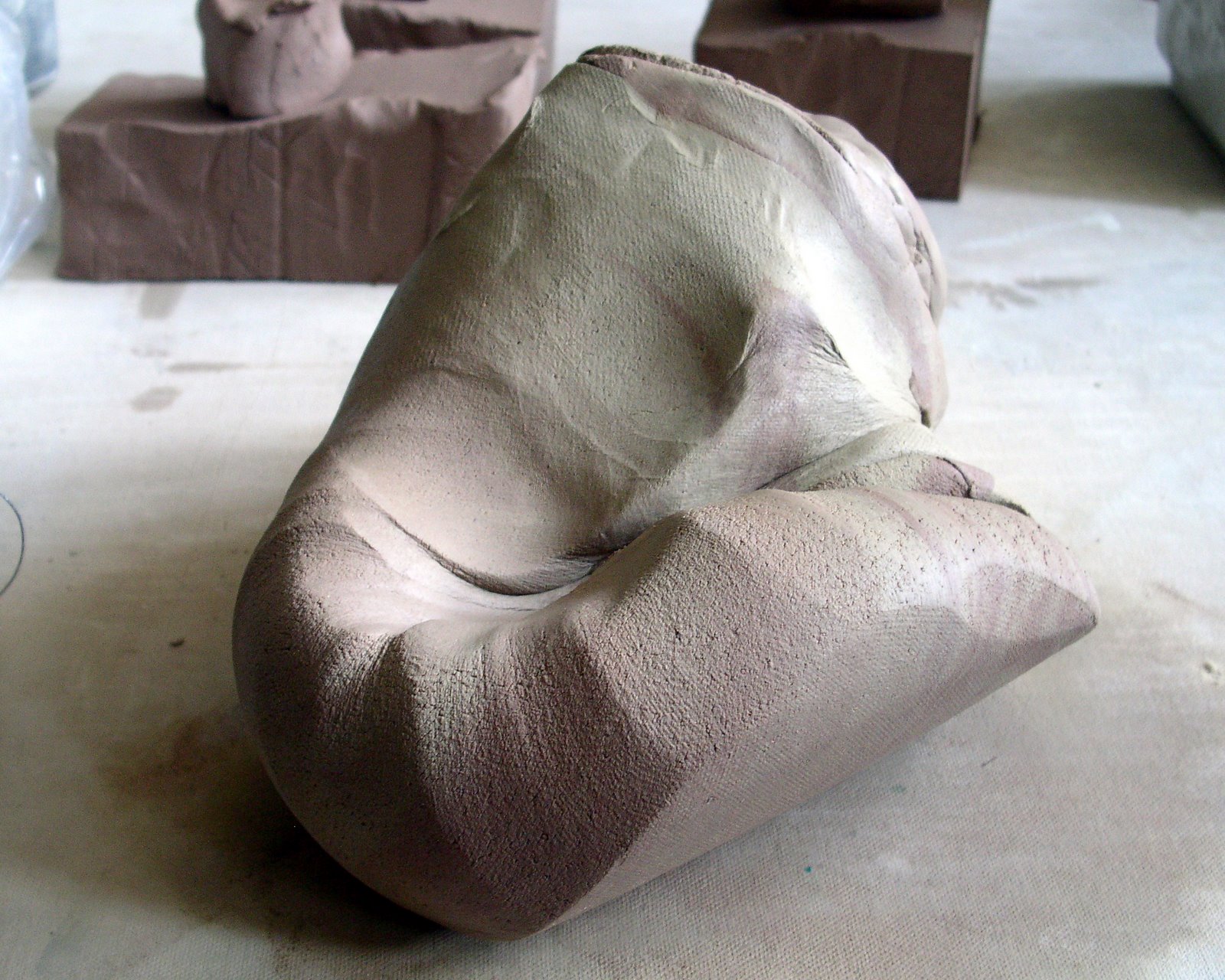
To get to a really great performance, you have to permit yourself to be a lump of clay initially.  Something formless and shapeless that you will gradually give definition to, until you have a delicate and distinctive bust to present to the audience.  You don’t want to start rehearsals with a piece of clay that can be clearly identified as a head, no matter how rudimentary.

There is no one to “please” in a rehearsal.  Not even the director.  There is no audience to “perform” for.  So whether you do it “right” in this run-through or not is meaningless.  Let me say that again.  MEANINGLESS.  (I’ll talk about “right” in the next post.)

We seem to have reverted to Problem No. 1, “public”.

It is this need to perform whenever you open your mouth that generally gets in the way of the Open Door Reading.  Actors HATE to break up a long sentence when they’re doing the reading.  They just hate it.  They want everything to “flow” naturally.  They can’t remember the entire sentence, so they say the words they can and immediately dip their heads back into the script without waiting for the three seconds I’ve suggested so they can get the sentence out in a full string.  (Which is why I assigned a specific amount of time to it, and I meant seconds, not beats.  One thousand one, one thousand two, one thousand three.  NOT one two three.)

But who is watching the Open Door Reading who gives a damn whether or not the sentence is completely comprehensible, delivered as smoothly as it will be on opening night?  Who cares if you’ve attached the “right” emotion to it or not?  Who cares if your intensity is what you want it to be in a final performance?  NO ONE.  Let me repeat that.  NO ONE.  That’s not the purpose of the Open Door Reading.  It’s purely a personal exercise for each actor individually and for the two as a creative team.

And so should most everything else be that you do in the first few weeks of rehearsals.

To read Part I, go here.  To read Part II, go here.  To read Staying in the Moment, go here.